Grocery x Agentic Commerce: How Predictive Replenishment and Zero-Click Delivery Are Transforming Food Shopping
Grocery is the vertical most naturally suited for agentic commerce. From Instacart's smart carts to Walmart's self-healing inventory and Alexa+ auto-replenishment, this article explores the frontline of predictive replenishment and zero-click delivery.

Key Takeaways
- Grocery's characteristics of repeat purchases, low involvement, and perishability make it the vertical most naturally suited for agentic commerce, with 32.6% of US consumers willing to let AI auto-reorder staple items
- Instacart's smart carts are deployed across 100+ cities and Walmart's AI agent "Wally" has reduced perishable waste by over $55 million
- The key to predictive replenishment lies in supply-chain AI accuracy improvements, with demand forecasting precision jumping from 55-65% with traditional methods to 85-92% with AI
Why Grocery Is the Ideal Vertical for Agentic Commerce
Have you ever considered how much time you spend on weekly grocery runs? Selecting items, adding them to the cart, choosing a delivery window. You repeat this routine over 50 times a year, and the vast majority of what you buy is the same as last week.
This "repetitiveness" is precisely what makes grocery the top candidate for agentic commerce. Unlike apparel or electronics, food involves low decision-making costs, short purchase cycles, and the time constraint of expiration dates. An AI agent that learns your consumption patterns and auto-orders the right quantity at the right time: this "predictive replenishment" mechanism works most naturally in the grocery domain.
According to a July 2025 joint survey by eMarketer and Amazon Ads, 32.6% of US food shoppers are willing to let AI auto-reorder staple items. Additionally, 45.8% are interested in AI chatbots that suggest recipes and auto-fill their carts. Some 47.7% expect their resistance to AI grocery tools to decrease over the next five years, indicating steadily growing acceptance.
So what exactly are the leading players building? Let us examine both the supply-chain side and the consumer-facing side.
AI That Knows Your Fridge: Instacart's Smart Cart and Grocery World Model
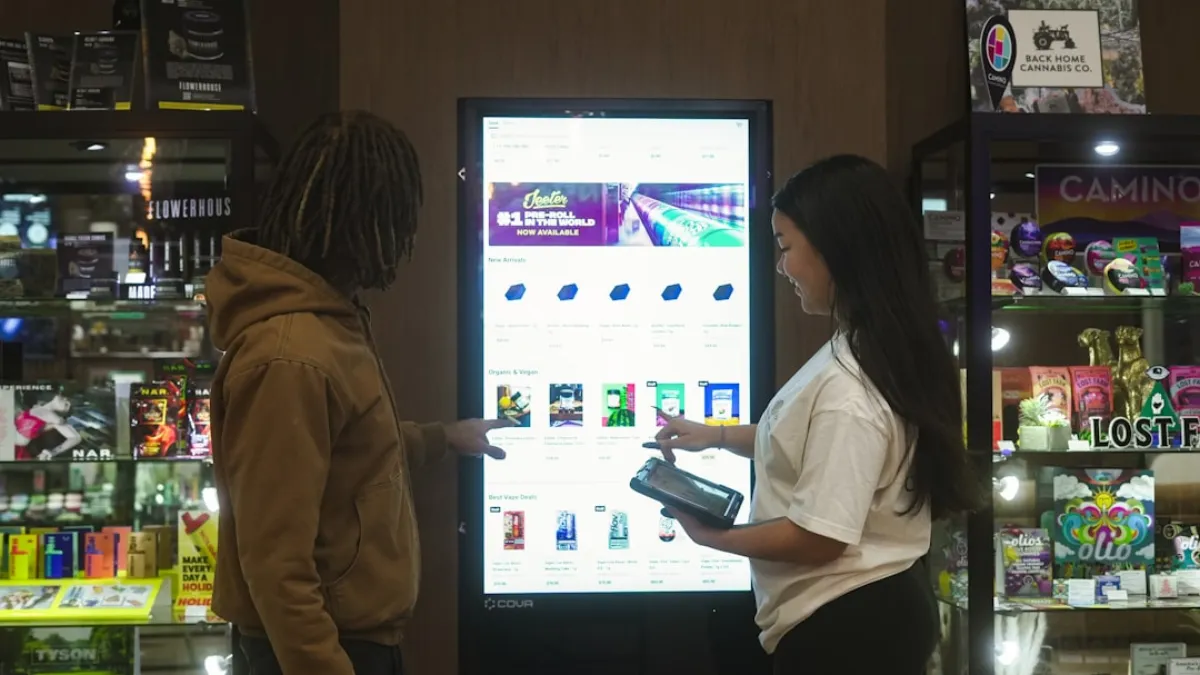
In March 2026, Instacart announced a partnership with NVIDIA to build a "Grocery World Model" that unifies online and offline data. At the core of this vision are Caper Carts deployed across more than 100 cities.
Caper Cart is far more than an electronic trolley. Equipped with basket-facing cameras, a weights-and-measures certified scale, and location-tracking systems, it processes data in real time on an NVIDIA Jetson chip as a form of "Physical AI." Every time a customer picks up or puts back an item, the cart records it. When this in-store physical data merges with online purchase history, AI can estimate "what is in your fridge" with high accuracy.
According to Instacart's announcement, an AI prompt displayed on the cart asking "Got everything you need?" alone lifts average basket size by approximately 1%. A single reminder nudging incremental sales demonstrates that AI's value in grocery lies less in dramatic transformation than in the micro-removal of friction.
Even more noteworthy is the "continuous learning system" Instacart is building. Thousands of smart carts collect physical data daily while millions of online orders generate digital signals. An AI that integrates these two data streams can estimate individual consumption velocity and predict: "This customer buys milk every five days. Next purchase: Thursday." Kroger and Sprouts Farmers Market have begun adopting this Cart Assistant technology, signaling industry-wide ripple effects.
"Self-Healing Shelves": Walmart's Demand Forecasting and Supply-Chain AI
Behind the consumer-facing "zero-click" experience lies AI that optimizes the entire supply chain. The player with the most large-scale implementation in this domain is Walmart.
Walmart's proprietary merchandise management AI agent, "Wally," detects inventory imbalances in real time. What distinguishes it is the ability to combine not just sales data, but local weather patterns, social media trends, and logistics bottleneck information to forecast demand. During its 2025 rollout, Wally reduced perishable waste by over $55 million.
Behind this figure lies a challenge unique to grocery. Fresh food has a short shelf life, meaning even slight forecasting errors translate directly into losses. While traditional methods achieved demand forecasting accuracy of only 55-65%, AI has improved this to 85-92%, according to industry data. The impact of this accuracy gap is incomparable to that in general merchandise.
Walmart's "Scintilla In-Store" platform, introduced in early 2026, should be understood in this context. It provides field representatives with real-time granular data, with AI directing "when and where" to replenish. Rather than restocking after shelves go empty, products arrive before they run out. This is the concept of the "Self-Healing Inventory" that Walmart pursues.
In the B2B procurement domain, automated negotiation between AI agents is advancing, and similar automation is occurring in the grocery supply chain. The difference is that while B2B focuses on "cost optimization," grocery must handle the additional variables of "freshness" and "timing."
Alexa+ and Subscribe & Save: Amazon's Vision of Unconscious Purchasing
Within Amazon's agentic strategy, grocery occupies a special position. While Rufus handles "discovery" and Buy for Me extends the catalog, Alexa+ is most powerful in the domain of automatic food replenishment.
Alexa+, made freely available to all US Prime members in February 2026, delivers a fundamentally new experience for grocery ordering. It remembers purchase history and recipe preferences, orders food from Amazon Fresh and Whole Foods Market, and auto-purchases specific items when they drop below a price threshold. Simply saying "Milk's running low, please order some" completes the entire process.
Amazon's early data shows that Alexa+ users' shopping activity has tripled. Notably, this increase stems not from "searching more" but from "reduced purchasing friction leading to higher frequency." The reality of "zero-click" in grocery is not a grand technological revolution but the simple value of "eliminating the hassle of reordering."
Meanwhile, Subscribe & Save, the subscription-based recurring delivery service, has served as a "prototype" for predictive replenishment for over a decade. Fixed-interval auto-delivery was convenient, but the "gap" between delivery schedules and actual consumption pace was a persistent issue. With the addition of Alexa+'s AI, the model is evolving from fixed intervals to dynamic predictive intervals.
The Bottleneck of Predictive Replenishment: Technology Is Ready, but Trust Lags Behind
Looking at the technological progress so far, a future where "your fridge is automatically restocked via zero-click" seems imminent. However, clear bottlenecks to widespread adoption remain.
The biggest barrier is consumer trust. The 32.6% who said they would let AI auto-reorder staples means that 67.4% are still hesitant. NIQ's 2026 study also acknowledges that AI is changing purchasing behavior while noting that "most consumers haven't jumped in yet."
A deep-seated desire to "see it with my own eyes" persists with food. An apparel sizing mistake can be returned, but wilted vegetables cannot be undone. This irreversibility raises the bar for AI trust in grocery higher than in other categories.
Technical challenges also remain. For predictive replenishment to work, real-time visibility into what is actually in a consumer's fridge is needed, but smart refrigerator adoption is still low and IoT device interoperability is not yet standardized. Instacart's smart carts capture "in-store purchase data," but in-home consumption data still relies on estimation.
Furthermore, as noted in agentic commerce market size forecasts, the lack of protocol standardization makes cross-retailer data integration difficult. When a consumer shops across Walmart, Kroger, and Amazon Fresh, it is technically challenging for a single AI agent to grasp the entire consumption pattern.
The Battle Against Food Waste: The Environmental Impact of Predictive Replenishment
The benefits of predictive replenishment extend beyond consumer convenience. It directly addresses one of the grocery industry's greatest structural challenges: food waste reduction.
According to a SupplyChainBrain report, one food retail chain that implemented AI demand forecasting reduced perishable waste by 37% while simultaneously improving stockout rates by 32%. Waste and stockouts are inherently a trade-off, but AI's forecasting accuracy is alleviating this dilemma.
Consumer-side predictive replenishment also holds potential for reducing food waste. "Overbuying" is a leading cause of household food waste. If AI can accurately predict a household's consumption and deliver only what is needed at the right time, food waste at home can decrease as well.
That said, an increase in delivery frequency raising environmental impact is also a concern. If a weekly bulk shop becomes three smaller deliveries per week due to AI optimization, last-mile carbon emissions increase. In this regard, automated fulfillment centers like Ocado's present solutions through efficient batch processing.
The Next Five Years of Grocery E-Commerce: The Day "Shopping" Disappears
| Capability | Traditional Online Grocery | AI-Assisted | Agentic (Predictive Replenishment) |
|---|---|---|---|
| Product Discovery | Search and browse categories | Recommendation engine | Auto-suggest from purchase history and inventory sensors |
| Ordering | Manually add to cart | One-click reorder | Zero-click ordering based on consumption prediction |
| Delivery Timing | Customer selects time slot | Optimal time suggested | Auto-delivery before stockout |
| Waste Reduction | Markdown stickers | Demand forecast adjusts order volume | Real-time optimization at SKU x store level |
| Customer Effort | 10+ minutes per order | A few minutes | Zero (approval only) |
As this table shows, the ultimate form of agentic commerce in grocery is a state where "the act of shopping itself vanishes from consciousness." Refrigerator sensors and AI agents work in tandem, and the consumer merely taps an approval button. Or perhaps even that becomes unnecessary.
Mass Market Retailers' analysis projects that automated online food replenishment will reach 20% of the US market within 2026. In a world where AI agents make purchasing decisions, products will be selected not by brand recognition but by objective specifications such as "ingredients, durability, and sizing." In grocery terms, this means AI-optimized purchasing that balances nutritional content, origin, and price.
The implications for e-commerce operators are clear. Preparing for agentic commerce in grocery begins with structured product data. Nutritional information, allergen labeling, expiration dates, package sizes. Without these in a machine-readable format, there is no chance of being included in an AI agent's consideration set.
Next comes API accessibility. Without an API that provides real-time inventory and pricing, a business cannot be integrated into predictive replenishment systems. Kroger's integration of its 84.51 data platform with Google Cloud's Gemini to build a nationwide Meal Assistant is precisely this direction.
Conclusion
Grocery, by virtue of the repetitive consumer behavior of "buying the same things every week," is the vertical where agentic commerce will penetrate most quickly. Instacart's smart carts, Walmart's self-healing inventory, and Alexa+'s ambient replenishment take different approaches, yet all converge on the same goal: bringing shopping friction to zero.
Before zero-click delivery becomes the norm, challenges in building consumer trust and IoT infrastructure remain. However, with forecasting accuracy already at 85-92%, the technological barrier is far lower than the psychological one. A future where your refrigerator is automatically restocked is not a question of "if" but "when."