Amazon's AI Agent Strategy: Rufus, Buy for Me, and the Walled Garden Approach (2026)
How Amazon approaches agentic commerce through Rufus and Buy for Me. The closed-stack strategy, absence from MCP/UCP, and what merchants should do in response.

Key Takeaways
- Amazon's agentic commerce posture is a fully closed walled garden, built around Rufus and Buy for Me.
- Rufus and Buy for Me skip MCP, UCP, ACP, and AP2, running on Amazon's proprietary catalog, logistics, and payments.
- The "sell on Amazon or not" binary persists and should be decided independently from AI assistant strategy.
Amazon Opted Out of the Protocol Wars
Amazon rarely comes up in agentic commerce discussions. The reason is simple: Amazon skipped MCP, UCP, and ACP and built its own closed stack. This article unpacks Amazon's AI agent strategy through Rufus and Buy for Me. For the wider protocol landscape see the agentic commerce protocols guide, and for the fundamentals see what is agentic commerce.
Rufus — Amazon's In-App Shopping Assistant
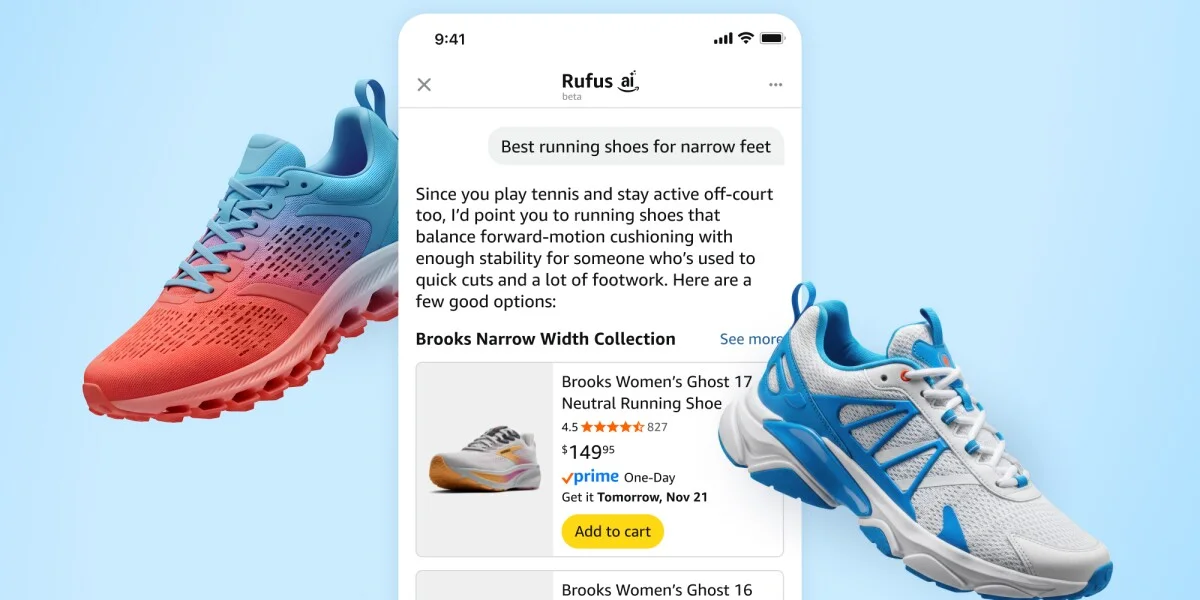
Rufus launched in US preview in February 2024 as Amazon's in-app AI shopping assistant. It runs inside the Amazon app and website handling product search, comparison, Q&A, and review summarization. "Running shoes under $100 for beginners" returns candidates from the Amazon catalog with explanations of differences.
Rufus is distinctive because it's trained on Amazon's reviews, purchase histories, and product Q&A — shopping-specific data rather than the general Web. That translates into higher accuracy on shopping-oriented questions like comparison, inventory, and delivery versus assistants trained on general data.
Through 2025 Rufus expanded to voice input, image input, order tracking, and reordering. Amazon's consistent direction is to polish the in-ecosystem experience to an absurd degree.
Buy for Me — Purchasing Outside Amazon Through Rufus
Buy for Me, announced April 2025, extends Rufus to purchasing products from sites outside Amazon. Users describe what they want, Rufus searches the wider Web, finds products on external merchant sites, and makes the purchase on the user's behalf — tied back to the user's Amazon account.
Under the hood this is genuinely agentic. Rufus operates like a browser agent, visiting merchant sites, adding to cart, and checking out. Payment routes through Amazon, returns come back through Amazon, and from the user's perspective it looks indistinguishable from a regular Amazon purchase.
Strategically, Buy for Me makes Amazon the payment-and-returns front-door of the agent era. Users stay in the "I buy everything through Amazon" mental model while the goods technically come from elsewhere. For merchants, that means Amazon-originated revenue can arrive without an Amazon listing — but the experience is controlled entirely by Amazon.
Closed Stack Strategy — Not in MCP, Not in UCP
Rufus and Buy for Me are not on any of the industry protocols. MCP, UCP, ACP, AP2 — Amazon hasn't publicly signed up for any of them.
This isn't accidental. Amazon already has four very strong assets — catalog, reviews, logistics, and payments — and getting behind industry standards would dilute the reason to prefer Amazon specifically. Standardization is riskier for Amazon than closure, so the strategy continues the classic walled garden approach turned up to maximum.
The effect is that Amazon seems to be sitting out the agentic commerce conversation. In reality, with hundreds of millions of weekly Amazon app users and Rufus embedded inside, Amazon is quietly running one of the largest AI shopping assistants in the world by user count.
The Merchant Playbook Doesn't Change
The crucial merchant takeaway: agentic commerce doesn't change the fundamental "sell on Amazon or not" binary.
If you already sell on Amazon, Rufus may surface your products. The algorithms remain a black box, and classic Amazon SEO — title, bullets, images, A+ content, reviews — remains the only actionable lever. There's no "Rufus-era" tactic distinct from regular Amazon optimization.
If you don't sell on Amazon, Buy for Me can surface your products — but you have no real control. Rufus's choices are opaque, and there's no exposed mechanism for merchants to influence placement inside Amazon. You may end up with Amazon-routed revenue you didn't plan for, while customer data lands in Amazon's hands.
The practical conclusion: decide Amazon separately from agent strategy. Use the same criteria you always did (fees, brand control, logistics), and pursue ChatGPT/Gemini/Perplexity via the playbook in the AI shopping assistants comparison as a parallel workstream.
Conclusion — The Walled Garden Stays Walled
Rufus and Buy for Me deliver a clear message: Amazon's walled garden stays walled in the agent era. No industry protocols, a maximally polished in-Amazon experience, and Buy for Me sweeping outside merchants into the Amazon purchase flow.
Whether merchants should welcome this is a hard call. What is clear is that treating Amazon and non-Amazon AI assistant strategy as independent decisions is the realistic move. For the wider landscape, see agentic commerce platforms compared.