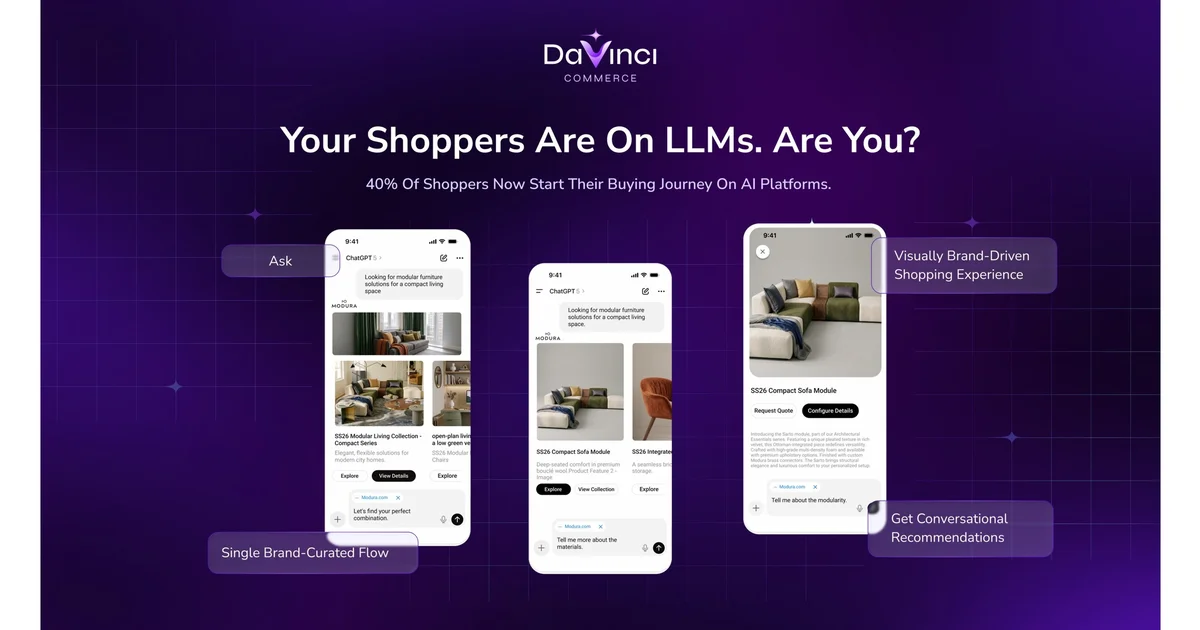
Will Brands Disappear When AI Goes Shopping? Share of Model and Survival Strategies for the Agentic Era
As AI agents take over product discovery, how can brands stay visible? Explore the rise of Share of Model, GEO, and survival strategies for agentic commerce with the latest data.


Key Takeaways
- As AI agents take over purchasing decisions, brand "invisibility" is accelerating across digital commerce
- Share of Model -- a brand's presence within AI-generated answers -- is emerging as the new competitive metric, replacing traditional SEO rankings
- 75% of consumers would lose trust in AI shopping if results were sponsored, making trust architecture the defining challenge
From the Link Economy to the Answer Economy -- Vanishing Brand Gateways

Agentic shopping is fast moving from an interesting curio to an integral part of the customer journey.
www.marketingweek.com"If your company doesn't show up in AI-powered answers, it might as well not exist." Jennifer Bender of Ipsos Strategy3 put it bluntly in her Marketing Week essay on the structural shift facing brands.
This is no exaggeration. According to Pew Research data, users click traditional search results only 8% of the time when an AI summary is displayed. With AI Overviews now triggering on 48% of queries, traffic to brand websites is declining structurally.
The old internet ran on a "link economy." Ranking at the top of search results, earning clicks, driving site traffic -- this was marketing's foundation. In the emerging "answer economy," where AI delivers direct responses, consumers may never need to visit a brand's website at all.
The numbers confirm the shift. G2's 2026 AI Search Insight Report found that 51% of B2B software buyers have already moved their research starting point to AI chatbots. On the consumer side, Fortune reported that 90% of URLs cited by ChatGPT do not appear in Google's top 20 search results. The competitive advantages built through years of SEO are being rendered nearly irrelevant.
The Era of Delegated Shopping Is Already Here
How deeply are AI agents actually involved in purchasing decisions?
The scale is striking. Amazon CEO Andy Jassy revealed during an earnings call that AI shopping assistant Rufus is on track to generate over $10 billion in incremental annual revenue. Monthly active users grew 140% year-over-year, and Rufus users are 60% more likely to complete a purchase. During the holiday season, Rufus sessions surged 90% from October through Black Friday, with AI driving approximately 90% of incremental sales growth.
Other platforms are moving equally fast. Google launched its Universal Commerce Protocol (UCP) with over 20 partners including Shopify, Target, and Walmart, building infrastructure that lets AI agents handle everything from cart management to loyalty program integration. Sephora opened a beauty advisor app within ChatGPT, enabling purchases without ever leaving the conversation.
Not everything has gone smoothly, though. OpenAI's Instant Checkout, launched in fall 2025, saw conversion rates at Walmart three times lower than redirect-based purchases and was replaced by retailer-operated apps in March 2026. The question of who controls the checkout experience cuts to the core of agentic commerce architecture.
Share of Model -- The New Metric for Getting 'Chosen' by AI
The most pressing question for brands is simple: will you make it into the AI agent's consideration set? The concept gaining traction to quantify this challenge is Share of Model.
Unlike Share of Voice (a brand's share of advertising exposure) or Share of Search (search volume share), Share of Model measures how frequently a brand is mentioned and recommended within AI-generated responses. As Bender emphasizes in Marketing Week, "If your product data isn't structured for an AI to digest, you simply won't make it into the agent's consideration set."
This metric matters because AI recommendation logic fundamentally differs from traditional search. Fortune's reporting revealed that only 12% of URLs cited by AI tools overlap with Google's top 10 results. Ranking first on Google offers no guarantee of appearing in ChatGPT or Gemini responses.
Some companies are already acting on this new metric. One business that restructured content for AI agent consumption achieved a 94% increase in agentic visibility within four months. Success came not from better website design, but from structured data, detailed FAQs, and specific use-case descriptions -- information architecture built for machines.
GEO (Generative Engine Optimization) Rewrites the Marketing Playbook
The practical methodology for improving Share of Model is GEO (Generative Engine Optimization). Where SEO optimized for Google's ranking algorithm, GEO focuses on getting your brand into the responses generated by ChatGPT, Gemini, Perplexity, and other AI platforms.
As Shopify's enterprise blog outlines, GEO rests on three core principles.
First, information density and accuracy. AI models prioritize hard facts -- specific specs, pricing, and comparison data -- over vague marketing copy. Bender notes that "AI algorithms seek information gain, and generic summaries of existing information offer no value."
Second, building external trust signals. AI models evaluate whether a brand is mentioned across multiple authoritative sources, not just on its own website. Reviews and mentions on Reddit, Wikipedia, and industry media directly influence AI recommendation confidence.
Third, leveraging user-generated content. Authentic buyer reviews and experience reports are data sources that AI systems particularly value to avoid model collapse. In the AI era, third-party voices carry even more weight than brand-authored messaging.
Do Consumers Actually Trust AI? The 75% Warning
Alongside brand-side adaptation, consumer psychology demands close attention. A fundamental tension exists here that will determine the trajectory of agentic commerce.
A survey by Quad delivered a stark finding: 75% of Americans would lose trust in AI shopping if they learned results were sponsored. Only 3% fully trust AI neutrality, while 68% assume some degree of commercial influence.
Yet interest in AI-assisted shopping continues to grow. Bain & Company's analysis shows that 72% of US consumers have already used AI tools in some form, and 73% are open to AI for product research and price comparison. However, only 10% have actually completed a purchase through AI.
Bender calls this the "AI trust paradox." Consumers want AI to narrow their options, but fiercely guard the final decision. The Ipsos study found that nearly 80% trust AI-recommended brands, yet 64% demand safeguards like money-back guarantees before authorizing AI purchases.
For brands, this psychology carries a dual implication. Making it onto AI's recommendation list provides a powerful pathway to purchase. But the moment sponsored content contaminates that list, trust collapses entirely.
Rebuilding Loyalty for the Agentic Era
Given this landscape, how do brands maintain consumer relationships?
Bender advocates for embedding loyalty rules within AI ecosystems. Consumers would configure their AI assistants with standing instructions: "Always buy skincare from Sephora for points," or "Prioritize sustainability-certified coffee brands." This "hard-coded loyalty" represents the most reliable way to avoid being filtered out in the agentic era.
Sephora's implementation of Beauty Insider integration within its ChatGPT app exemplifies this strategy in practice. By passing points balances, purchase history, and skin profile data to the AI, personalized recommendations and the loyalty program merge into a single experience.
Not every brand can build a platform-native app like Sephora, however. For smaller brands, the realistic first step is structuring product data and accumulating external reviews. eMarketer projects that US e-commerce sales via AI platforms will reach $20.57 billion in 2026, nearly quadrupling year-over-year. Whether brands catch this wave depends on the groundwork they lay right now.
Conclusion
The era of AI agents searching, comparing, and recommending products on behalf of consumers is not a distant possibility -- it is the present reality. As Rufus, ChatGPT apps, and Google's UCP demonstrate, the ecosystem where AI intermediates most of the purchasing process is expanding rapidly.
The actions brands must take are clear: structure product data for AI readability, build trust signals across external sources, and start tracking Share of Model as a core competitive metric. The playbook that secured top Google rankings will not transfer directly to this new landscape.
At the same time, the foundation of consumer trust cannot be neglected. In a market where 75% reject sponsored AI recommendations, the path onto AI's recommendation list runs through information quality and transparency, not advertising spend. Brand strategy in the agentic era comes down to one question: can you earn the trust of both machines and humans?