E.l.f. Beauty Testifies AI Answer Engines Are Changing Shopping — Fierce Debate Erupts at Shoptalk 2026
E.l.f. Beauty CDO Ekta Chopra testifies at Shoptalk Spring 2026 that AI answer engines are reshaping consumer behavior. Her prediction of 'cost per agent recommendation' replacing CPM sparks industry-wide debate.

Key Takeaways
- E.l.f. Beauty's CDO testified at Shoptalk 2026 that consumers are already using search engines like answer engines, urging brands to transform their data strategies
- ReFiBuy's CEO predicted 10% of commerce will be fully agentic by 2030, while analysts fired back with "not a chance," revealing a deeply polarized industry
- OpenAI's Instant Checkout retreat and Sephora's ChatGPT app integration show that AI commerce is concentrated at the discovery stage, with a long road ahead to purchase completion
"AI Answer Engines" Emerge as the Biggest Talking Point at Shoptalk 2026

There is fierce disagreement around how much generative AI models, which are changing the way that people find and discover products, will also disrupt retail media and ecommerce systems.
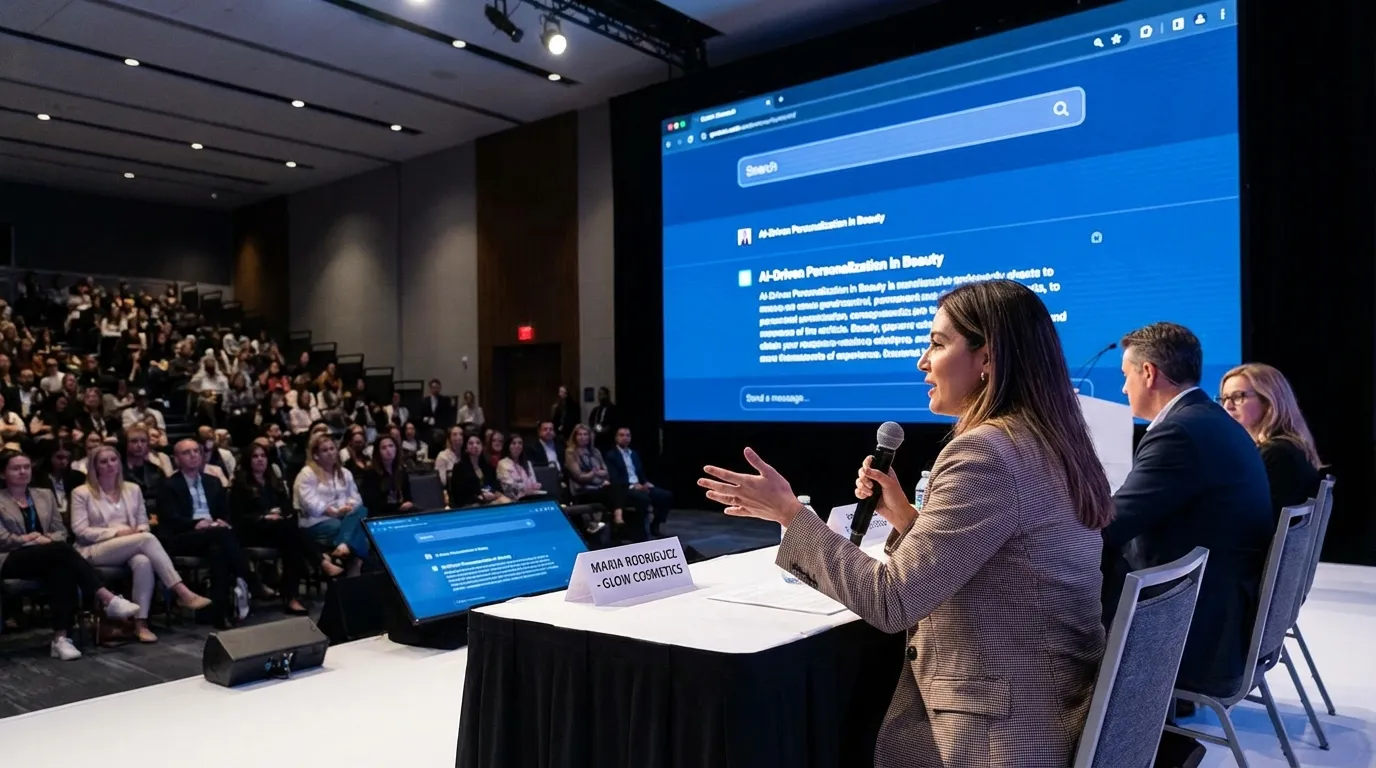
www.adweek.comAt Shoptalk Spring 2026, held March 24-26 at Mandalay Bay in Las Vegas, a panel titled "AI Agents Will / Will Not Transform Retail" drew significant attention. The panelists were Ekta Chopra, CDO of E.l.f. Beauty; Scot Wingo, co-founder and CEO of ReFiBuy; retail media analyst Andrew Lipsman; and Sarah Marzano, principal analyst at Emarketer.
The panel's focus was clear: as generative AI models are changing how consumers discover products, how far will the disruption extend into retail media and e-commerce systems themselves?
E.l.f. Beauty Describes Changes Happening on the Ground
E.l.f. Beauty is a cosmetics brand with over $1 billion in annual revenue, known for piloting more than 85 AI agent use cases internally. At the panel, Chopra stated that consumers are already using search engines as if they were answer engines.
The challenge this presents for brands is clear. For products to appear in AI-generated answers, brands need to provide "detailed product data, relevant to many scenarios and consumers." Unlike traditional SEO optimization, product information must be structured in ways that LLMs (large language models) can understand and recommend — otherwise, products simply won't surface in AI answer engine responses.
Chopra went further, predicting a fundamental shift in advertising metrics.
CPMs are going to change to cost per agent recommendation. Impressions won't matter anymore.Source: Ekta Chopra, CDO, E.l.f. Beauty
Wingo echoed this sentiment, adding "RIP clicks." The argument: traditional advertising metrics like CPM (cost per impression) and CPC (cost per click) will lose relevance in a world where AI agents recommend products.
"10% Agentic by 2030" — A Polarizing Prediction
The most heated moment came over predictions about the scale of agentic commerce. ReFiBuy's Wingo declared that "10% of commerce will be fully agentic by 2030." ReFiBuy, founded in 2025 by Wingo (creator of ChannelAdvisor), develops a Commerce Intelligence Engine that optimizes product catalog data for AI agents.
Not a chance.
Lipsman flatly dismissed the prediction. While acknowledging that LLMs are compressing the marketing funnel and changing product discovery, he doesn't believe truly agentic "bot-to-bot" commerce will become mainstream. His argument: regardless of how much AI improves efficiency, consumers still need to go through each stage — from discovery and awareness to consideration and purchase.
Emarketer's Marzano also struck a cautious tone, pointing out that infrastructure development is significantly outpacing actual changes in consumer behavior.
OpenAI's Instant Checkout Retreat Reveals the Reality
The "infrastructure ahead, behavior lagging" dynamic is perfectly illustrated by OpenAI's retreat from Instant Checkout.
OpenAI rolled out a new shopping experience within ChatGPT to make it easier for users to find and compare products, after its Instant Checkout feature failed to take off.
www.cnbc.comOpenAI launched "Instant Checkout" — a direct payment feature within ChatGPT — in September 2025 in partnership with Etsy, Shopify, and Stripe. Just six months later, the feature was effectively abandoned. Users browsed and compared products in enormous volumes, but overwhelmingly preferred to complete purchases on familiar retail sites rather than within ChatGPT. Reports indicate that only about a dozen merchants actually integrated the checkout infrastructure, out of millions on the Shopify platform.
At the Shoptalk panel, Lipsman and Marzano cited the Instant Checkout failure as evidence that consumers resist autonomous AI shopping.
Sephora's "ChatGPT App" Points to an Alternative Path
At the same time, Shoptalk 2026 made clear that AI commerce is generating substantial value at the discovery stage. Sephora launched an app within ChatGPT on March 24, offering a personalized shopping experience integrated with its Beauty Insider loyalty program.
With over 80 million active members, Sephora's approach doesn't attempt to complete purchases within ChatGPT. Instead, it uses AI as an interface for product discovery and personalization. Users can ask "Sephora, help me find a foundation for dry skin" on ChatGPT and receive personalized recommendations linked to their Beauty Insider account profile.
This model aligns with Lipsman's argument that AI functions as a discovery tool, not an autonomous purchasing mechanism.
Actions E-Commerce Operators Should Take Now
Optimize product data for LLMs. For your products to be recommended by AI answer engines, you need structured data beyond traditional SEO. Provide machine-readable, multi-faceted attribute information — use cases, ingredients, target users, usage scenarios — as a starting point.
Prepare a measurement framework for "agent recommendations." In anticipation of the shift from CPM to cost per agent recommendation that Chopra envisions, build tracking systems that measure AI channel traffic and conversions separately from existing attribution models.
Prioritize investment in the discovery layer. As OpenAI's Instant Checkout retreat and Sephora's app integration demonstrate, AI commerce currently works best at the product discovery stage. Strategies that maximize visibility in AI answer engines will be more effective than building infrastructure for purchase completion.
Summary
The Shoptalk 2026 panel highlighted just how polarized industry views are on the future of agentic commerce. E.l.f. Beauty and ReFiBuy argue that AI answer engines are already changing shopping behavior, while analysts counter that fully autonomous AI shopping isn't what consumers want.
The current consensus is that AI is fundamentally transforming product discovery, but the path to purchase completion is still long. The practical priority for e-commerce operators is to start preparing now — structuring product data in ways that LLMs can understand and positioning to benefit from AI-driven discovery.