Google's Universal Commerce Protocol (UCP): Inside the Open Standard Vying to Become the Common Language of Agentic Commerce
A protocol-level look at Google's UCP: the capability manifest, payment separation, and security design of the open standard, and how its ecosystem has grown from 20+ launch partners to a 10-company Tech Council.


Key Takeaways
- On January 11, 2026, Google announced the Universal Commerce Protocol (UCP), an open standard for commerce conducted through AI agents. Shopify, Walmart, Target, Wayfair, and Etsy co-developed it, and more than 20 companies including major payment players endorsed it at launch
- UCP collapses the N-to-N integration problem between merchants and AI channels into a single integration point, covering discovery, checkout, and order management under one specification. Steady spec releases and a growing governing council since launch are turning it into an established standard
- The takeaway for merchants is to invest in the shared foundation—machine-readable product data and standards support—rather than one-off integrations per channel. That groundwork pays off no matter which protocol prevails
An Open Standard Backed by Retail and Payments Heavyweights

An overview of Google's new open standard for agentic commerce and AI tools to help retailers connect with shoppers and drive sales.
blog.googleOn January 11, 2026, Google announced the Universal Commerce Protocol (UCP), an open standard for agentic commerce, timed to the opening of NRF 2026, the National Retail Federation's annual conference. Five companies signed on as co-developers: Shopify, Etsy, Wayfair, Target, and Walmart.
The circle of endorsers is wider still—more than 20 companies including Adyen, American Express, Best Buy, Flipkart, Macy's, Mastercard, Stripe, The Home Depot, Visa, and Zalando. The presence of card networks and payment providers from day one matters. Purchases made by AI agents are inseparable from delegated payment, and a standard's viability depends heavily on buy-in from the payments side.
UCP has kept generating headlines since, including its expansion into lodging and food delivery. Rather than chasing each event, this article focuses on the protocol itself: the problem UCP is trying to solve, what the specification actually contains, and how the ecosystem has moved since launch.
The Goal: Collapsing the N-to-N Integration Problem
Agentic commerce refers to commerce in which AI agents discover, compare, and purchase products on a user's behalf. In that world, multiple AI channels—ChatGPT, Gemini, Copilot—stand side by side as entry points to a purchase. If merchants build bespoke API integrations for each channel, the number of connections balloons as merchants multiplied by channels. Google's developer blog calls this the "N x N integration bottleneck" and frames UCP's purpose as collapsing it into a single integration point.
Behind the launch is a race to set the standard. In September 2025, Stripe and OpenAI published the Agentic Commerce Protocol (ACP) and put Instant Checkout live inside ChatGPT. On January 8, 2026, Microsoft announced Copilot Checkout. With McKinsey sizing the market at $3-5 trillion globally by 2030, Google is making its own bid to define the "common language" of commerce.
Reading the Spec: Manifest, Capabilities, and Payment Separation
UCP: An open-source protocol by Google and partners to power agentic commerce. It ensures secure, seamless shopping across consumer surfaces.
developers.googleblog.comThe first thing to grasp in the specification is the /.well-known/ucp manifest. A business places a JSON declaration file at a fixed location on its own domain, publishing its supported features, endpoints, and available payment configurations. An agent can discover how to connect simply by reading this file, eliminating hard-coded, one-off integrations. Much as websites have long negotiated with search engines through robots.txt, the manifest makes the terms of doing commerce machine-readable.
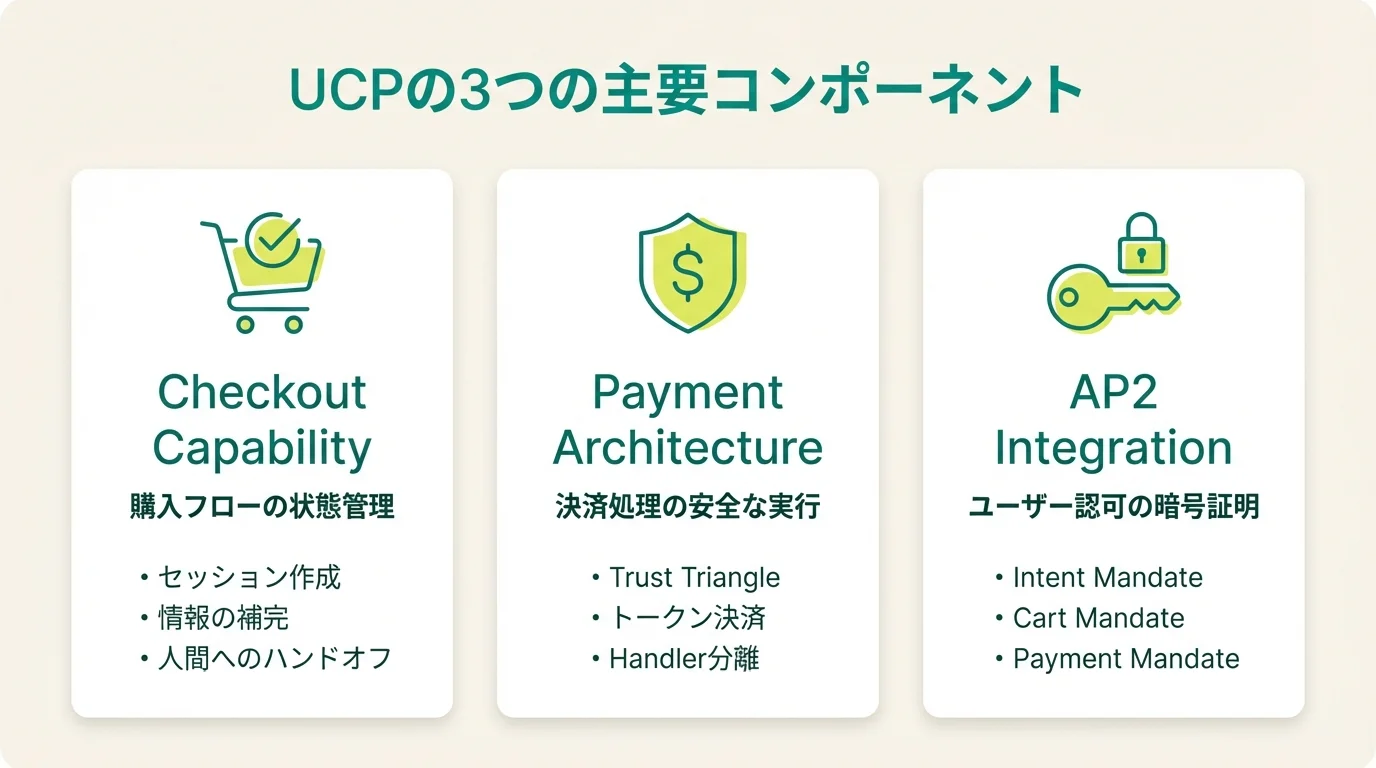
Functionality is defined in units called capabilities. The official specification site lists the core set: checkout, which handles carts and pricing logic; identity linking built on OAuth 2.0; and order management covering fulfillment tracking and returns. Transport rests on REST and JSON-RPC, and the protocol composes with the Model Context Protocol (MCP) for connecting AI to tools, Agent2Agent (A2A) for agent-to-agent communication, and the Agent Payments Protocol (AP2) for payment authorization. Rather than replacing existing standards, UCP layers a commerce vocabulary on top of them. The developer blog walks through a flower-shop order as an example, from invoking the checkout capability to applying a discount code in a single flow.
The treatment of payments is also distinctive. UCP separates payment instruments—cards and wallets—from the payment handlers that process them, so that diverse payment providers can operate on the same specification. Request signing, tokenized payment data, and cryptographic proof of user consent are built into the spec. In transactions where no human is at the screen, being able to verify who authorized what is the foundation of fraud prevention.
The First Implementation: Checkout in Google Search and Gemini
A protocol only gains force once implementations exist. Alongside the announcement, Google said it would roll out direct checkout in Search's AI Mode and the Gemini app, starting with eligible US retailers. Users tap a buy button mid-conversation while researching a product and complete the purchase with payment and shipping details saved in Google Pay. PayPal support was slated as coming soon at announcement time. Google also showed a mechanism for brands to present targeted discounts keyed to the context of a shopper's research in AI Mode.
What matters most from the merchant's seat is that the retailer remains the seller of record. This is not a model in which Google buys and resells inventory; the selling entity stays the merchant, and order data and the customer relationship stay attributed to it. That is a different structure from the loss of customer touchpoints that has long dogged marketplace selling. Support for loyalty features, such as member benefits and exclusive offers, has also been signposted.
The on-ramp is Google Merchant Center. Merchants connect through a Merchant Center account with registered product data, following the published integration guides. In other words, the state of your product feed directly determines whether you can participate in the new channel.
Six Months On: Spec Releases and a Doubled Council
UCP is maintained as open source on GitHub under the Apache 2.0 license and versioned by date. The v2026-04-08 release, published on April 9, 2026, added a cart-building capability, signing for both requests and responses, first-class error handling, OAuth 2.0-based identity linking, and catalog search, among other changes. The skeleton unveiled in January is steadily acquiring the parts needed for production use.
Governance has broadened too. On April 24, 2026, Amazon, Meta, Microsoft, Salesforce, and Stripe joined the UCP Tech Council, the body that steers the protocol's technical direction, alongside founding members Google, Shopify, Etsy, Target, and Wayfair—ten organizations in all. That Stripe, the driving force behind ACP, and Amazon, with its own vast ecosystem, now sit on the same council signals convergence rather than a standards war.
At Google Marketing Live in May 2026, Google previewed UCP's expansion into hotel booking and food delivery, along with checkout rolling out to Canada and Australia and later the UK. The intent to grow beyond a retail standard into a cross-industry commerce protocol is unmistakable. We cover the event announcements in detail in our Google Marketing Live 2026 article.
Reading a Multi-Protocol Era, and Where to Start
| Protocol | Led by | Layer |
|---|---|---|
| UCP | Google + 10-company Tech Council | The full commerce journey, from discovery to checkout and order management |
| ACP | OpenAI/Stripe | Checkout and merchant integration; live in ChatGPT's Instant Checkout |
| AP2 | Payment authorization and trust model; used alongside UCP |
The current lineup is shown in the table, but the three are not necessarily competitors on the same layer. ACP centers on checkout and merchant integration, AP2 handles payment authorization and the trust model, and UCP targets the full journey from discovery through post-purchase. We map the overlaps and differences in our UCP versus ACP comparison; with Stripe now on the UCP council, the room for interoperability is wider than it looked at launch.
For merchants, the takeaways come down to three. First, product data readiness is the price of admission: accurate prices and inventory, structured attributes, and a clean product feed are the lifeline across every AI channel, not just UCP. Second, avoid locking into any single protocol. The spec is still evolving through dated releases, and firming up the shared data foundation first is safer than betting on one standard. Third, design the customer relationship deliberately. Seller-of-record status is preserved, but how you surface member benefits and offers inside AI channels is a customer-strategy question you have to answer yourself.
Conclusion
At its core, UCP is an attempt to refold e-commerce's integration problem—years of one-off optimizations for each channel—into an open standard. Uniting retail and payments majors at launch, then advancing through spec releases, a doubled council, and vertical and geographic expansion within six months, shows the contest over agentic commerce infrastructure has entered the stage of facts on the ground. The preparation asked of merchants is unglamorous: organize machine-readable product data, confirm your on-ramps such as Merchant Center, and keep the capacity to track spec updates. Building the foundation that pays off no matter which standard prevails is the practical lesson to draw from UCP.