PayPal and Google Tell Consensus Miami Agentic Commerce Will Run on Crypto Rails: The Three Pillars Merchants Need to Watch
At Consensus Miami 2026, PayPal and Google Cloud executives argued AI agents structurally cannot use bank accounts, so agentic commerce must run on crypto rails. Here are the three pillars they named (AP2, PYUSD, multi-party custody) and what merchants should do.

Key Takeaways
- Google Cloud's Richard Widmann and PayPal's May Zabaneh used the Consensus Miami 2026 stage to declare that agentic commerce will run on crypto rails because AI agents structurally cannot hold traditional bank accounts
- They named three pillars: open payment protocols (Google's AP2, donated to the FIDO Alliance with 120+ partners), machine-readable merchant catalogs, and multi-party crypto custody that prevents agents from holding the full private key
- PayPal's own survey found 95% of merchants already see AI agent traffic, but only 20% have machine-readable catalogs, meaning the merchant-side readiness gap is the immediate constraint on adoption
The Miami Declaration: Crypto Rails as Structural Necessity
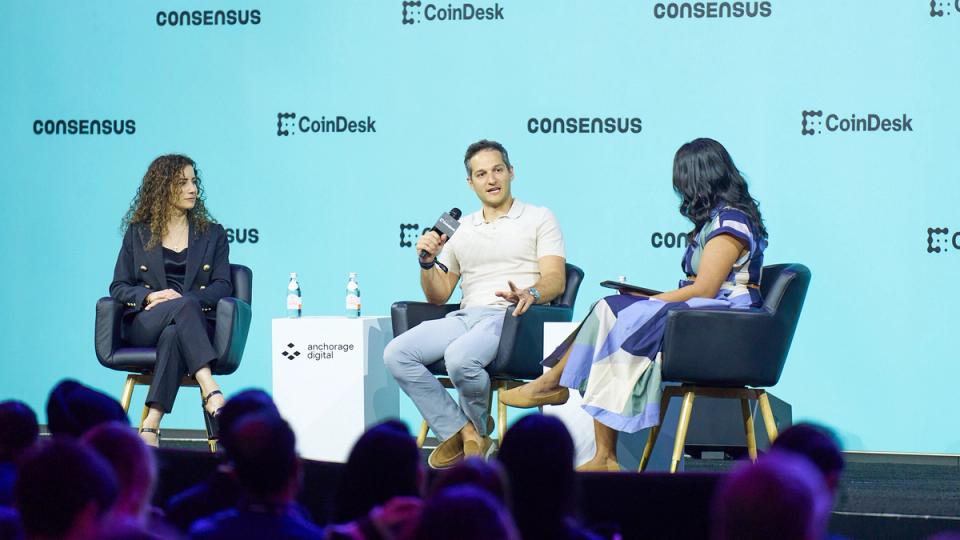
Senior figures from PayPal and Google Cloud said open payment protocols, machine-readable merchant catalogs and multi-party crypto custody are needed to scale agentic commerce.
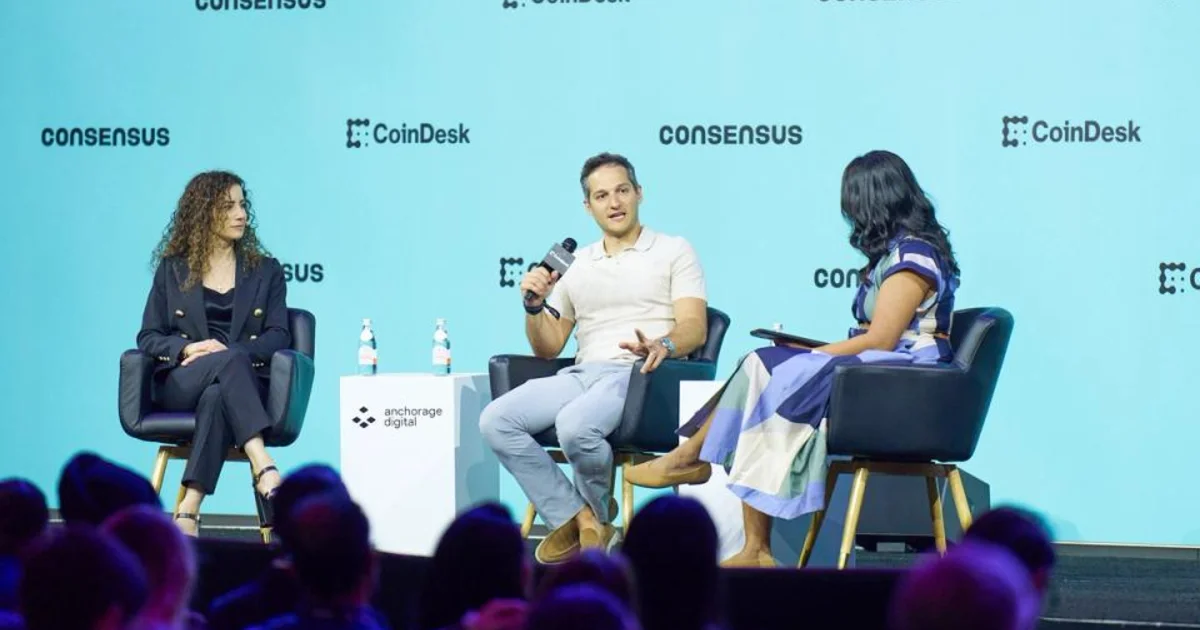
www.coindesk.comAt CoinDesk's Consensus Miami 2026 on May 7, Google Cloud's global head of Web3 strategy Richard Widmann and May Zabaneh, senior vice president and general manager of crypto at PayPal, made an unusually blunt argument. The next wave of internet commerce, they said, will run on crypto rails because AI agents structurally cannot use traditional financial accounts.
Widmann put it plainly. "An agent cannot get a bank account. It's not hard, it just is impossible," he said, pointing to both technological and regulatory barriers. Crypto, by contrast, offers "a fantastic machine readable interface for payments." Zabaneh stacked PayPal's stablecoin PYUSD on top of that argument, calling it "a very natural programmable layer for payments" suited to commerce trends toward globalization, AI-native experiences, and tokenized assets.
Three Pillars: Protocol, Catalog, Custody
The executives named three pillars. They are worth unpacking in order.
The first is the open payment protocol layer. Google launched the Agent Payments Protocol (AP2) and donated it to the FIDO Alliance, where it now sits with more than 120 partners including PayPal. Widmann compared the move to the donation of x402 to the Linux Foundation, framing it as the same template: "open dialogues and open standards are really the foundation you need to build on." Details are summarized in Google's announcement.
The second is machine-readable merchant catalogs. Zabaneh cited PayPal's Agentic Commerce Pulse Report, a February to March 2026 survey of 498 US merchants. The headline data is stark: 95% of merchants now see AI agent traffic on their sites, but only 20% have machine-readable catalogs that those agents can actually understand and act on. "Merchants need to be ready for this next era," she said, comparing the moment to the shift from offline to online retail. If your products are not exposed in agent-readable formats, you simply do not exist on the surface that AI assistants browse.
The third is multi-party crypto custody, which Widmann said is becoming central to agent design. Google has extended its Cloud KMS platform to cryptocurrency custody, and the design intent is precise: an agent should hold only one of two or three key shards rather than the full private key. "It cannot simply unilaterally move funds or take action," he said. The safety property is enforced by cryptography, not policy. Even a compromised or hallucinating agent cannot single-handedly settle a transaction.
How the Hyperscaler Camps Are Lining Up
Pair the Miami declaration with the previous week's announcements and the picture sharpens considerably.
Two days before Consensus, on May 6, the Solana Foundation and Google Cloud unveiled Pay.sh, a gateway that lets AI agents pay for Google Cloud APIs (Gemini, BigQuery, Vertex AI and others) in USDC over Solana. The protocol underneath is x402. The next day, AWS rolled out Amazon Bedrock AgentCore Payments in preview with Coinbase and Stripe, letting agents transact mid-task during a single execution loop. Both Pay.sh and AgentCore Payments sit on the same Coinbase-incubated x402 rail. Cloud platforms are still competing fiercely on the surface, but the payment protocol has already been neutralized one layer down.
PayPal's posture is consistent with the same architecture. The company launched its Agentic Commerce Services in October 2025, plugging merchants directly into ChatGPT, Copilot, and Perplexity, and PYUSD is the programmable settlement layer beneath. Zabaneh framed agents as PayPal's next channel after the offline-to-online and online-to-mobile transitions, with stablecoins as the natural primitive when commerce becomes global, AI-native, and tokenized at once.
The harder question of liability did not get a tidy answer. Asked who is responsible when an agent makes a bad purchase, Zabaneh acknowledged it as "definitely something that we have to think through as an industry." Widmann's key-shard architecture answers the technical "can the agent unilaterally act" question, but it does not by itself solve chargebacks, fraud disputes, or the question of whose underwriting absorbs the loss.
What About the Card Rails
The crypto-rail argument lands alongside an aggressive card-network defense.
Visa launched its Trusted Agent Protocol (TAP) with Cloudflare in October 2025. TAP signs agent identity into HTTP request headers, and merchants verify the signature against Visa's directory. It is designed to interoperate with OpenAI's Agentic Commerce Protocol (ACP), and Visa has lined up Shopify, Stripe, and several major AI platforms behind it. Mastercard has taken a parallel route with Agent Pay and Agentic Tokens. CEO Michael Miebach told analysts on the Q3 2025 earnings call that the first agentic transaction had executed on Mastercard's network during the quarter.
The networks are also burrowing into the crypto-rail camp's protocols rather than fighting them externally. Visa extended Stripe and Tempo's Machine Payments Protocol (MPP) to support card-based payments. Mastercard co-developed Verifiable Intent with Google as an AP2-compatible standard and is donating it to FIDO alongside Google. The contested ground has shifted: card rails will retain their advantage in chargebacks, underwriting, and regulatory coverage, while embedding their own claims in the neutral protocols emerging on the stablecoin side. The fact that both networks already appear in AP2, x402, AgentCore Payments, and Pay.sh tells you the fight is no longer about which rail wins, but about who owns which slice of every rail.
What Merchants and Payments Teams Should Do Now
The 95%-versus-20% gap is the right starting point for a checkout strategy review.
Catalog readiness is no longer optional. Schema-structured product data, clear terms of use, and machine-readable pricing are the entry requirements for AI assistants to recommend, compare, and transact against your inventory. Without them, your site receives agent traffic but converts none of it. The AEO (AI Engine Optimization) conversation has moved out of marketing strategy and into payments engineering: discoverability is now upstream of checkout.
Payment strategy is heading toward a dual-rail posture. Trusted Agent Protocol and Agent Pay over Visa and Mastercard will remain the default for the foreseeable future, especially for high-ticket transactions like travel where chargebacks and underwriting matter. At the same time, the long tail of API access, MCP server usage, and content-level micropayments is shifting to real-time stablecoin settlement. Whether your checkout speaks PYUSD or USDC over x402 or AP2 will determine whether you participate in that economy at all.
Liability design needs an owner inside your organization. Refund flows for agent misorders, fraud detection on agent-initiated transactions, and intent verification cannot be wholly outsourced. Multi-party custody constrains what a rogue agent can do on its own, but merchants will still need logic for which agents to trust. Plan to integrate identity attestations like Trusted Agent Protocol and intent logs like AP2's Verifiable Intent into your checkout stack sooner than later.
Closing Thoughts
The Miami declaration sharpened the industry's center of gravity. With AI agents unable to hold bank accounts, programmable stablecoins and machine-readable protocols stop being the speculative path and become the assumed substrate.
The structural details to watch are AP2's residence at FIDO, the shared x402 base under both Pay.sh and AgentCore Payments, and the way card networks are embedding themselves into the neutral protocols rather than competing against them. The three questions left for merchants are concrete: is your catalog readable to agents, is your checkout ready to run alongside crypto rails, and where does liability sit when an agent gets it wrong. As the 95-to-20 numbers make clear, the time to start answering is now.