TCS and Rezolve Ai Forge Global Partnership to Scale Agentic Commerce for Enterprise Retail
TCS will resell Rezolve Ai's brainpowa platform worldwide, marking its entry into the agentic commerce market and giving the NASDAQ-listed AI native firm access to one of the world's largest IT services delivery footprints.

Key Takeaways
- TCS will resell Rezolve Ai's brainpowa platform globally, marking TCS's formal entry into the agentic commerce market through a first-of-its-kind partnership
- Rezolve Ai (NASDAQ: RZLV) posted $60M in Q1 2026 revenue and reaffirmed a $360M full-year guide while serving more than 950 enterprise clients
- The deal accelerates a pattern of SI-plus-AI-native camps (Accenture-Google, IBM-Salesforce, now TCS-Rezolve) that turns enterprise commerce AI procurement into an ecosystem choice, not a tool choice
TCS and Rezolve Ai announce a global agentic commerce partnership

Together, they will help retailers embed agentic-AI into core commerce workflows and drive enterprise transformation.
www.tcs.comOn May 12, 2026, Tata Consultancy Services (TCS) and Rezolve Ai (NASDAQ: RZLV) announced a global strategic partnership to scale agentic commerce worldwide. The deliberate framing of the press release as "first-of-its-kind" signals what is really happening: TCS is making its formal entry into the agentic AI commerce market.
The structure of the deal is concrete. TCS will resell and deliver Rezolve Ai's proprietary brainpowa™ platform to enterprise retail clients around the world. According to Rezolve's own release, this is a formal reseller agreement that exposes Rezolve to one of the broadest enterprise client footprints in the world, anchored by a partner with more than $30 billion in annual revenue.
The market reaction was less enthusiastic. TCS shares fell more than 4% the day of the announcement, trading down to 2,296.40 rupees on the NSE per local reporting. The sell-off coincided with broader weakness across India's large-cap IT sector, but it also reflects the persistent investor skepticism around the pace of AI monetization in enterprise services.
Inside Brain Suite and brainpowa
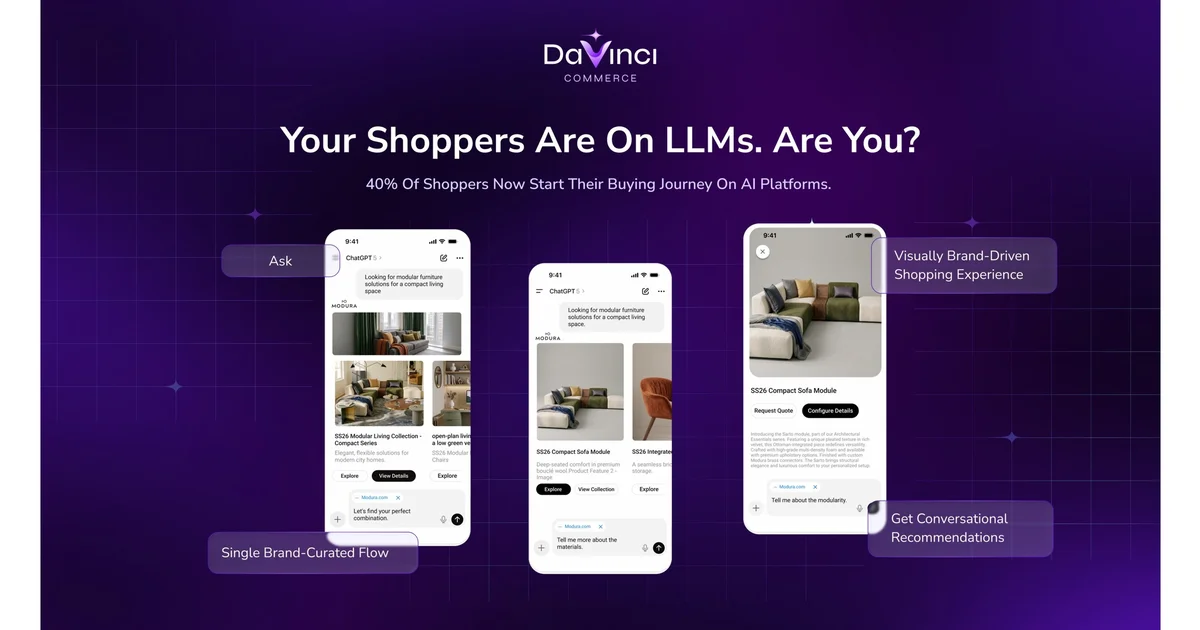
The weight of this announcement only becomes clear once you understand what Rezolve is actually selling. The Brain Suite is positioned as an end-to-end enterprise AI platform spanning search, transactions, fulfillment, and personalization in a single stack.
It is structured as three layers: Brain Commerce for AI-driven product discovery and conversational search; Brain Checkout for agentic checkout flows; and brainpowa, the commerce-tuned generative model family that powers both. brainpowa reached general availability inside Microsoft Foundry in early 2026, giving brands a path to build commerce copilots directly on Azure.
Three production models are available today. brainpowa-general-toolcalling-m-v1 is built for multi-turn ecommerce conversations and agentic workflows with tool orchestration. brainpowa-general-conversational-l-v1 is the large-format conversational model optimized for catalog enrichment. brainpowa-general-conversational-m-v1 is the efficient middle tier tuned for real-time customer support. Rather than retrofitting a general-purpose LLM with retail prompts, Rezolve trained these models on commerce-specific workflows from the start.
The evaluation metrics tell a similar story. Rezolve measures model quality on sales-closing rate, clarification quality, and timing of product presentation. These are not BLEU scores or perplexity numbers; they are retail-operator KPIs that fit cleanly inside an SI engagement and a board-level ROI conversation.
Rezolve Ai as a category-leader candidate
Why did TCS choose Rezolve specifically? The growth profile underneath the company answers most of the question.
Rezolve Ai posted $60M in Q1 2026 revenue, exceeding its entire audited FY2025 revenue ($46.8M) in just 90 days per the company's own filing. Management has reaffirmed a $360M full-year guide and entered 2026 with a $232M-plus annualized run-rate. The customer base now exceeds 950 enterprises, with strategic relationships across Microsoft, Google, and Tether.
In other words, TCS bought into the AI-native vendor that is most credibly building category-leader scale in commerce-tuned AI. Compared to the Accenture-Google playbook, which is anchored on Gemini's horizontal capability, TCS chose to build its retail vertical on top of a specialist. That is a deliberate bet on depth over breadth in this segment.
Rezolve Ai CEO Daniel M. Wagner described the partnership as creating "a clear pathway to take agentic commerce from platform innovation to enterprise-scale deployment." Read in reverse, that quote acknowledges Rezolve's main gap to date: a strong product, but limited muscle inside Fortune 500 procurement organizations. TCS's 56-country footprint and 194 service delivery centers close exactly that gap.
What the deal tells you about TCS's AI strategy
TCS's own framing matters. Shekar Krishnan, who runs retail across the UK and Europe at TCS, called the partnership "a key component of TCS' strategy to create an integrated AI ecosystem bringing together in-house innovation with strategic partnerships to industrialize AI."
That ecosystem language is not boilerplate. TCS has publicly set its aspiration to become "the world's largest AI-led technology services company," and the implicit admission is that organic build is not enough. Wrapping a specialized AI-native vendor in TCS's distribution and delivery is the fastest way to capture retail before Accenture does. That is the strategic logic on the TCS side.
There is also a delivery hook. Global retailers can experience the joint solution hands-on at TCS's Pace Port™ innovation centers, providing a clear path from sales conversation to PoC to production. The motion is designed to remove friction at every step a CIO has to walk to commit to a multi-year contract.
How the ecosystems stack up
Enterprise retail AI procurement has shifted from tool selection to ecosystem selection. The map is now clear enough to compare.
| Camp | AI Commerce Stack | SI / Delivery Partner | Distinctive Strength |
|---|---|---|---|
| TCS x Rezolve Ai | Brain Suite / brainpowa | TCS (56 countries, 194 delivery centers) | Retail-native AI platform, Microsoft Foundry distribution on Azure |
| Accenture x Google Cloud | Gemini Enterprise Agent Platform | Accenture (4th year as Partner of the Year) | 450+ pre-built agents, forward deployed engineers |
| IBM x Salesforce | Agentforce 360 + IBM Z | IBM Consulting | Direct mainframe data access, systems-of-record integration |
| Deloitte x AWS camp | Bedrock / Q | Deloitte | AWS Marketplace-led distribution |
Each camp is anchored on an SI plus AI commerce platform pairing. Accenture-Google fields Gemini Enterprise Agent Platform with 450-plus pre-built agents at $295 per active agent per month. IBM-Salesforce wires Agentforce directly into IBM Z mainframe data, selling depth of integration. TCS-Rezolve differentiates by going vertical: a commerce-tuned model family, evaluated on retail KPIs, distributed through TCS's existing retail client base.
A second under-appreciated angle: Rezolve is available inside Microsoft Foundry. Many of TCS's retail clients run major Azure footprints, so the technical onboarding has very little friction. Where Accenture-Google effectively assumes a Google Cloud preference, TCS-Rezolve plays cleanly on Microsoft's infrastructure too — a meaningful tactical advantage in mixed-cloud retail estates.
Implications for Japanese retailers and ecommerce leaders
Three takeaways matter for retail and ecommerce decision-makers in Japan.
First, the option set just got wider. Until now, Japanese enterprises mostly chose between rolling their own stack on top of GPT or Gemini and bolting agentic features onto Salesforce Commerce Cloud or Adobe Commerce. Rezolve, distributed through TCS, becomes a credible third option — especially for large retailers that already have a TCS relationship and can move via a contract amendment rather than a fresh procurement cycle.
Second, retail-KPI-evaluated AI is a structurally different proposition. The failure mode of most Japanese AI pilots is "we measured response quality but cannot prove revenue impact." Designing model evaluation around sales-closing rate and product-presentation timing is a far more useful frame for RFPs and post-launch governance.
Third, ecosystem choice now matters more than tool choice. CIOs and CDOs at large Japanese retailers face a structural decision: Accenture-Google, IBM-Salesforce, or TCS-Rezolve. That call will shape the next five-to-ten years of their commerce stack. Watching the standardization of agent-to-agent protocols such as A2A will be important for preserving long-term optionality and hedging lock-in risk.
Closing thoughts
The TCS-Rezolve partnership locks in another major camp in the agentic commerce market. Where Accenture-Google paired the largest SI with the largest cloud, TCS chose to pair with a retail-specialist AI native — a different shape of bet, but one with its own logic.
The next twelve to eighteen months will determine how much of TCS's retail client base actually adopts brainpowa in production, how much of Rezolve's $360M revenue guide the partnership contributes, and which camps Japan's largest retailers ultimately join. The headline equity reaction is a sideshow. The structural shift in how enterprise commerce AI gets sold is the story to track.