Salesforce Agentforce Commerce Drives 59% Faster Sales Growth as Agentic AI Becomes a Revenue Engine
Research firm Futurum calls Salesforce's Agentforce Commerce the moment agentic AI shifts from hype to real revenue. Retailers deploying shopper agents reportedly grew sales 59% faster, signaling that enterprise agentic commerce monetization has arrived.


Key Takeaways
- Research firm Futurum calls Salesforce's Agentforce Commerce a move that pushes agentic AI from hype to retail revenue, citing 59% faster sales growth for retailers that deploy their own shopper agents.
- The figure comes from Salesforce itself, and Futurum argues the real differentiator is not LLM intelligence but the data and business logic underneath: real-time inventory, contract pricing, and service integration.
- For e-commerce operators, the key questions are whether to run your own agents that own the customer relationship and purchase data, and how to guarantee reliability and manage hallucinations in production.
The Moment Agentic AI Moves From Pilot to Revenue

Salesforce's Agentforce Commerce shifts agentic AI from hype to results, with retailers deploying shopper agents achieving 59% faster sales growth.
futurumgroup.comOn June 24, 2026, Keith Kirkpatrick, an analyst at The Futurum Group, published an analysis of Salesforce's Agentforce Commerce. The headline framed the story plainly: Agentforce Commerce pushes agentic AI from hype into real retail revenue. The argument is that agentic AI, long treated as an experimental side project, is shifting into a mainstream driver of growth.
Agentic commerce here refers to a new form of transaction in which AI agents search, compare, and complete purchases on a person's behalf. Unlike traditional e-commerce, where a shopper types into a search bar and browses a storefront, buying increasingly happens inside a conversation with AI assistants such as ChatGPT or Gemini.
Kirkpatrick's thesis can be reduced to a single line: AI agents are no longer a nice-to-have differentiator but a measurable force shaping retail growth. The piece starts from Salesforce's announcement and works calmly through the competitive implications and the adoption risks.
What Agentforce Commerce Actually Announced
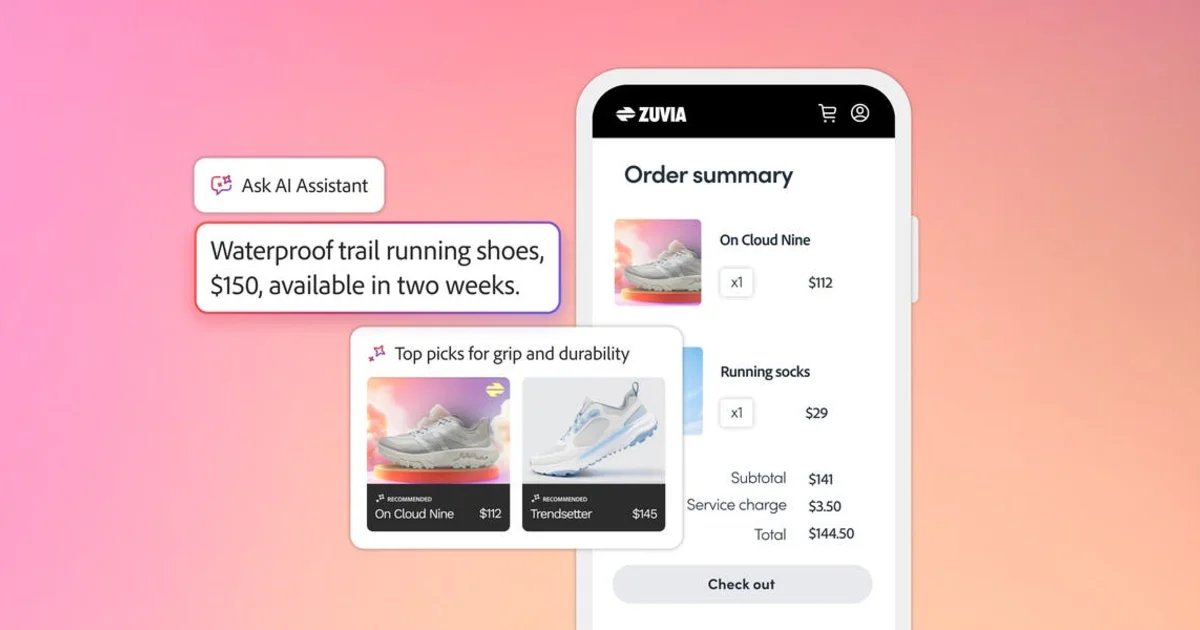
Agentforce Commerce, now generally available, is built around three agents: a Shopper Agent for consumers, a Buyer Agent for B2B procurement, and a Merchant Agent that supports store-side operations. Native integrations with ChatGPT and Google Gemini sit on top of them.
The Shopper Agent handles the consumer buying experience with natural-language product discovery and recommendations. The Buyer Agent is the interesting one: it lets B2B procurement happen through familiar channels like WhatsApp and SMS, so a buyer can simply text an order without portals or logins.
Working behind the scenes, the Merchant Agent lets teams manage inventory and respond to trends using natural language, which Salesforce says cuts time spent on manual tasks by up to 88%. At Pandora, automating routine inquiries such as "where is my order?" contributed to a 10% lift in net promoter score, according to Salesforce's announcement.
On integration, Salesforce connects product catalogs and pricing to AI channels like ChatGPT through OpenAI's Agentic Commerce Protocol (ACP). Checkout is completed inside the conversation via an ACP integration with Stripe, and support for Google's Agent Payments Protocol (AP2) lets the platform handle agent-led payments securely.
How to Read the 59% Figure
The "59% faster sales growth" line in the headline is persuasive. It also deserves a careful look at its source and assumptions.
This number comes from Salesforce itself: retailers that deployed their own shopper agents reportedly grew sales 59% faster than peers lagging in AI adoption, with AI-referred traffic converting at eight times the rate of social channels. Salesforce further claims that during the last holiday season, AI influenced 20% of global online sales, totaling $262 billion.
The caveat is that these are vendor-supplied figures. The 59% gap compares "AI adopters" with "laggards," and it is hard to separate a pure AI effect from the underlying strength of firms that were already investing aggressively in digital. The claim that AI-assistant-driven retail traffic grew 119% year over year in the first half of 2025 is confirmed in Salesforce's own newsroom, but the exact conditions behind the sales-growth comparison are not specified in public materials. Trust the direction of travel; avoid treating it as settled fact.
Futurum's own piece pairs the vendor claims with its independent 1H 2026 AI Platforms Decision Maker Survey (n=820), noting that 56% of enterprises cite customer support and experience as their top generative AI use case. Placing vendor claims and independent research side by side is a useful discipline for readers.
The Real Differentiator Is Under the Hood
The most instructive part of Kirkpatrick's analysis is his insistence that the battleground is not which LLM you use, but the business logic and data beneath it.
The market tends to fixate on which large language model powers the agent. Salesforce's core argument, however, is that agentic commerce only works when agents can access real-time inventory, honor contract pricing, and resolve service issues, which are precisely the domains where its data and workflow integration run deep.
Competitors with strong AI models but weaker operational backbones, the reasoning goes, will struggle to deliver the reliable experiences that drive repeat purchases. Salesforce itself frames the fragility of agent coordination without shared context, arguing that when marketing, commerce, and service agents each optimize locally, the customer experience breaks down. That, of course, is also Salesforce's sales pitch.
The risks are stated plainly, too. In Futurum's survey, reliability and hallucination management rank as the number one adoption challenge at 55%. If agents fail at basic tasks, the warning goes, the revenue gains can evaporate as fast as they appeared.
What E-Commerce Operators Should Prepare
Now that the implementation phase has begun, the industry is heading toward a wall of execution risk. The questions operators need to face lie beyond the flashy demos.
As agent deployment spreads, two challenges intensify: hallucinations and security/privacy. In Futurum's survey, 53% of organizations cite privacy and security as a top challenge for generative AI adoption, and 43% struggle to quantify business value. The winners, the article concludes, will be those who patiently build reliability, auditability, and integration with legacy systems, not those who rush to ship the latest LLM integration.
The practical implications for operators are clear. First, treat two efforts as a pair: preparing to syndicate your catalog correctly into external AI channels like ChatGPT and Gemini, and running your own agents on your site so you retain the customer relationship and purchase data. Salesforce's own design separates external exposure from owned-property experiences for exactly this reason.
Second, build the plumbing so agents can accurately reference real-time data on inventory, pricing, and orders. When that foundation cracks, even a charming agent will erode trust with wrong information. The unglamorous work of operational grounding, more than headline numbers, will decide the return on investment.
Conclusion
This assessment of Agentforce Commerce reflects a real shift: agentic commerce is moving its center of gravity from experiment to revenue. The 59% sales-growth gap warrants some reservation as a vendor figure, but the larger trend, surging AI-assistant traffic and a buying journey that increasingly begins with AI, is corroborated across multiple sources.
For e-commerce operators, the point is not which LLM to choose but whether you can wire real-time inventory, pricing, and service into your agents while keeping the customer relationship and purchase data in your own hands. And then, how to guarantee reliability and manage hallucinations in production. The operators who can answer that are the ones most likely to capture the fruits of agentic commerce.