Adobe Commerce Summit 2026 Unveils Agentic Upgrades: Reducing Time-to-Value for Developers and Shop Front Experiences
Adobe Summit 2026 announcements for Adobe Commerce include Commerce Developer Agent, Commerce MCP Server, and native Brand Concierge integration. We unpack the roadmap impact for enterprise retailers and how it reshapes competition with Shopify and SAP.

Key takeaways
- At Adobe Summit 2026, Adobe Commerce announced a wave of agentic upgrades including Commerce Developer Agent, Commerce MCP Server, and native Brand Concierge integration.
- The stated goal is reducing time-to-value, overhauling developer tooling, storefront experience, and AI discoverability in a single sweep.
- Adobe Commerce customers should revisit their migration roadmaps, and competition with Shopify and SAP in enterprise commerce is set to intensify.
Adobe Commerce unveils a coordinated set of agentic upgrades at Summit 2026
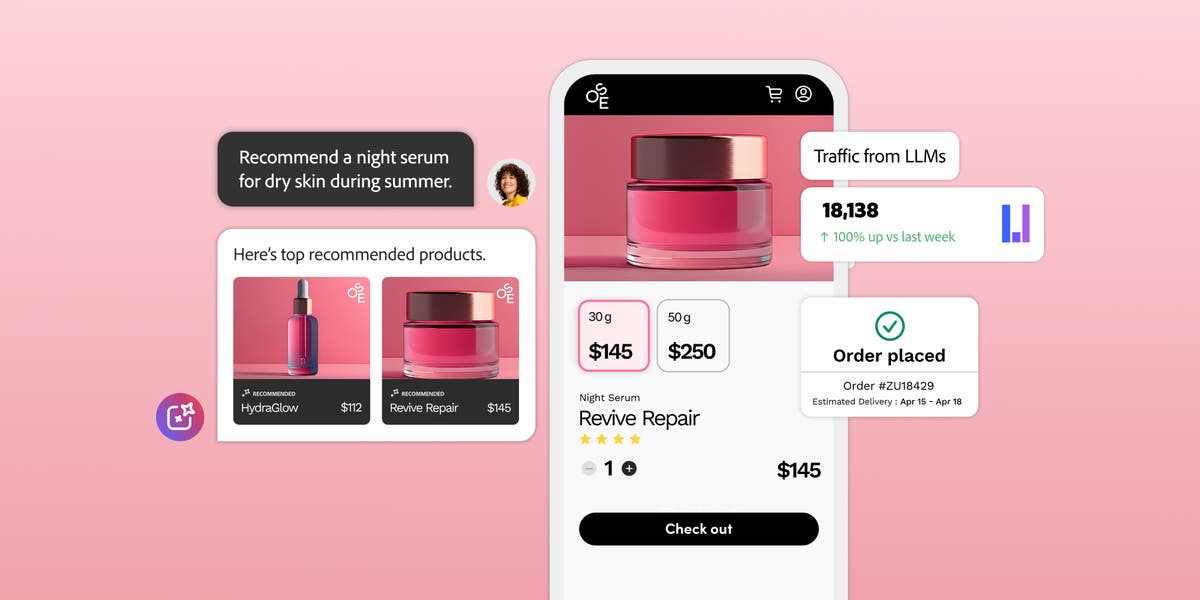
Learn how AI is transforming commerce and explore Adobe Commerce innovations that help brands improve discovery, shop front experiences and customer loyalty.
business.adobe.comAt Adobe Summit 2026 in Las Vegas, Adobe Commerce rolled out a broad set of updates it calls agentic upgrades. Rather than a handful of isolated features, they are framed as a coordinated lift across three surfaces at once: developer tooling, the storefront, and AI-driven discovery. The explicit objective is to compress time-to-value for enterprise retailers.
The announcements also land against a larger corporate backdrop. Adobe is rebranding Experience Cloud as CX Enterprise and going all-in on AI agents. Adobe Commerce is one of the clearest expressions of that strategy at the storefront level.
Why time-to-value matters now
Adobe Commerce, the platform rooted in the Magento lineage, has long carried a reputation for heavy implementations: layered PHP customizations, Luma-based themes, and migration projects often measured in quarters. In an era when AI-driven retail traffic grew 269% year-over-year in March 2026 by Adobe Digital Insights' own data, the pressure to move faster is acute. Every month spent re-platforming is a month competitors spend optimizing for LLM surfaces.
That is the competitive tension Adobe is trying to resolve. The new announcements aim squarely at shrinking implementation drag without forcing merchants to sacrifice the enterprise depth that differentiates the platform from off-the-shelf SaaS.
Commerce Developer Agent: rethinking the migration project
The centerpiece is the Commerce Developer Agent (coming soon), a suite of AI-powered developer tools. According to McFadyen Digital's breakdown, the agent family includes:
- Migration Assessment Agent: automatically inspects existing implementations and produces readiness reports, risk analyses, and effort estimates.
- App Builder MCP: generates App Builder-compatible code from natural language prompts and refactors legacy in-process PHP extensions into out-of-process apps.
- Storefront Builder Agent: automates the hard part of modernization — migrating from Luma templates to Edge Delivery Services.
- API-First Data Migration Framework: enables incremental, controlled data transfers instead of risky cutover events.
Per Adobe's developer documentation, the tooling is IDE- and LLM-agnostic, working with Cursor, VS Code, Claude, Kiro, and GitHub Copilot, and validates output against Core Web Vitals and Adobe best practices.
What is notable is the conceptual shift: Adobe is reframing migration from a human project to an agent-assisted process. Work that previously took weeks of manual discovery and refactoring can now be drafted by agents, with humans reviewing and finalizing.
Storefront and AI discoverability
Alongside developer acceleration, Adobe is pushing the storefront itself into an agentic posture across three layers.
On the discovery layer, PDP Enrichment adds a hidden semantic layer to product detail pages, surfacing variants, specs, and use cases in a machine-readable format LLMs can cite. The human shopping experience is unchanged. Product Catalog AI Enrichment then rewrites names and descriptions to improve the odds of being recommended by an LLM.
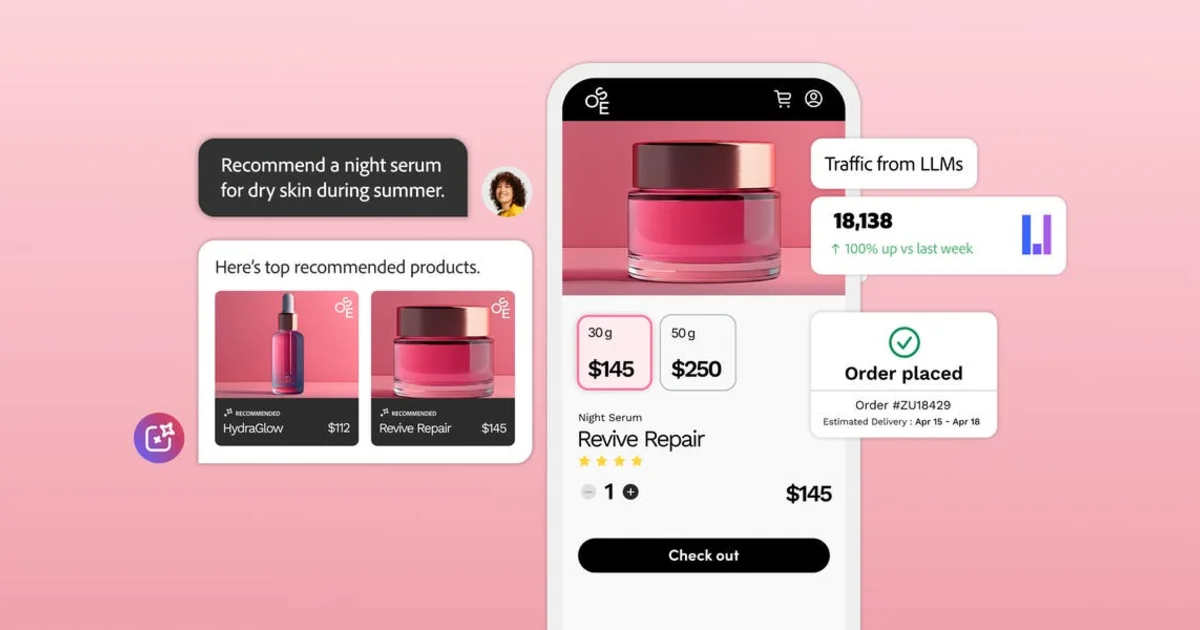
On the conversational layer, Brand Concierge becomes native to Adobe Commerce. Shoppers can move through recommendations, comparisons, order tracking, and checkout inside a single conversational UI. Adobe is extending Brand Concierge's reach further through partnerships with [24]7.ai, Algolia, and Netomi.
On the connection layer, the Commerce MCP Server exposes catalog, cart, pricing, inventory, promotions, checkout, order management, and post-purchase flows via a standardized, secure interface. Merchants can either build their own shopping assistants, voice agents, or upsell bots, or integrate with third-party agents. Adobe also announced support for Google's Universal Cart Protocol and PayPal's transaction protocols, layered on top of previously announced UCP and ACP support.
How this fits into Adobe's broader agentic roadmap
Today's announcements extend a string of earlier moves rather than starting from scratch.
| Timing | Announcement | Positioning |
|---|---|---|
| Jan 2026 (NRF) | GA of AI agents and Commerce Optimizer | Operational optimization layer |
| Feb 2026 | Commitment to UCP and ACP | Alignment with agent payment protocols |
| Apr 2026 (Summit) | Commerce Developer Agent / MCP Server / Brand Concierge integration | Agentic implementation across dev and storefront |
| Apr 2026 (Summit) | Rebrand to CX Enterprise | Company-wide agentic AI strategy |
Each prior step laid a piece of infrastructure — the optimization layer, then the protocol compatibility. Summit 2026 is the moment the pieces hit the shop floor, where developers and shoppers actually interact with them.
Implications for Shopify, SAP, and commerce leaders
In enterprise commerce, Adobe's direct comparisons are Shopify and SAP Commerce Cloud. Shopify has been vocal about its agentic stack and has shipped MCP-adjacent capabilities earlier. With these updates, Adobe is attempting to close that gap on both developer experience and conversational shopping in a single release cycle.
SAP retains its strength in back-office integration and B2B depth. Notably, Adobe is not ceding B2B: it announced drop-in components (Company Accounts, Negotiable Quotes, Requisition Lists) and a B2B Starter Theme due April 26, 2026.
For enterprise merchants, three practical implications stand out:
- Existing Adobe Commerce or Magento customers should re-scope their migration roadmaps. The Migration Assessment Agent offers a quick way to quantify the work ahead.
- New platform evaluations should update the comparison axes. The old tradeoff between customization depth and launch speed is narrowing.
- Product data readiness for AI agents should start in parallel with platform decisions. PDP Enrichment and Brand Concierge only perform as well as the structured data that feeds them.
In closing
Adobe Commerce Summit 2026 showed that agentic commerce is moving from protocols to implementation. Commerce Developer Agent, Commerce MCP Server, and native Brand Concierge are not standalone features so much as different facets of a shop built for AI agents.
What to watch next: the real-world time-to-value numbers from early customers, and how Shopify and other enterprise vendors respond. For merchants, the pragmatic move is to shore up protocol readiness and product data quality while carefully reassessing where their platform should sit a year from now.