The Agent-to-Agent Era of eCommerce: When Consumer AI Meets Brand AI
Based on eDesk CEO Gareth Cummings' analysis, we explore the emerging Agent-to-Agent era where consumer AI agents directly interact with brand AI agents. Conversational AI is replacing point-and-click workflows, accelerating the shift toward Resolution-First models.

Key Takeaways
- Conversational AI drives measurable results: Walmart's AI users place 35% larger orders, and eDesk customers resolve 73% more inquiries without adding headcount
- In 2026, the "Agent-to-Agent" era begins in earnest as consumer AI agents directly interact with brand AI agents
- The shift from traditional point-and-click eCommerce to "Resolution-First" models where AI autonomously handles inventory checks, delivery, and returns is urgent
Conversational AI Is Fundamentally Transforming eCommerce Customer Experience
The rise of agent-to-agent eCommerce and the resolution-first support approach
www.unite.aiIn a recent Unite.AI article, eDesk CEO Gareth Cummings describes a seismic shift in eCommerce customer support. Customers now expect instant responses, personalized experiences, and seamless support across multiple channels as standard. With global eCommerce sales projected to reach $6.3 trillion in 2026, businesses must deliver consistent experiences across Amazon, eBay, Shopify, Instagram DMs, WhatsApp, and every other channel.
Traditional point-and-click workflows cannot accommodate this multi-channel reality. Rigid predetermined paths, lack of real-time order integration, and poor scalability for complex queries create fundamental limitations. Conversational AI addresses these challenges by providing consistent brand voice across all channels while maintaining personalized customer experiences.
The results speak for themselves. Walmart revealed in its latest earnings call that customers using its AI shopping assistant "Sparky" place orders approximately 35% larger than those who don't. eDesk's data across 300+ marketplaces, webstores, and social channels shows that businesses using AI capabilities resolve up to 73% more customer inquiries without adding headcount, with AI chatbots associated with approximately 4x higher conversion rates.
When the Consumer Agent Meets the Brand Agent
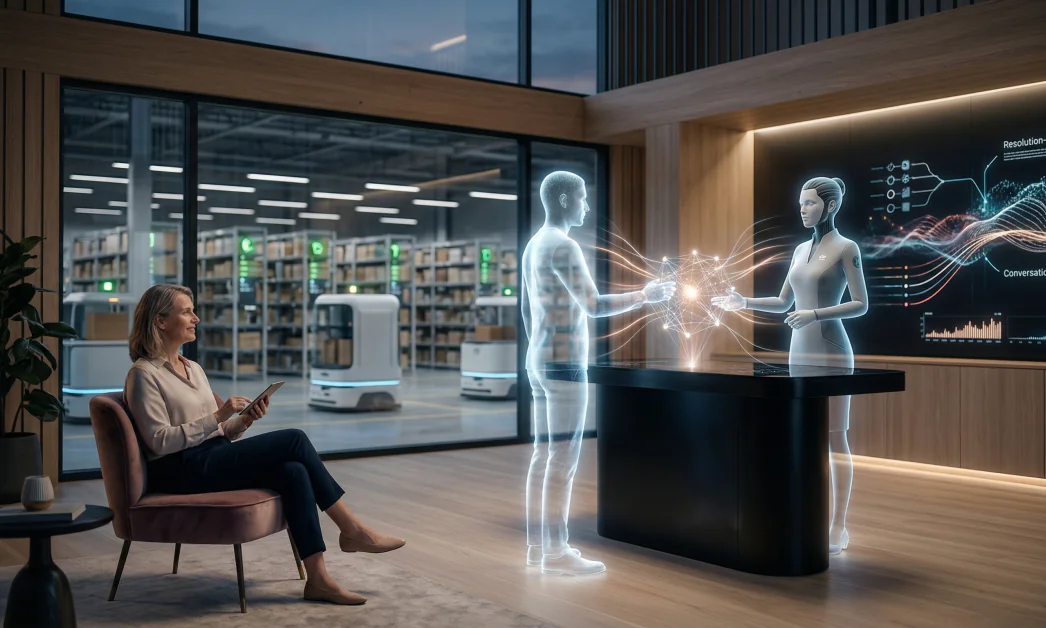
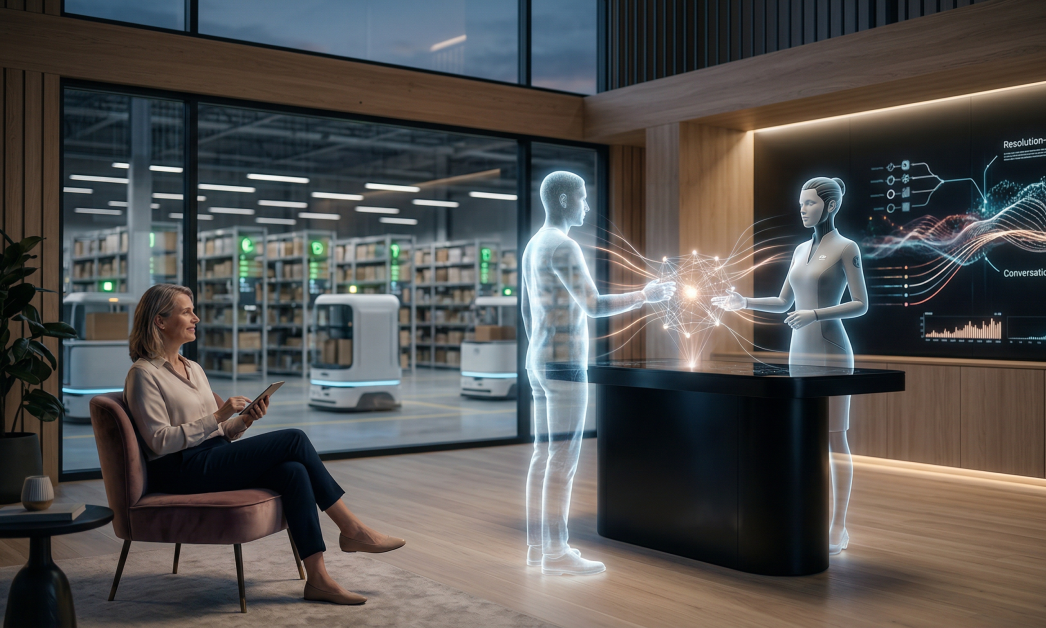
The evolution of conversational AI extends beyond human-to-AI interactions. Cummings points out that in 2026, a meaningful share of customer interactions will become agent-to-agent -- where a consumer's own AI agent directly exchanges data with a brand's AI agent.
The technology enabling this is already in market. OpenAI's Agentic Commerce Protocol (ACP) is an open protocol for eCommerce businesses to implement product search and purchase flows through ChatGPT. Meanwhile, Google's Universal Commerce Protocol (UCP) aims to standardize purchasing experiences through Google Search AI Mode and Gemini.

Google Cloud's vision for the agentic commerce era, adopted by Kroger, Lowe's, Papa John's, and more
cloud.google.comAt NRF 2026 in January, Google Cloud announced "Gemini Enterprise for CX," providing an AI agent platform that manages everything from product discovery to post-purchase support in a single platform. Kroger, Lowe's, Papa John's, and Woolworths are already onboard.
What Cummings emphasizes is a fundamental change in speed. Conversations that once took minutes are gradually collapsing into sub-second machine-to-machine exchanges. Retailers with unified data foundations can meet machine customers seamlessly, but those with fragmented systems won't even be able to participate.
The Shift to Resolution-First Models
The point-and-click model has dominated eCommerce for over two decades, but it has fatal limitations for modern consumer demands. Cummings argues that the industry is in a transition phase toward Resolution-First models -- where AI autonomously checks stock, confirms delivery times, and processes returns.
The customer is no longer just a human with a mouse but increasingly an AI agent. These machine customers aren't browsing websites; they're exchanging data.Source: Gareth Cummings, eDesk CEO
According to McKinsey's research, AI-powered personalization can enhance customer satisfaction by up to 20%. However, traditional "bolted-on" AI -- single-channel chatbots and automated email triggers -- is insufficient to retain modern customers. Resolution-First models directly connect order data with customer support, enabling AI agents to fully understand the context of inquiries and resolve them instantly.
What eCommerce Businesses Should Do Now
The actions required to prepare for the Agent-to-Agent era are clear.
First, unify your data foundation. AI agents judge by data, not design. Product information, inventory status, order status, and customer history must be integrated in real-time and served in machine-readable formats.
Second, adopt protocols like ACP and UCP. As OpenAI and Google each advance their respective protocols, supporting at least one -- ideally both -- secures your purchasing channel through AI agents.
Third, build Resolution-First support infrastructure. By enabling AI to access order data and autonomously handle inventory checks, returns processing, and delivery tracking, human customer support teams can focus on more complex, high-value interactions.
Summary
The core message of Cummings' analysis is that eCommerce's competitive axis is shifting from "UI design for humans" to "data design that AI agents can understand and process." Data points like Walmart's 35% increase in order value and eDesk customers' 73% improvement in inquiry resolution demonstrate that conversational AI's effectiveness is already proven. The future where consumer AI agents and brand AI agents directly converse is no longer hypothetical -- it is a reality that many businesses will face this year.