AI Shopping Agent Showdown — ChatGPT, Rufus, Perplexity, and Alexa+ Compared
A data-driven comparison of the five major AI shopping agents — ChatGPT, Amazon Rufus, Perplexity, Alexa+, and Google AI Mode — analyzed through two lenses: search-first vs. purchase-first, and open vs. closed ecosystems.


Key Takeaways
- ChatGPT commands 900 million WAU but, after abandoning Instant Checkout, has pivoted to product discovery — ceding purchase completion to Perplexity and Rufus
- 79% of consumers rank accuracy as the top priority for AI shopping, and Rufus users convert at 3x the rate of non-AI sessions — yet only 17% of consumers trust AI enough to complete a purchase
- The competitive landscape is defined by two axes — "search-first vs. purchase-first" and "open vs. closed" — and e-commerce businesses must understand this structure to prioritize their multi-platform strategy
AI Shopping Agent Comparison — Reading the 2026 Competitive Landscape
In March 2026, OpenAI effectively abandoned Instant Checkout, the flagship commerce feature of ChatGPT. Six months after launch, only about 30 merchants had gone live. A Walmart executive revealed that purchase conversion rates within ChatGPT were one-third of those on Walmart.com.
That same month, Amazon Rufus rolled out its Auto Buy feature, enabling fully autonomous purchasing when prices drop below a user-set threshold. Perplexity continued expanding its merchant base while maintaining zero fees, and Alexa+ — now free for all Prime members — saw shopping activity triple.
The agentic commerce race has moved beyond "can AI help you buy things?" to "which AI do you trust enough to buy from?" This article maps the major AI shopping agents along two axes — search-first vs. purchase-first, and open vs. closed — to help e-commerce businesses chart their strategy.
Search-First vs. Purchase-First — How Design Philosophy Shapes the Experience
The most critical lens for understanding AI shopping agents is whether the agent starts from "researching" or from "buying."
ChatGPT and Perplexity are search-first by design. When a user types "I'm looking for noise-canceling headphones under $300," the AI compares products across multiple brands, synthesizes reviews and pricing data, and delivers recommendations. Both use conversation to narrow options, but their paths diverge sharply at the point of purchase.
Perplexity maintains in-chat checkout through its PayPal partnership, offering Pro subscribers one-click purchasing and free shipping. According to Shopify's analysis, Perplexity shoppers have an average order value 57% higher than those on other AI platforms. While its 45 million monthly users represent a fraction of ChatGPT's reach, Pro subscribers skew affluent — 80% college-educated, 65% high-income — which explains the outsized AOV.
ChatGPT, after the Instant Checkout retreat, launched enhanced visual search and product comparison features in March 2026. Major retailers including Target, Sephora, Nordstrom, Lowe's, Best Buy, and The Home Depot now feed product data into ACP, and ChatGPT's 900 million WAU make it the largest product discovery surface in AI. However, purchases complete through an in-app browser that redirects to merchant sites via Shopify — a less seamless experience than Perplexity's integrated checkout.
Amazon Rufus and Alexa+ stand in stark contrast as purchase-first agents. When users open the Amazon app, buying intent already exists; the AI's job is to accelerate the "what to buy" decision. Rufus drives an estimated $12 billion in incremental annual sales, reaching over 300 million customers. Purchase sessions involving Rufus convert at more than 3x the rate of non-AI sessions, a figure that underscores this structural advantage.
Why Instant Checkout Failed
ChatGPT's Instant Checkout retreat is the most instructive case study for understanding where AI shopping agents stand today.
Forrester titled its analysis "What It Means That the Leader in Agentic Commerce Just Pulled Back". The failure had three structural causes that compounded each other.
First, the absence of inventory management infrastructure. Forrester described this gap as "disastrously absent from the plan." OpenAI lacked a system for reflecting real-time inventory and pricing data accurately. Product information scraped from the web was unreliable, leading to order failures and user frustration.
Second, tax compliance gaps. As of February 2026, OpenAI had not built a system for collecting and remitting state sales taxes across the U.S. — a fundamental requirement for any commerce platform processing millions of transactions.
Third, the conversion wall. Users browsed in enormous numbers but did not buy. Walmart's EVP confirmed that ChatGPT's in-app purchase conversion rate was one-third of Walmart.com. Even with 900 million users, OpenAI could not breach the trust barrier of "buying through this AI."
What this failure revealed is that conversational AI capability and commerce operations capability are entirely different muscles. Finding and recommending products is one thing; managing accurate inventory, processing taxes, tracking shipments, and handling returns is another. The infrastructure Amazon built over decades could not be replicated in six months.
Open vs. Closed — The Platform Strategy Divide
| Feature | ChatGPT | Perplexity | Amazon Rufus | Google AI Mode |
|---|---|---|---|---|
| Monthly Reach | 900M WAU | 45M MAU | 300M users | Shown on 14% of queries |
| Checkout Model | Redirect to merchant | In-chat (PayPal) | Amazon-native | Google Pay / redirect |
| Merchant Fees | 4% (ACP) | 0% | Standard Amazon fees | CPC ads |
| Strength | Massive reach | High AOV & search accuracy | Inventory, logistics, trust | Product data scale |
| Weakness | Checkout drop-off | Small user base | Closed ecosystem | Ad dependency |
The second critical axis is whether the agent traverses the open web or operates within a closed ecosystem.
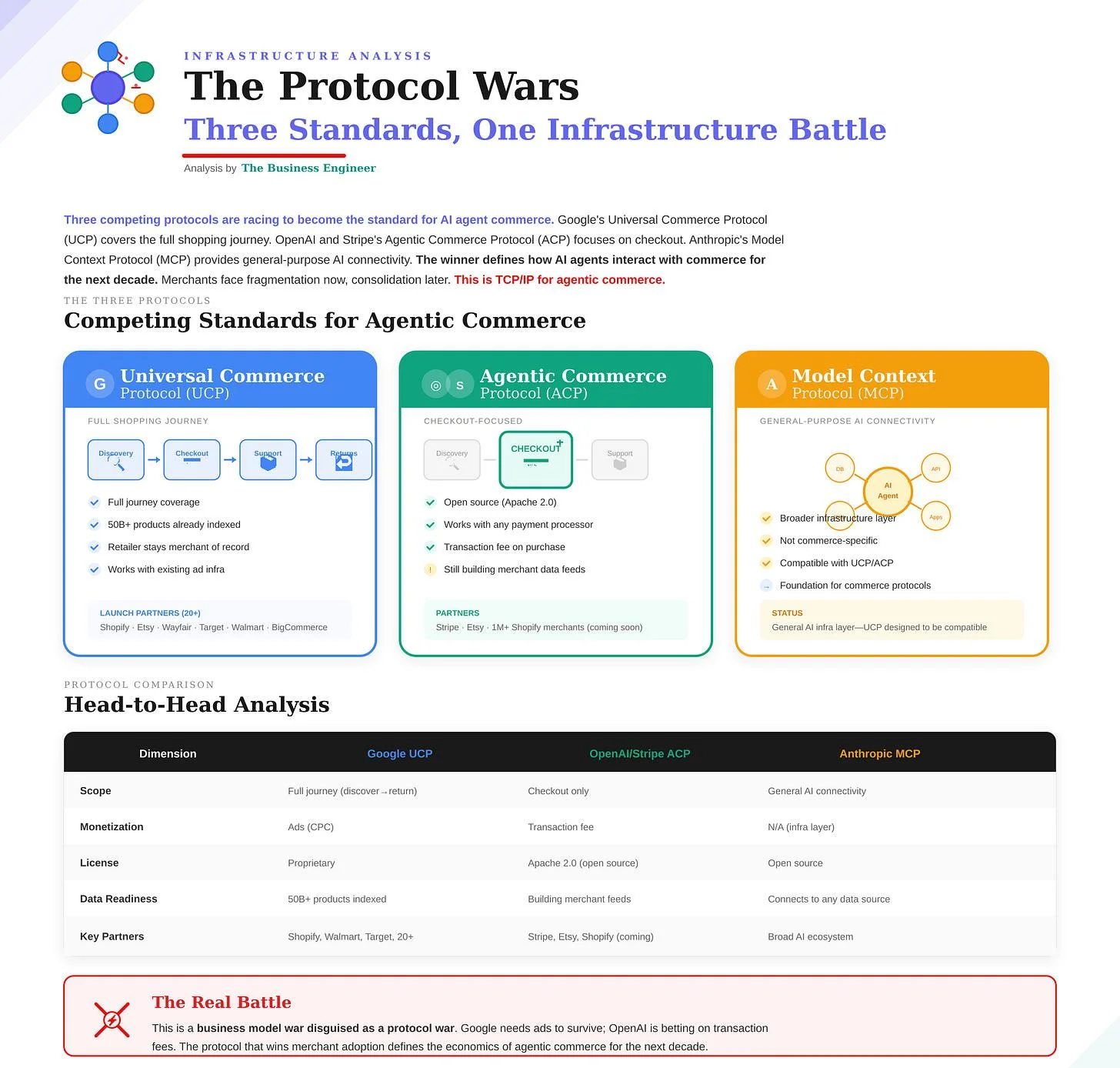
Perplexity, ChatGPT, and Google sit in the "open" camp. They search and compare products across multiple retail sites, presenting users with cross-platform options. Google's Universal Commerce Protocol (UCP) has secured endorsement from over 20 companies, and its Shopping Graph — containing over 50 billion product listings with 2 billion refreshed hourly — provides the data backbone. Google AI Mode already appears on 14% of shopping queries, and agentic checkout enables automated purchasing through Google Pay.
What sets Google apart from other open players is the scale and freshness of its product data. While ChatGPT and Perplexity rely on web scraping and merchant data feeds, Google maintains a real-time structured product database. This data advantage is precisely what Instant Checkout lacked.
Amazon takes the opposite approach with its thoroughly closed strategy. It blocked 47 AI crawlers and pursued legal action against Perplexity's Comet browser agent. Inside its walls, Rufus handles product discovery, Buy for Me pulls in external products, and Alexa+ automates everyday purchasing. Three agents covering different funnel layers, designed to eliminate any reason for consumers to leave.
Which strategy wins? In the short term, closed has the edge. Bain's 2026 research found that consumers trust retailers' on-site AI agents 3x more than third-party agents like ChatGPT or Perplexity. Amazon's AI, operating within a familiar environment, inherits that trust.
Over the medium term, however, open protocol adoption could shift the balance. As Shopify, Walmart, and Target join UCP and API standardization advances, consumers may gain the ability to access optimal products without being locked into a single platform.
The Trust Wall — Consumers Are Not Yet Ready to "Buy Through AI"
Despite rapid technological progress, consumer trust has not kept pace. This trust gap is the most fundamental factor shaping the 2026 AI shopping competition.
A global study found that only 17% of consumers feel comfortable completing a purchase through AI. Another 27% use AI tools for research but make the final decision themselves, while 33% don't use them at all. When asked what matters most in AI-powered shopping, 79% cited accuracy — far ahead of speed (36%) or transparency (35%).
This trust structure directly explains each agent's performance. Rufus converts at high rates because Amazon's inventory, pricing, and review data is accurate in real time. Instant Checkout failed because it could not guarantee this accuracy. Perplexity achieves high AOV because its sourced recommendations earn the trust of information-savvy users.
Another noteworthy data point: McKinsey's 2026 AI trust report identifies trust-building as the central challenge in the shift to agentic AI. Moving from "AI recommends" to "AI buys on your behalf" requires not just accuracy but safety nets — return handling, personal data protection, and safeguards against unintended purchases.
Microsoft Copilot Checkout takes an interesting approach to this trust gap. Shopping journeys through Copilot show a 33% reduction in time-to-purchase and a 53% increase in purchase rates — results that benefit from the existing trust consumers place in Microsoft's enterprise platforms (Microsoft 365, Azure). The logic: "If I trust Microsoft for work, I can trust it for shopping."
A Platform Selection Guide for E-Commerce Businesses
Based on the analysis above, the right approach for e-commerce businesses is not "support everything" but prioritize based on your product characteristics and target customers.
High-consideration, high-value products (electronics, jewelry, specialty equipment) should prioritize Perplexity and ChatGPT. In these search-first agents, users conduct extensive research before purchasing, so providing detailed structured specs, reviews, and comparison data is the key to earning AI recommendations. Perplexity's Merchant Program charges zero fees, eliminating the barrier to entry.
Everyday, repeat-purchase products (groceries, consumables, personal care) should prioritize Amazon ecosystem optimization. Rufus's conversion uplift and Alexa+'s 3x shopping activity increase demonstrate Amazon's overwhelming strength in "buy without thinking" categories. In the grocery segment, predictive replenishment integration is already underway.
Regardless of product category, structured data preparation is the universal priority. Product Schema, Offer Schema, structured review data — without these, no AI agent will consider your products for recommendation. Shopify merchants can connect to ChatGPT (ACP), Perplexity, Google (UCP), and Microsoft (Copilot Checkout) with relatively modest additional effort.
Most importantly, set up measurement for AI channel traffic now. Use GA4 custom channel groups to identify referrals from Perplexity, ChatGPT, Gemini, and Copilot, and track AOV and conversion rates by channel. The data will tell you which AI agent delivers the best ROI for your business.
Conclusion
The AI shopping agent race, as the Instant Checkout failure illustrates, has exposed just how difficult it is to make consumers "buy through AI." Even ChatGPT with its 900 million users could not complete the commerce loop without operational infrastructure. The current leaders are Amazon Rufus — backed by decades of inventory, logistics, and trust — and Perplexity, which captures high-value shoppers through search accuracy and zero fees. But with 83% of consumers still not fully trusting AI-driven purchases, this competitive map is far from settled. The question is not about technology. It is about who earns the consumer's trust first.