Alibaba Integrates Qwen with Taobao: 4 Billion Products Become Conversational
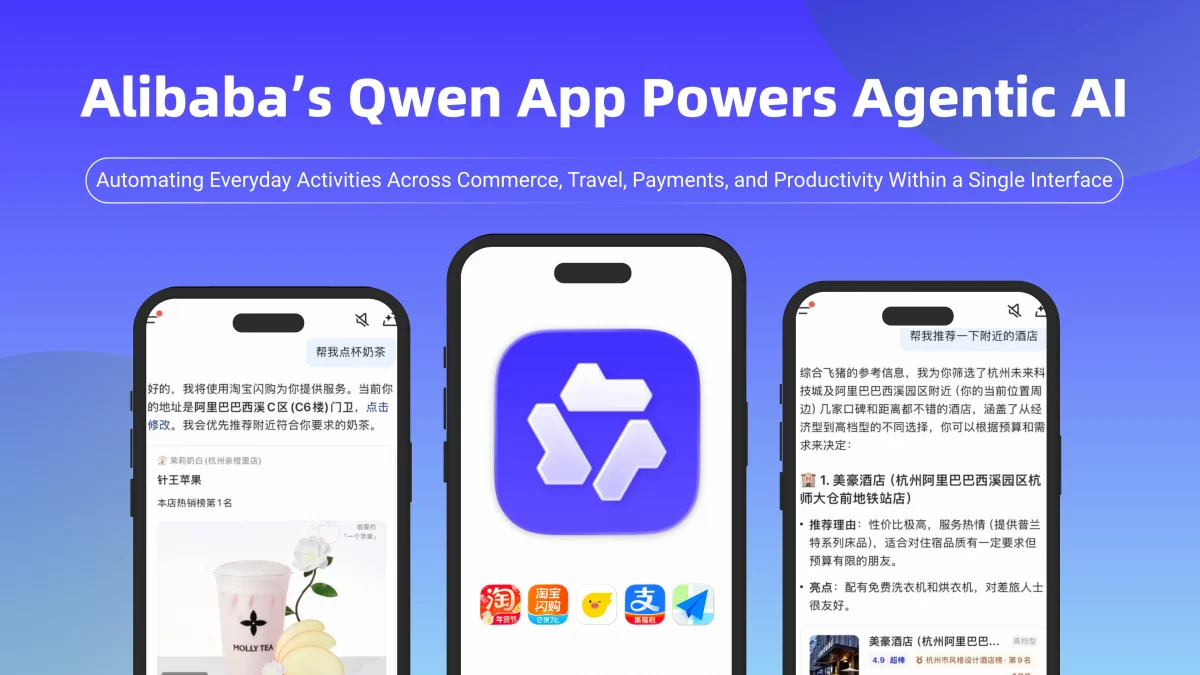
Alibaba is integrating its Qwen AI with Taobao and Tmall, exposing a 4-billion-product catalog to chat-based agentic shopping. Inside the launch, the contrast with Amazon and Shopify, and what it means for cross-border sellers.

Key Takeaways
- Alibaba is opening the combined Taobao and Tmall catalog of more than 4 billion products inside its Qwen AI app, letting shoppers search, compare, and buy through conversation instead of keyword search
- A Qwen-powered shopping assistant is also being placed inside Taobao itself, complete with virtual try-on tools and 30-day price tracking
- Unlike Amazon and Shopify, China's model permits full agent autonomy inside live transactions, a structural difference that cross-border and global sellers cannot afford to ignore
Alibaba's Bet on the End of Keyword Search

Alibaba is preparing to unveil the integration of its AI platform Qwen and online marketplace Taobao, a move that seeks to drive shopping with conversations rather than keyword searches.
www.reuters.comOn May 10, 2026, Reuters reported, citing a source familiar with the plan, that Alibaba is preparing to roll out a deep integration between Qwen, its consumer AI assistant, and Taobao and Tmall, its flagship e-commerce marketplaces. The shift moves online shopping from typed keywords to a chat with an agent.
Users will no longer have to scroll product listings manually. Telling Qwen "I need a lightweight folding umbrella I can take on a trip to Japan" should be enough to have the agent narrow down candidates, compare options, and walk the user to checkout. Analysts cited by the South China Morning Post call this a clear pivot to "conversational shopping."
The scale is what makes the announcement weighty. The Qwen app will have access to the entire Taobao and Tmall catalog of more than 4 billion products, backed by a "skills library" that handles logistics and after-sales services. Recommendations based on order history and shopping preferences are woven into the conversation itself.
The timing fits a strategy Alibaba has been advancing since the start of the year. The company has been positioning Qwen as the AI gateway into every part of its ecosystem, from food delivery and travel booking to movie tickets. The e-commerce flagship was the missing piece.
Inside the Implementation: Two Surfaces, One Engine
Read carefully, the Reuters report describes two distinct experiences. They are worth separating.
The first is the Qwen-app-as-shopping-entry-point path. Inside the Qwen app, the agent talks to consumers and traverses Taobao and Tmall on their behalf, making Qwen the de facto storefront.
The second is a Qwen-powered shopping assistant embedded inside Taobao itself. Both Reuters and Economic Times report that this surface ships with virtual try-on and 30-day price tracking tools — capabilities aimed squarely at the friction points existing Taobao shoppers already feel.
The "skills library" behind both surfaces is more than a product search engine. It is built to invoke APIs and operational systems for fulfillment, delivery tracking, and returns. Viewed as an automation layer running underneath the conversational UI, it shows what agentic commerce actually requires to work at retail scale.
Alibaba had not issued an official statement as of Reuters' filing. SCMP suggested the formal unveiling may come at an industry event around May 15, so confirmation of final details is still pending.
Connecting the Dots With Accio Work
Reading this announcement in isolation misses the point. On May 4, 2026, Alibaba launched "Accio Work," an agentic AI workspace on its B2B wholesale platform that lets buyers move from supplier discovery to quoting and contracting through conversation.
The pattern becomes clear with the consumer-side reveal a week later. Alibaba is consolidating both its B2B and B2C surfaces into a single AI assistant called Qwen.
This aligns with the guidance CEO Eddie Wu shared at the March earnings call, where he targeted $100 billion in cloud and AI revenue over five years. Bloomberg has reported that recent quarterly profits dropped sharply, which makes monetizing AI an urgent investor conversation, not just a long-term ambition. Repositioning Qwen from a chatbot into "the gateway every Alibaba transaction passes through" is the structural answer.
April also saw Qwen's first external partnership with China Eastern Airlines, which lets users search, book, choose seats, and check in for flights via natural-language chat. Each of these moves nudges agent-led transactions closer to mainstream consumer behavior.
The Sharp Divide With U.S. Platforms
Reuters identifies a substantive design gap between Chinese and Western platforms.
The Chinese model permits AI to be embedded directly inside live transactions. Because the platform itself owns payments, logistics, and after-sales service, agents can be granted authority to close purchases from day one. Alipay for payments, Cainiao for logistics, four-billion-item catalog under one roof — that vertical stack is what makes the design tractable.
The U.S. side is more fragmented. Amazon's Rufus assistant reportedly grew past 300 million users by the end of 2025 and drove around $12 billion in incremental annualized sales, but Reuters notes Amazon remains cautious about full autonomy. PYMNTS has reported Amazon is also weighing a hybrid mode that surfaces conversational AI summaries directly above traditional search results, so the assistant is not boxed off into a separate destination.
Shopify takes a different stance again. Rather than running its own consumer AI platform, Shopify lets external agents — ChatGPT, Microsoft Copilot, Google — sell from a single system of record. Shopify's Q1 2026 earnings showed AI-driven traffic to its stores grew 8x year over year, with orders from AI search up roughly 13x. The "be the rails, not the agent" bet appears to be working.
OpenAI and Google have also been wiring up partners like Etsy and Shopify so users can complete purchases inside ChatGPT and Gemini, according to Huayuan Securities research cited by SCMP. None of these arrangements yet match Alibaba's structure, where conversation, catalog, payment, and logistics all close inside a single company.
The difference is structural more than technical. The Chinese model trades consumer freedom for the ability to fully delegate to an agent. The U.S. model trades agent authority for openness across platforms. Neither outcome has been settled by the market.
What It Means for Cross-Border and Global Sellers
The impact on sellers outside China is uneven, but no operator can afford to ignore the trend.
For cross-border sellers using Tmall Global or other China-facing channels, the immediate question is whether their products surface inside Qwen's conversation. The competitive battleground shifts one layer up — from search ads and SEO to "does the agent narrow you in." Product names that read cleanly in natural language, structured specs, reviews, Q&A, and price history are becoming entry tickets to the recommendation slot.
Sellers operating outside China are also implicated. The skills-library pattern — agents calling logistics, payment, and returns systems directly behind the conversation — is the same direction emerging globally as Agentic Commerce Protocol (ACP) and Google's AP2 spread through Amazon and Shopify. Our overview of agentic commerce and the MCP vs A2A vs AP2 comparison lay out the broader picture worth reading alongside this announcement.
There is one more thread. Consumer behavior is moving from "type a keyword" to "ask for advice," which changes how brand preference forms. Walmart's Instant Checkout pilot with OpenAI saw conversion rates fall to roughly one-third of external-link rates inside ChatGPT, a reminder that agentic commerce monetization is still an unsolved problem. Alibaba's mass rollout will effectively be one of the largest live experiments yet to test that question.
Conclusion
The Qwen-Taobao integration signals the main event in Alibaba's strategy of making Qwen the AI gateway across its businesses. The four-billion-product catalog plus payments, logistics, and after-sales under one roof is precisely the vertical stack that makes embedded agentic shopping feasible — a structurally different starting point from Amazon and Shopify.
Cross-border sellers face a new competitive axis built around being chosen by the agent. Global sellers face a sharper strategic choice: how far to open their own platforms to external agents, or whether to ride someone else's. There is a real possibility that whatever ships in China defines the default UX of agentic commerce worldwide.