Alipay Launches User-Approved AI Agent Payments — Agentic Commerce Scales to 100M+ Users in China
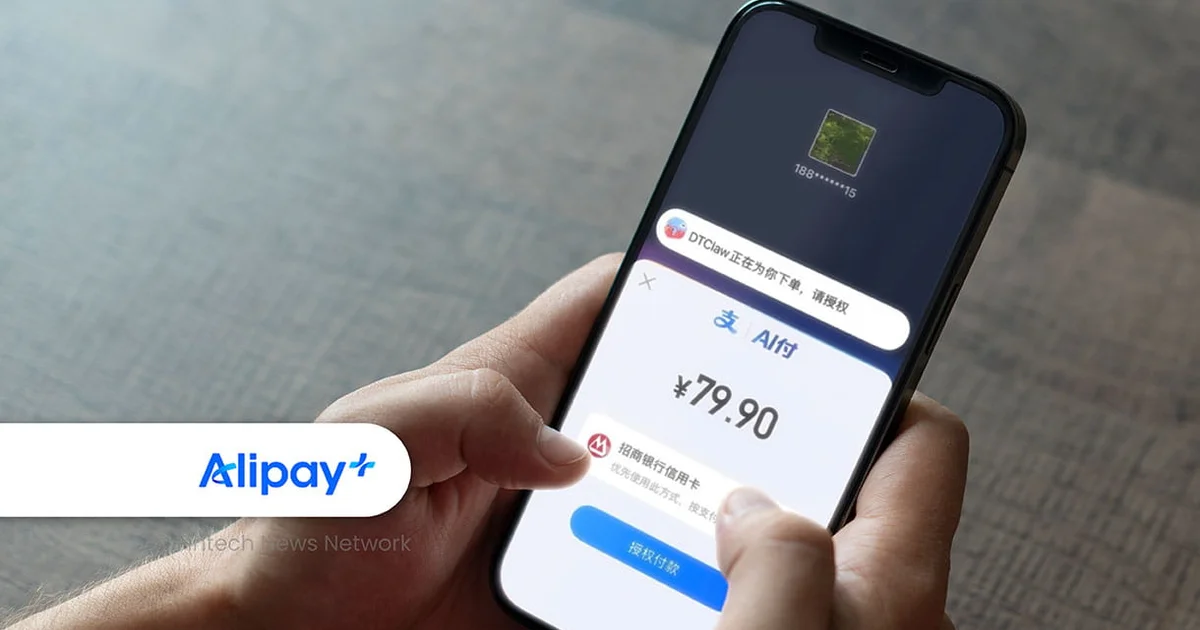
Alipay officially enables OpenClaw-type AI agents to complete user-approved payments via Alipay AI Pay, now integrated with JVS Claw, DTClaw, Claude Code, and Hermes Agent. The service hit 100M users and processed 120M transactions in a single week of February 2026, positioning China's answer to ACP, AP2, and x402.

Key Takeaways
- Alipay has officially launched AI agent payments with explicit user approval, letting OpenClaw-type agents complete purchases and settle transactions end-to-end
- Built on Alipay AI Pay (2025), the service surpassed 100M users and processed 120M+ transactions in a single week during Chinese New Year 2026, with integrations across JVS Claw, DTClaw, Claude Code, and Hermes Agent
- Amid a crowded protocol landscape — ACP (OpenAI), AP2 (Google), x402 (Coinbase) — China now has its own large-scale commercial template for agent-driven payments
From Recommendations to Agents Actually Opening the Wallet

Alipay has added a payments capability to its AI agent ecosystem, letting OpenClaw-type agents complete purchases with explicit user approval. Built on Alipay AI Pay (2025), requires agent installation, identity verification, per-transaction authorization.
letsdatascience.comAlipay has formally extended its agentic commerce stack with a payments capability that lets OpenClaw-type AI agents complete purchases and settle transactions on behalf of users — with explicit, per-transaction approval.
Until now, most discussions of "agentic commerce" have stopped short of the final mile. ChatGPT's Instant Checkout and Perplexity's shopping flows largely end with a human pressing a button. What makes this announcement significant is that Alipay is stepping into that last mile — agents themselves executing payments, with user consent, at commercial scale.
The underlying service, Alipay AI Pay, originally launched in 2025 but its scale is now fully visible. In the single week of February 5 to 11, 2026, it processed more than 120 million transactions. In the same month, user count surpassed 100 million. Chinese New Year demand played a role, but no other market has seen agent-initiated payments run at this kind of volume.
How Alipay AI Pay Works — and Its Safeguards
The user flow is straightforward but deliberately layered. Users first install Alipay AI Pay into a compatible agent, enable the payment function, and complete identity verification. That is the one-time setup.
In day-to-day use, every transaction triggers a user confirmation step. Even after the agent assembles an order, the user can modify or cancel it through a simple command before settlement. The safeguards Alipay highlights include:
- Authentication and consent: user-initiated activation, identity verification, and per-transaction payment authorization
- Risk controls: 24/7 risk control system plus an extended Full Compensation account protection program
- Developer tooling: SDKs and APIs for payment integration, tipping, subscription billing, and agent-side payment flows
What matters here is that the safeguards are not a copy-paste of existing card-payment defaults. Agents introduce new attack surfaces — prompt injection, unintended autonomous purchases, social engineering targeted at the agent rather than the user. By combining per-transaction consent, 24/7 risk monitoring, and a full-compensation guarantee, Alipay is building the conditions under which users can actually delegate payment authority with confidence.
JVS Claw, DTClaw, and the Third-Party Agent Layer
Alipay AI Pay is no longer a standalone button. It is now embedded across a growing set of agent runtimes:
- JVS Claw — Alibaba Cloud's consumer-facing OpenClaw agent app, pre-installed with Alipay AI Pay
- DTClaw — an enterprise-oriented agent from Ant Group Digital Technologies, bundled by default
- Claude Code and Hermes Agent — third-party OpenClaw-type agents supported via integration
Alibaba Cloud's JVS Claw, opened to the public in March 2026, runs an AI assistant called Clawbot inside an isolated cloud environment called ClawSpace. Clawbot browses the web, handles files, shops online, books travel, and clears inboxes. With Alipay AI Pay pre-installed, the "buying" step happens inside the same conversation.
DTClaw targets enterprise use cases, while Claude Code and Hermes Agent extend the reach to global developer audiences. In other words, Alipay has wired payment rails into the consumer, developer, and enterprise layers of the agent stack at once.
The breadth of surfaces is equally striking. From traditional retailers like Luckin Coffee embedding agents into their apps and mini programs, to Rokid's smart glasses, to Alibaba's Qwen app, and now OpenClaw-type agents — Alipay AI Pay provides a unified payment layer regardless of agent form factor.
Positioning Alongside ACP, AP2, and x402
The agent-payments protocol landscape has clarified rapidly in 2026. As a rough sketch: ACP (Agentic Commerce Protocol) from OpenAI and Stripe standardizes checkout flows; AP2 (Agent Payments Protocol) from Google standardizes authorization and trust; x402 from Coinbase handles machine-to-machine settlement over HTTP using stablecoins.
Layer Alipay AI Pay onto this picture and the shape changes. Alipay AI Pay is less a protocol specification and more an implemented, vertically integrated payment service that bundles authorization, identity, and payment rails. On top of that, Ant Group launched the Agentic Commerce Trust Protocol in January 2026, already adopted by Alibaba's Qwen app and Taobao Instant Commerce. Execution and trust/authorization are both being captured by the same group.
Beyond fiat-rail payments, Ant Group's blockchain arm has already unveiled Anvita, a crypto platform purpose-built for AI agents that leans on x402 and USDC for machine-to-machine settlement. Human-approved payments run on fiat rails via Alipay AI Pay; agent-to-agent micropayments run on stablecoin rails via Anvita. A two-layer architecture is effectively coming into focus inside the same corporate group.
Implications for Merchants and Cross-Border Brands
For merchants outside China, this is not a distant story.
Brands running cross-border e-commerce or a local presence in China may find agent-driven traffic scaling faster than their reporting can catch. With 100M+ users and 120M weekly transactions already running through Alipay AI Pay, a portion of Chinese consumers are clearly shifting from "search and tap" to "ask the agent to buy it for me." Product data, inventory APIs, and shipping conditions that are not machine-readable will simply drop out of that flow.
Then there is protocol strategy for global expansion. ACP, AP2, x402, and now Alipay AI Pay. The realistic stance is not to bet on one protocol but to design APIs, product data, and authorization flows that can support multiple rails — with ACP and AP2 heavier in North America, x402 for crypto-native use cases, and Alipay AI Pay for China.
Finally, safeguards. The four-point pattern Alipay has landed on — user-initiated activation, per-transaction approval, 24/7 risk control, and full compensation — is shaping up to be the minimum trust contract merchants will be expected to surface to customers as agent payments spread. Your agent integration design should spell out, in concrete terms, where explicit consent is captured and who bears compensation responsibility.
Summary
What Alipay has demonstrated is that agentic commerce has moved from demo videos and pilots into 100-million-user commercial traffic. Agents executing payments is no longer a future scenario — in China, it is part of everyday life.
The next questions worth watching: how far Alipay AI Pay's APIs and SDKs will be opened to developers outside China, how interoperability with ACP, AP2, and x402 gets sorted out, and when global e-commerce brands will commit real engineering effort to agent traffic. Decisions made during this protocol-proliferation window will shape channel economics for years to come.