ChatGPT Ads Manager Now Supports Product Feeds: OpenAI's Commerce Pivot After Killing Instant Checkout
OpenAI moved product feed management into the ChatGPT Ads Manager after instant checkout shut down. A deep dive into why OpenAI pivoted from in-chat checkout to advertising, and how e-commerce brands should optimize product feeds for ChatGPT exposure.

Key Takeaways
- In June 2026, OpenAI migrated the product feed feature, once tied to the now-defunct Instant Checkout, into the ChatGPT Ads Manager, letting retailers auto-generate ads from their catalogs.
- The pivot follows Walmart's data showing in-chat checkout converted at one-third the rate of site-redirect purchases, pushing OpenAI to shift from transaction fees toward advertising budgets.
- For e-commerce brands, the same product feed already sent to Google Shopping can be reused for ChatGPT ads, while optimizing product data for conversational intent becomes a new path to winning exposure.
The Day OpenAI Moved Product Feeds Into the Ads Manager
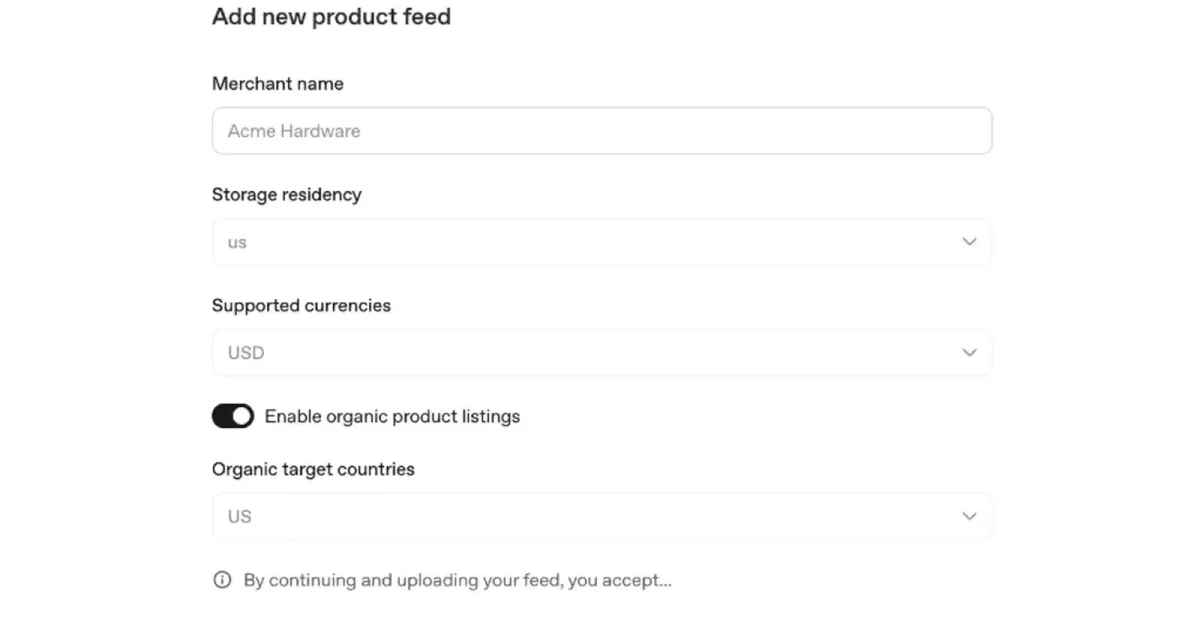
OpenAI migrated product feed management to the ChatGPT Ads Manager after instant checkout shut down in March, letting retailers auto-generate ads from catalogs.
ppc.landOn June 2, 2026, entrepreneur Juozas Kaziukenas shared an observation on LinkedIn: OpenAI had moved product feed management into its dedicated advertising interface, the ChatGPT Ads Manager. It looked like a minor screen reshuffle, yet the migration symbolized a genuine shift in OpenAI's commerce strategy.
A product feed is a structured data file describing attributes such as product name, price, image, and inventory. Until now, this feed was used inside ChatGPT to sharpen organic product discovery, surfacing relevant products in response to user questions. The new Feeds section in the Ads Manager asks merchants to enter a merchant name, choose a storage residency option and supported currencies, and toggle organic product listing participation before creating a feed.
What stands out is that the Ads Manager Beta interface already listed a feed entry dated March 1, 2026. In other words, the feature had been developing quietly well before its wider disclosure. The shift opens a path for catalog data to connect directly to paid campaigns, bridging a retailer's organic presence and its paid activity on the platform into a single flow.
Why OpenAI Killed Checkout and Steered Toward Advertising
This is the heart of the story. To understand why product feeds landed in the Ads Manager, you have to trace the fate of the discontinued Instant Checkout.
OpenAI launched Instant Checkout on September 29, 2025, through a partnership with Stripe. It let users buy products directly inside the ChatGPT interface. The technical foundation was the Agentic Commerce Protocol (ACP), an open standard co-developed by OpenAI and Stripe that defines how AI agents and businesses complete purchases, including a Shared Payment Token (SPT) mechanism that initiates payment without exposing buyer credentials. Product feeds were added that same September precisely to ingest accurate, current pricing data and to control which products were eligible for Instant Checkout.
Then, in March 2026, Instant Checkout was shut down. The decisive blow came from data Walmart disclosed publicly: conversion rates for products sold directly inside the chatbot were three times lower than those for users who clicked out to Walmart's own website. The episode laid bare a consumer instinct: AI chat excels at discovery and recommendation, but shoppers prefer to finish checkout on a retailer's familiar site.
OpenAI's response was clear. Rather than run its own checkout layer, it embedded Walmart's own Sparky chatbot inside ChatGPT. That left the product feed feature stranded. Very few merchants had ever connected a feed, and its only host, Instant Checkout, no longer existed.
The migration to the Ads Manager filled that structural gap. The same structured data is now used not for in-chat transactions but for automated ad generation. According to Kaziukenas, the move signals OpenAI's shift from taking a cut of transactions toward capturing the advertising budgets brands already allocate to platforms like Amazon and Meta.
OpenAI's revenue ambitions are aggressive. The company is targeting $2.5 billion in ad revenue in 2026 and $100 billion by 2030. With 800 million weekly active users and roughly 50 million shopping queries a day, advertising is a far larger and more scalable revenue source than transaction fees.
How Ads Are Generated From Product Feeds
The post-migration mechanics will feel familiar to anyone who has run Google Shopping. According to Digiday's reporting, retailers connect their catalog to ChatGPT, set filters for which products are eligible, and let the platform auto-generate ads from product names, images, and attributes. Brands no longer build campaigns product by product.
This automation matters most at scale. The system can handle up to one million SKUs per advertiser. Manually building ad creatives for a catalog that size is operationally impossible, but treating the structured data file as the creative source converts feed attributes into individual ad units automatically. The ad itself looks unchanged to a user, appearing below the response clearly labeled as sponsored, while the backend generation process is entirely new.
The barrier to entry is low. OpenAI currently asks new e-commerce partners to submit a sample of 100 products before sharing their full catalog, yet retailers can largely repurpose the same structured file they already send to Google, so there is no need to rebuild a feed. Yang Han, co-founder and CTO of StackAdapt, described the partner-side connection this way.
We have the same feature so once OpenAI supports it, we post our feed to their feed. And that's just an example of, like, a seamless connection.
StackAdapt is one of five technology partners, alongside Criteo, Kargo, Adobe, and Pacvue, and it joined the ChatGPT ad pilot on May 5, 2026. That same day, OpenAI opened its Ads Manager to all US businesses and dropped the minimum spend threshold entirely. For retailers running structured product data through such partners, a path into ChatGPT advertising is taking shape without requiring any new feed format.
Can Conversational Intent Drive Purchases?
Now that ChatGPT operates as an ad platform, the question the industry is watching most closely is whether conversational intent can drive commercial outcomes.
Google Shopping, Meta's catalog ads, and Amazon's sponsored products all run on behavioral signals from search and browsing. ChatGPT instead holds a different signal, the conversational intent a user reveals in dialogue. Debra Aho Williamson, founder and chief analyst at Sonata Insights, noted that auto-generating ads from a catalog is essentially table stakes in the age of AI and resembles what Google, Meta, and Amazon already offer; the difference is that ChatGPT serves ads based on conversational intent rather than search behavior.
Early numbers are not uniformly grim. Criteo, the first technology partner, connects roughly 17,000 advertiser clients to ChatGPT's Free and Go tiers, and over 1,000 brands are now running active campaigns. The company reported AI-referred conversion rates approaching twice those of traditional search in retail categories including consumer electronics, lifestyle and wellbeing, and home and garden, up from the 1.5x figure first reported in March. Even without in-chat checkout, AI can deliver strong results at the discovery and referral stage.
What E-commerce Brands Should Do for ChatGPT Exposure
Here is the practical part. The failure of Instant Checkout and the migration to the Ads Manager mark a shift for brands from "selling on ChatGPT" to "being discovered on ChatGPT." The moves to make fall roughly into three.
First, prepare and reuse your product feed. If you already run a feed for Google Merchant Center, that structured data transfers to ChatGPT ads almost as-is. Since the accuracy of product names, images, prices, and attributes feeds directly into ad creative quality, the fundamentals of shopping ads apply: specific keywords in titles, high-resolution images, and real-time inventory and price syncing.
Second, design product data with conversational intent in mind. Ads are inserted as users talk through contexts like "looking for a gift" or "want cosmetics for sensitive skin," not discrete search keywords. Weaving use cases, target audiences, and problems solved into product attributes and descriptions helps you match the flow of conversation, a new optimization axis distinct from traditional SEO or paid search.
Third, choose your entry route. Beyond using the Ads Manager directly, you can connect through technology partners such as Criteo or StackAdapt. If you already run shopping campaigns on those platforms, you can reach ChatGPT advertising by the shortest path without a new feed format. Given the current 100-product sample requirement, starting with a pilot of your hero products is the pragmatic move.
It is worth noting that Instant Checkout has not vanished entirely. The ACP open standard lives on, and the payment-side ecosystem, including PayPal's ACP server, continues to expand. In-chat checkout and advertising are likely to coexist with divided roles rather than one replacing the other.
Conclusion
OpenAI's latest move reflects the realistic trajectory of AI commerce. The ideal of completing everything inside the chat was pulled back by the hard reality of Walmart's conversion data, settling instead into a division of labor: discovery and referral in conversation, checkout on the retailer's site, and revenue from advertising. For e-commerce brands, the question is no longer whether they can sell on ChatGPT but how they can be discovered in the flow of conversation. Whether the existing asset of a product feed honed for Google holds up on this new battleground, and whether the near-2x conversion rates emerging via Criteo prove durable, is something the next few quarters of real numbers will reveal.