Deeplumen Launches Open Commerce Protocol, Challenging Agentic Commerce Infrastructure Standards
Deeplumen announces OCP, a full-stack infrastructure for AI agents. The M2AI pioneer aims to standardize agentic commerce with a Schema Contract Layer.

Key Takeaways
- Deeplumen launches OCP as a "Schema Contract Layer" to standardize how AI agents discover, negotiate, and settle commerce transactions
- OCP completes the M2AI (Marketing to AI) full-stack alongside UCP for Java and Agentic Page
- OCP takes a distinct approach from Google's UCP and OpenAI's ACP by building natively on the OpenClaw ecosystem
Deeplumen Launches Open Commerce Protocol for AI Agents
Deeplumen announced the launch of Open Commerce Protocol (OCP), a full-stack infrastructure layer for agentic commerce.
www.prnewswire.comOn March 30, 2026, M2AI (Marketing to AI) infrastructure company Deeplumen announced the launch of the Open Commerce Protocol (OCP). OCP is a "Schema Contract Layer" that enables AI agents to autonomously discover products, negotiate terms, and execute payments on behalf of users. Built as the first open protocol within the OpenClaw ecosystem, it aims to establish a new infrastructure standard for agentic commerce.
The M2AI Paradigm Shift
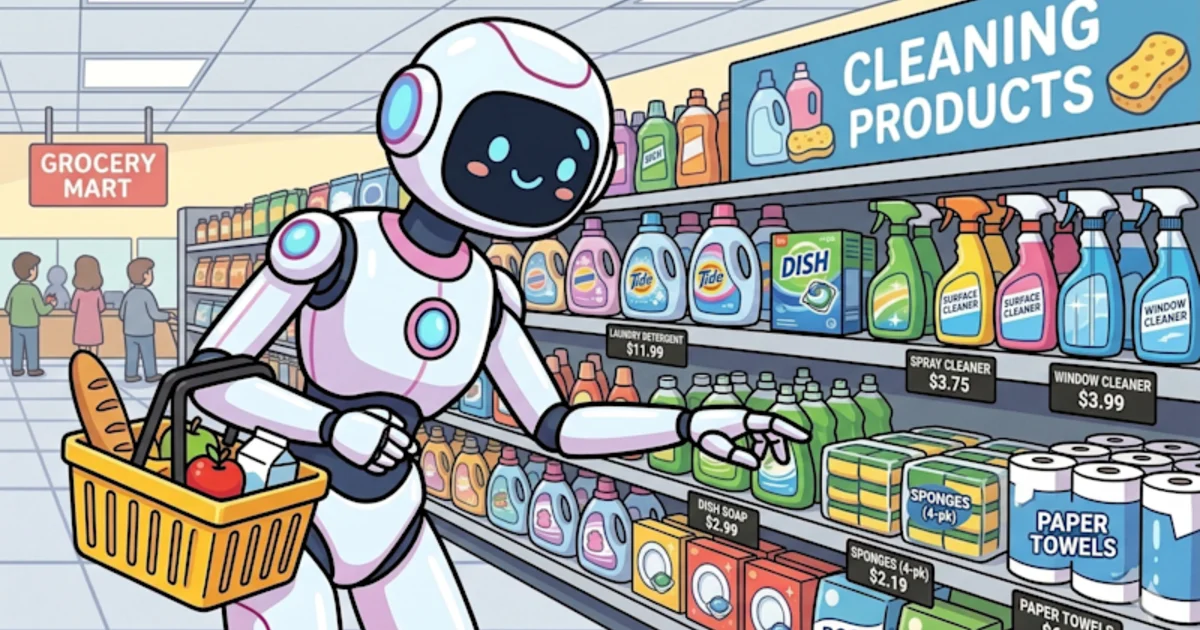
Understanding OCP requires grasping Deeplumen's M2AI (Marketing to AI) framework. Traditional digital marketing optimized for human perception. But in an era where AI agents handle purchasing, brands must optimize for the agent's decision-making logic instead.
Deeplumen COO Joy Wu stated: "The goal in the M2AI era isn't to create brand illusions, but to provide high-fidelity, structured data that allows AI agents to discover, verify, and execute transactions seamlessly." This philosophy underpins Deeplumen's entire full-stack strategy, including OCP.
OCP's Three-Layer Architecture
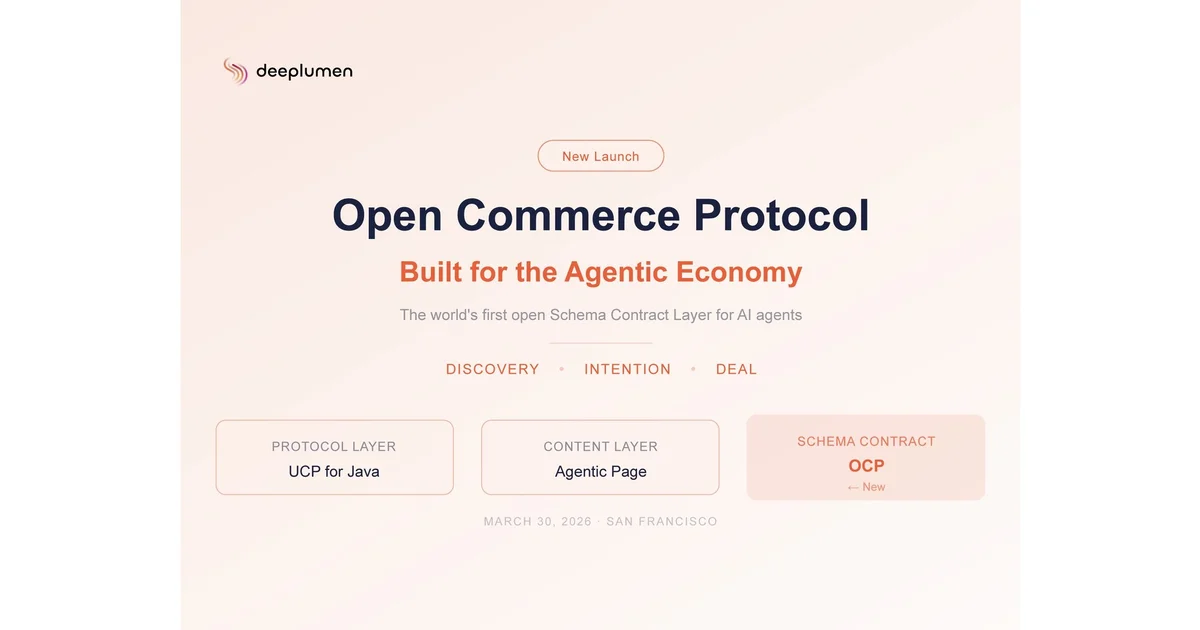
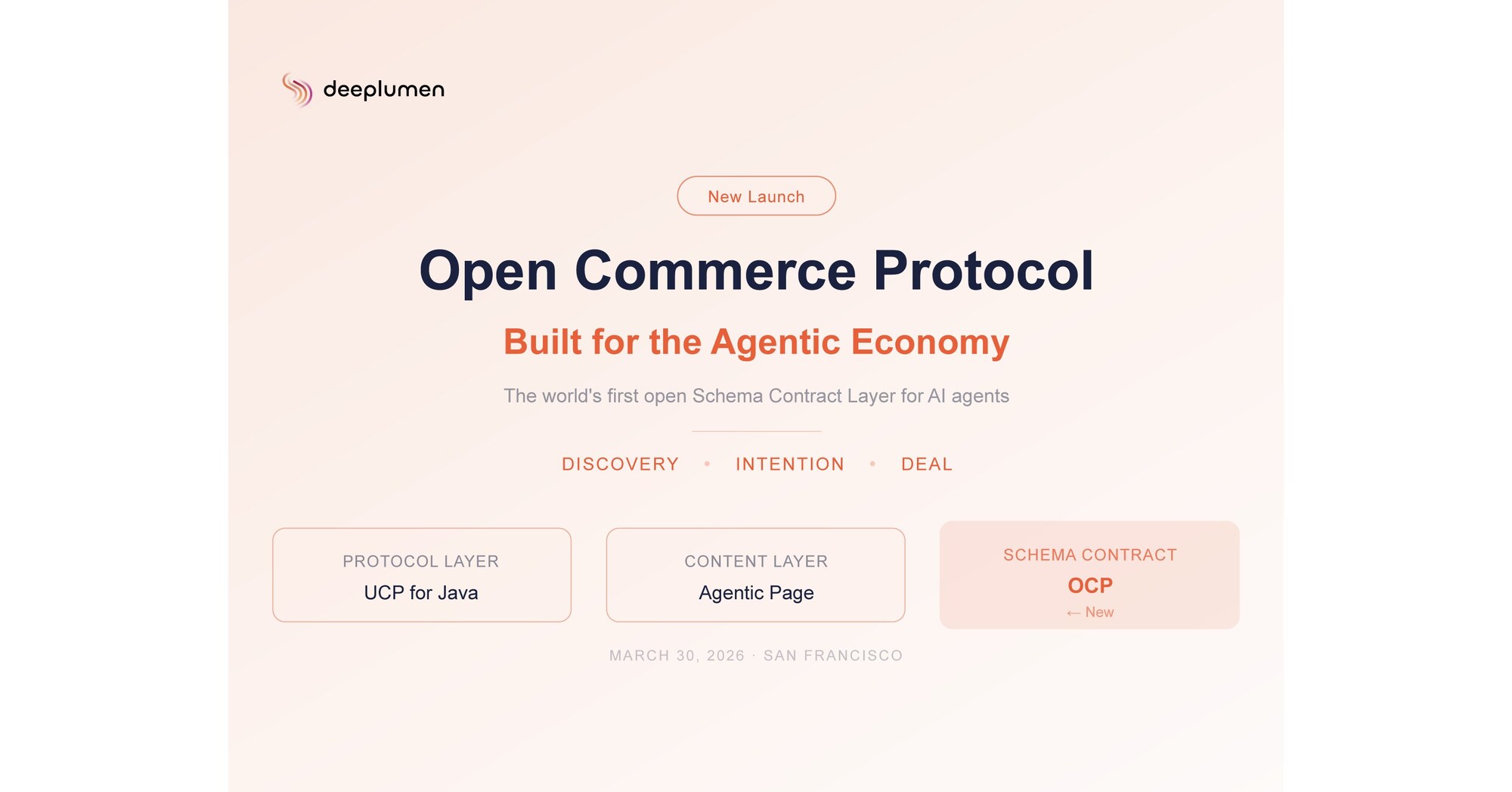
OCP structures agent-mediated commerce into three layers: Discovery, Intention, and Deal.
The Discovery layer enables AI agents to autonomously identify brands and verify their capabilities, such as checkout or identity linking, without central oversight. The Intention layer manages the alignment between buyer intent and merchant requirements, handling budget constraints and scenarios requiring human approval at the final step. The Deal layer executes binding commitments and payment settlements across distributed nodes, with an append-only event ledger tracking everything from shipping to returns and dispute resolution.
OCP also supports dual-mode operations: a precision mode using structured "Merchant Profiles" and a compatibility mode that infers capabilities from existing web environments. This design allows merchants without full structured data to still participate in agent-mediated transactions.
Three Steps to a Full Stack
The OCP announcement represents the third and culminating phase of Deeplumen's full-stack strategy deployed throughout 2026.
UCP for Java, announced in January, provides a Java implementation of Google's Universal Commerce Protocol (UCP) as the protocol layer, connecting legacy Java-based commerce systems with AI agents. Agentic Page, launched in February, serves as the content layer, functioning as a "Semantic Translator" that converts brand websites into structured data that LLMs can natively understand and cite.
OCP now sits atop this stack as the Schema Contract Layer, providing the contract and settlement framework for agents to execute actual commerce transactions.
Positioning in the Agentic Commerce Protocol Race
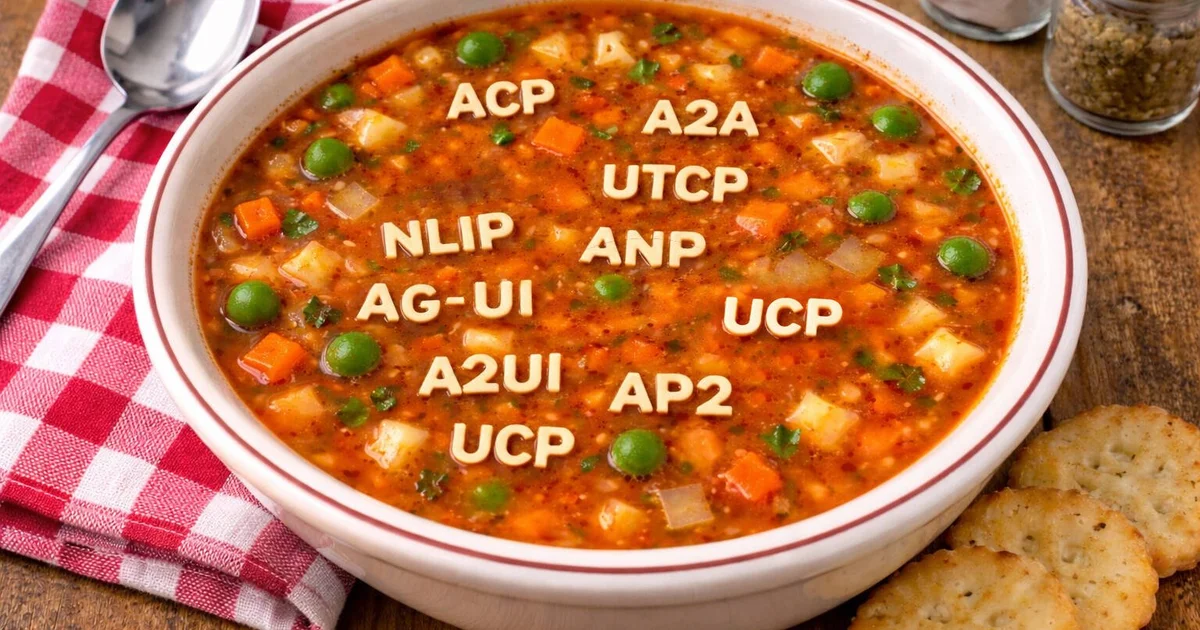
Multiple competing standards currently coexist in the agentic commerce protocol space. UCP, co-developed by Google and Shopify, has more than 60 participating organizations including Walmart, Target, and Etsy, and is consolidating its position as the de facto standard. Meanwhile, OpenAI and Stripe's ACP (Agentic Commerce Protocol) is already live on ChatGPT.
OCP takes a distinct path by focusing on the OpenClaw ecosystem rather than pursuing cross-platform universality. While UCP aims to be a universal standard, OCP concentrates on delivering an end-to-end transaction experience within OpenClaw. That said, OCP's source code is publicly available on GitHub, enabling open extensibility.
Impact and Practical Considerations for E-commerce Merchants
For e-commerce merchants, OCP's launch means another option in the growing question of how to make their brands discoverable to AI agents.
The current priority should be UCP adoption. Shopify merchants can expect agent-mediated sales channels to be enabled through dashboard settings, keeping the barrier to entry low. For merchants running existing Java-based systems, Deeplumen's UCP for Java SDK is worth evaluating.
Regarding OCP itself, watching the OpenClaw ecosystem's adoption trajectory is key. The current proliferation of protocols has been compared to the VHS vs. Beta format wars. With the Agentic AI Foundation (AAIF) established by the Linux Foundation driving standardization, which protocols will survive remains fluid.
Conclusion
Deeplumen's OCP is noteworthy for completing a full-stack agentic commerce infrastructure under the M2AI paradigm. The three-layer architecture of UCP for Java, Agentic Page, and OCP presents a comprehensive blueprint for brands adapting to the AI agent era.
However, with established protocols like UCP and ACP already gaining traction, whether OCP can carve out a distinct position depends on future adoption. For e-commerce merchants, the practical approach is to first solidify UCP readiness while monitoring emerging protocols including OCP as the landscape continues to evolve.