AI Commerce News Digest (April 9, 2026)
Visa launched Intelligent Commerce Connect globally while Mastercard rolled out authenticated agentic transactions across ASEAN on the same day. Juniper Research projects agentic commerce spending will reach $1.5 trillion by 2030, and Rezolve AI went hostile on Commerce.com in the first major M&A drama in AI commerce.


Key Takeaways
- Visa and Mastercard both unveiled agentic commerce infrastructure on the same day, signaling the full-scale entry of payment giants into the space
- Juniper Research forecasts agentic commerce spending will reach $1.5 trillion by 2030, putting a concrete number on industry expectations
- Rezolve AI launched a hostile takeover bid for Commerce.com, marking the first major M&A drama in AI commerce
Today's Featured News
Visa Launches "Intelligent Commerce Connect" Globally

Visa has launched Intelligent Commerce Connect, a single integration on the Visa Acceptance Platform that supports AI agent-initiated payments across multiple protocols.
www.pymnts.comOn April 8, Visa announced Intelligent Commerce Connect, a unified platform for accepting payments initiated by AI agents. A single integration through the Visa Acceptance Platform supports major protocols including the Trusted Agent Protocol, Machine Payments Protocol, Agentic Commerce Protocol, and Universal Commerce Protocol.
What stands out is that the design does not depend on any specific protocol, token vault, or even the Visa brand, since it can handle cards from other networks as well. For merchants, it acts as a common on-ramp that lets them participate without having to bet on which standard will win. Pilot participants include Aldar, AWS, Diddo, Highnote, Mesh, Payabli, and Sumvin.
Full article: Visa Unveils Intelligent Commerce Connect — Inside the Agentic Commerce On-Ramp for Businesses
Mastercard Rolls Out Authenticated Agentic Transactions Across ASEAN

Mastercard is expanding authenticated agentic transactions across ASEAN with UOB and regional banks, and will open an AI Centre of Excellence in Singapore later this year.
www.thefastmode.comOn the same day as Visa's announcement, Mastercard said it is rolling out Authenticated Agentic Transactions across ASEAN. Working with UOB and other regional banks, the scheme combines Payment Passkeys with tokenized credentials and leverages "Verifiable Intent," co-developed with Google.
In Thailand, Mastercard partnered with credit card leader Krungthai Card (KTC) to complete the first live agentic transaction — an AI-booked ride from Suvarnabhumi Airport to Central Chidlom. KTC has 3.7 million accounts and an annual transaction volume of 302 billion baht, making this a bellwether for practical deployment in a major ASEAN market.
Full article: Mastercard Launches Authenticated Agentic Transactions Across ASEAN — First Live Transaction Completed in Thailand
Agentic Commerce
Agentic Commerce Spending to Reach $1.5 Trillion by 2030

Juniper Research forecasts agentic commerce spending will jump from $8 billion in 2026 to $1.5 trillion by 2030, with Mastercard, Visa, and Stripe leading the competitor leaderboard.
technode.globalUK-based Juniper Research forecasts that agentic commerce spending will grow from $8 billion in 2026 to $1.5 trillion by 2030 — roughly a 190x jump in four years.
Its accompanying 2026 Competitor Leaderboard ranks 14 providers, with Mastercard, Visa, and Stripe occupying the top three spots. Evaluation criteria focus on agent transaction processing capabilities and engagement with emerging protocols, reinforcing today's Visa and Mastercard announcements. McKinsey projects $1 trillion (US) / $3–5 trillion (global), Bain estimates $300–500 billion, and Morgan Stanley sees $190–385 billion, making Juniper's number on the more bullish end.
Full article: Agentic Commerce to Reach $1.5 Trillion by 2030 — Juniper Research Forecast and the Three Payment Giants
Visa Partners with Coinbase and Nevermined on AI Agent Payments
Visa is working with Coinbase and AI agent payment startup Nevermined to extend agentic commerce into crypto-native rails.
cryptobriefing.comAlongside the Intelligent Commerce Connect announcement, Visa revealed a partnership with Coinbase and Nevermined, an AI agent payment infrastructure startup. The goal is to bridge traditional payment networks with crypto-native agent payments, positioning Visa across both legacy and emerging layers.
Runner AI Launches First "Autonomous E-commerce Engine"
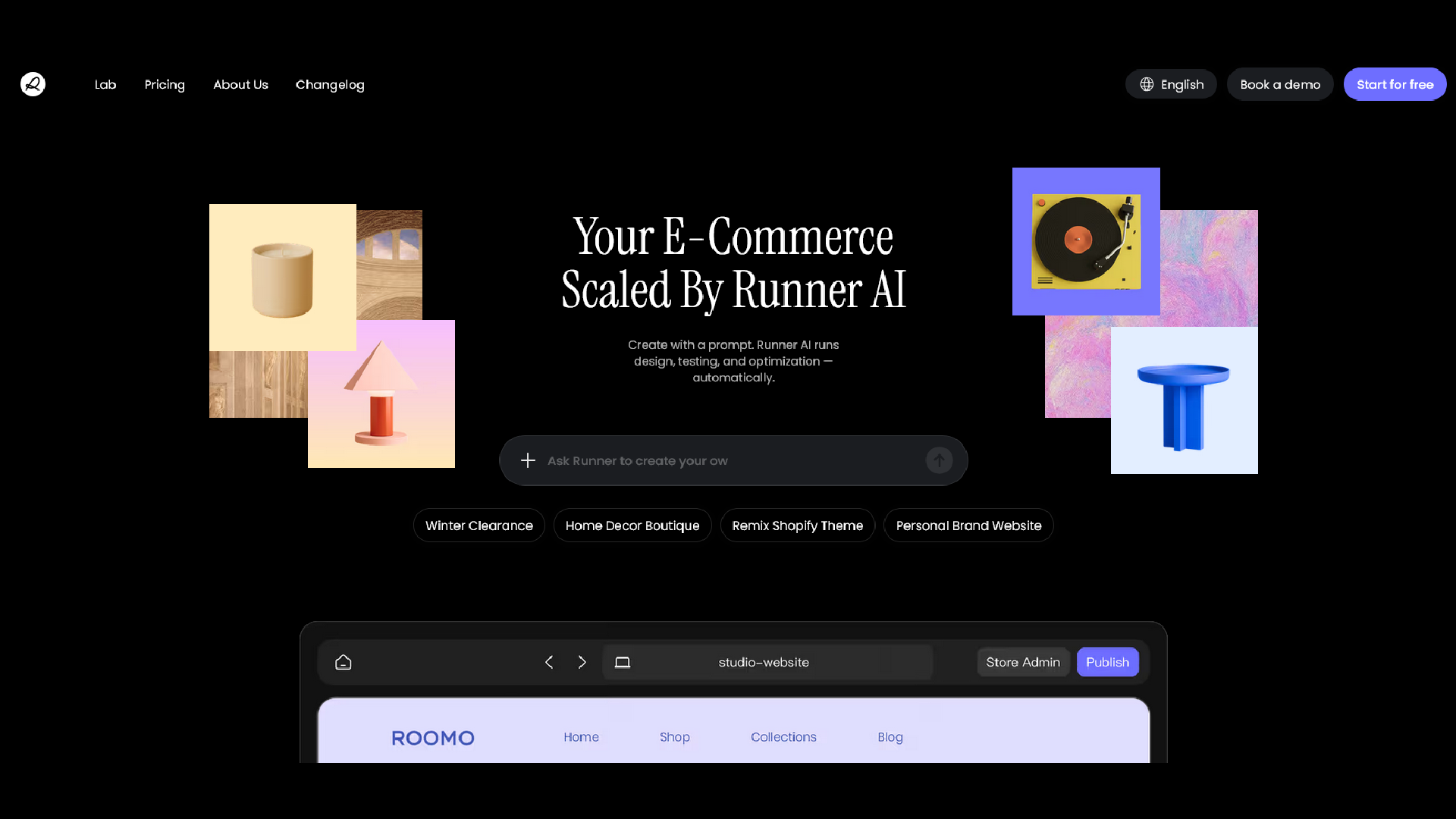
Runner AI claims its autonomous ecommerce engine can build, run, and optimize online stores end-to-end without human operators.
www.desertsun.comRunner AI launched what it calls the first autonomous e-commerce engine, claiming to handle store construction, operations, and optimization autonomously. Unlike traditional no-code builders, the agent takes over decisions on product listing, pricing, ad spend, and inventory replenishment.
Real-world deployment data is still limited, but the emergence of agent-operated store concepts is notable. A future where human-run and agent-run stores compete in the same marketplace is steadily approaching.
Company Moves & M&A
Rezolve AI Launches Hostile Bid for Commerce.com

Rezolve AI has gone directly to Commerce.com shareholders with a 2-for-1 share exchange proposal to create a $700 million global agentic commerce powerhouse after private talks broke down.
www.proactiveinvestors.co.ukRezolve AI (NASDAQ: RZLV) issued an open letter directly to Commerce.com (NASDAQ: CMRC) shareholders, proposing a 2-for-1 share exchange. Private talks had broken down, prompting the hostile approach. The combined entity would target a market capitalization of roughly $700 million as a global agentic commerce company.
Rezolve positions its Brain Suite and RezolvePay products as synergistic with Commerce.com's base of approximately 60,000 merchants. Major M&A drama is rare in the AI commerce space, and this could mark the start of broader industry consolidation.
Full article: Rezolve AI Launches Hostile Bid for Commerce.com — Proposal to Build a $700 Million Agentic Commerce Powerhouse
Wallapop CEO Discusses Sale to Korea's Naver

Wallapop CEO Rob Cassedy explains why the Spanish marketplace decided to sell to Naver, citing the Korean giant's unmatched scale in commerce and AI.
sifted.euIn a Sifted interview, Wallapop CEO Rob Cassedy explained the backstory of the sale to Korea's Naver. He cited Naver's scale and technical depth — particularly in AI commerce — as the deciding factors.
The deal is symbolic as a European startup acquired by an Asian major, and it gives Naver a foothold for full-scale European expansion.
AI Commerce Tools
Google Gemini Adds AI Shopping and Price Comparison

Google has added shopping and price comparison capabilities directly into Gemini, turning the chatbot into a shopping assistant.
mexicobusiness.newsGoogle added shopping features and price comparison tools directly into Gemini. Users can now search for products, compare prices, and narrow down candidates within the chatbot, with integration into existing Google Shopping.
Following OpenAI's ChatGPT Shopping and Anthropic's Claude, major LLMs are each strengthening their commerce capabilities, intensifying competition toward a future where purchases complete entirely inside AI assistants.
Alibaba's E-commerce AI Strategy Reconstructs Commerce Around "Tokens" (36kr Exclusive)
36Kr reports on how Alibaba is reconstructing e-commerce around tokens and reorganizing its internal AI teams.
eu.36kr.comChina's 36kr published an exclusive report on new trends in Alibaba's e-commerce AI strategy. Alibaba is accelerating a move to reframe product information and user behavior as "tokens" that can be referenced directly by AI models, rebuilding its e-commerce foundation around that concept.
Internal reorganizations for AI commerce teams are underway, with the shift progressing from traditional search and recommendation-centered structures to generative AI-native architectures.
Brambles.ai × Shopnomix Bring AI Commerce to Editorial Content

Brambles.ai and Shopnomix have partnered to bring AI-powered product discovery and affiliate commerce into publishers' editorial content.
www.affiversemedia.comBrambles.ai and Shopnomix partnered on a solution that embeds AI-powered product discovery and affiliate commerce into publishers' editorial content. Publishers gain stronger per-article monetization as AI automatically recommends contextually relevant products.
With ad revenue under pressure, context-aware commerce within editorial content is drawing attention as a new revenue pillar.
Global E-commerce
India's E-commerce Market to Reach $250 Billion by 2030 (Google-Deloitte)

A new report by Google and Deloitte predicts that India's digital commerce market will grow from $90 billion to $250 billion by 2030, driven by quick commerce, Gen Z consumers, and AI.
retail.economictimes.indiatimes.comA joint Google-Deloitte study projects India's e-commerce market to reach $250 billion by 2030, roughly 2.8x today's $90 billion. Key growth drivers include AI, Gen Z consumers, quick commerce, and creator-led commerce.
Creator-led commerce alone is estimated to reach $25 billion by 2030, influencing 30% of India's retail spending. India is increasingly positioned as one of the next major battlegrounds for agentic commerce.
Flipkart Expands Hemant Badri's Role to Drive AI Strategy

Flipkart has expanded the role of Hemant Badri to drive its AI agenda across logistics, quick commerce, and customer experience.
retail.economictimes.indiatimes.comFlipkart expanded Hemant Badri's remit to lead its overall AI strategy. He will now oversee logistics, quick commerce, and customer experience — key areas for AI application — across the organization.
For a company locked in fierce competition with Amazon in India, strengthening AI execution has become a top priority.
Other Highlights
Dell: Agentic AI May Be Better for Search Than Commerce

Dell executives suggest agentic AI's most practical use case in e-commerce may be in search and discovery rather than full purchase automation.
www.digitalcommerce360.comIn an interview with Digital Commerce 360, Dell executives argued that the most practical use case for agentic AI is in search and discovery, not full purchase automation. In complex B2B procurement processes, humans should make the final purchase decision while agents support earlier stages of information gathering and comparison.
While Visa and Mastercard build infrastructure premised on full automation, this more incremental view from practitioners in the field highlights the temperature gap within the industry.
Summary
Today was symbolic — Visa and Mastercard, the two leading payment networks, both announced agentic commerce infrastructure on the same day. Juniper Research's $1.5 trillion forecast for 2030 provides the context supporting both moves.
Meanwhile, Rezolve AI's hostile bid hints at the start of serious industry consolidation in AI commerce. At the same time, voices like Dell's calling for a more measured view of practical AI agent use cases show the balance between optimism and pragmatism that will likely define upcoming debate.
Tomorrow and beyond, attention turns to how Shopify and Stripe respond to today's Visa and Mastercard announcements, regulatory developments across markets, and early outcomes from active pilot programs.