AI Commerce News Digest (September 8, 2026)
Swiggy added wallet payments to its MCP and Okta launched identity features for agent-led buying. Here is where agentic commerce implementation and consumer trust stand today.


Key Takeaways
- Swiggy added its own wallet to MCP so agents can now complete payment
- Okta unveiled new Auth0 capabilities as identity infrastructure for the agentic era
- Implementation is reaching the payment layer, but consumer trust has not caught up
Here is the AI commerce news for September 8. Today the spotlight fell on the last step of agent-led buying: payment and identity verification. In India, Swiggy added wallet payments to MCP orders, while Okta shipped identity capabilities for delegating authority to an agent. At the same time, French consumer research found that 41% trust no organisation to run an AI shopping agent. Read alongside AEON's agentic checkout covered yesterday, the gap between how fast the supply side is building and how slowly trust is forming comes into sharper focus.
Today's Top Stories
Swiggy adds Swiggy Money to its MCP so agents can complete payment
Swiggy adds Swiggy Money to its MCP integrations, letting AI agents pay for Food, Instamart and Dineout orders.
www.medianama.comIndia's Swiggy has added its own wallet, Swiggy Money, to its Model Context Protocol (MCP) integrations. Once a user tops up the balance, an AI agent can draw on it for subsequent transactions. The aim is to stop the conversation from breaking at the payment step, and the change covers Swiggy Food, Instamart and Dineout.
What makes this worth attention is that MediaNama ran an actual order through ChatGPT. Asked to pick a chocolate treat within a budget of Rs 300, the agent could not pull up order history, and only after the tester named cookies did it search, add the item to the cart and pay with Swiggy Money. Compared with the January test, when cash on delivery was the only option, completing the transaction is a clear step forward.
Friction remains, though. The agent could not autonomously choose a delivery address from saved options, and that failure to read order history also meant it could not personalise the recommendation. After payment went through, ChatGPT initially returned an error saying the order had not been paid. The case shows that adding a payment rail and letting an agent finish a purchase on its own are two different problems.
Full article: Swiggy Adds Its Swiggy Money Wallet to MCP: How Far Agentic Payments Actually Got
Okta launches new Auth0 capabilities as identity for the agentic era

Auth0 introduces new identity capabilities to help businesses drive growth, secure AI agents, and deliver seamless customer experiences in the agentic era.
www.okta.comIdentity provider Okta has announced a set of new Auth0 capabilities. On the consumer side, the pillars are the Identity Conversion Suite, which lifts sign-up and sign-in completion, and AI Identity for Agentic Commerce, which secures AI-assisted shopping. For enterprises, B2B Connect and Tenancy-as-a-Service round out the release.
In an agentic commerce context, what matters is giving merchants a way to establish who an agent is acting for and how far its authority extends. Authentication built on the assumption that a human fills in the form cannot answer that question. That an identity vendor has now carved this out as a product is itself a sign of how far implementation has moved.
Standards for verifying agents are still unsettled. How frameworks from payment networks and protocol bodies mesh with vendor implementations remains an open question.
Full article: Auth0 launches AI Identity for Agentic Commerce: who gets authenticated when an AI agent buys
Agentic Commerce
ICSC and McKinsey project $1 trillion by 2030, with complications behind the hype

A new report from ICSC and McKinsey & Company projects that agentic commerce in the U.S. business-to-consumer retail market could reach $1 trillion in revenue by 2030.
www.ibtimes.comA report from ICSC and McKinsey & Company projects that agentic commerce in US business-to-consumer retail could reach $1 trillion in revenue by 2030. According to the findings, 68% of consumers used at least one AI tool in their shopping journey over the past three months, and 62% used AI to compare brands, models, prices or reviews.
The behavioural shift is already underway, so the debate has moved to pace and to who benefits. Stripe co-founder John Collison likens the handover of tedious shopping tasks to AI to the way consumers once handed trip planning and product search to outside services.
The article also flags the complexity behind the enthusiasm. Who owns the agent, which transaction data flows to whom, and where brands differentiate are questions that remain unresolved.
Fynd's founder argues the entry point is post-purchase, not discovery

The part of retail no one is talking about is where agentic commerce pays off first, says Sreeraman Mohan Girija, Founder at Fynd.
retailtechinnovationhub.comSreeraman Mohan Girija of Fynd argues that the return on agentic commerce shows up first in post-purchase operations rather than product discovery. Handling a parcel that never arrived stacks up waiting time and cost, and often leaves the customer more frustrated than the original problem did.
His figures are concrete. UK retailers lost GBP 27 billion to online returns in non-food categories in 2024. Nearly half of returns come down to differences in size, fit or colour, and a further 14% stem from product descriptions that were not accurate enough. Both are recurring, predictable costs sitting exactly where an agent can step in.
He adds a trust argument. Customers are more comfortable letting an agent resolve a problem they already have than letting one spend their money. Starting with post-purchase support and moving to purchasing once trust is established is a realistic sequence for adoption.
AI Commerce Tools
Forrester says answer engines now shape brand choice

Marketers may need to rethink search metrics as AI responses increasingly narrow buyers' shortlists before they reach a website.
ecommercenews.com.auForrester has published research arguing that answer engines such as ChatGPT, Google AI Mode, Claude and Perplexity should be treated as a brand-building channel rather than a way to harvest existing demand. Conversational responses shape awareness, consideration and purchase intent.
The firm warns against treating answer engine optimisation as an extension of SEO. Organisations that watch only rankings, snippets and clicks risk missing how large language models present a brand's relevance and trustworthiness.
The larger implication is that visibility now originates outside a brand's own site. Because answer engines synthesise many sources to construct a reply, the wider body of third-party commentary and citations does the work. Communications and thought leadership now sit on the same footing as search teams.
Payments and Fintech
Mastercard and Flowcart bring chat-to-pay commerce to East Africa

This initiative allows consumers to discover products, place orders and complete payments within a single chat-based journey, eliminating the need to redirect users to external websites or apps.
techafricanews.comMastercard and Flowcart have formed a collaboration to embed card payments directly inside conversational commerce journeys. The rollout starts in Kenya and is set to expand across East Africa and into South Africa, Nigeria and Côte d'Ivoire.
The point is that the purchase path closes inside the chat instead of redirecting to an external site. Finding a product, ordering and paying all happen in the same conversation. In markets where social and messaging apps are the entry point for shopping, that design translates directly into fewer drop-offs.
It reads as a card network's answer to the same problem agent-led buying faces: how to clear a payment without stopping the conversation.
Consumer Trends
41% of French consumers trust no organisation to run an AI shopping agent
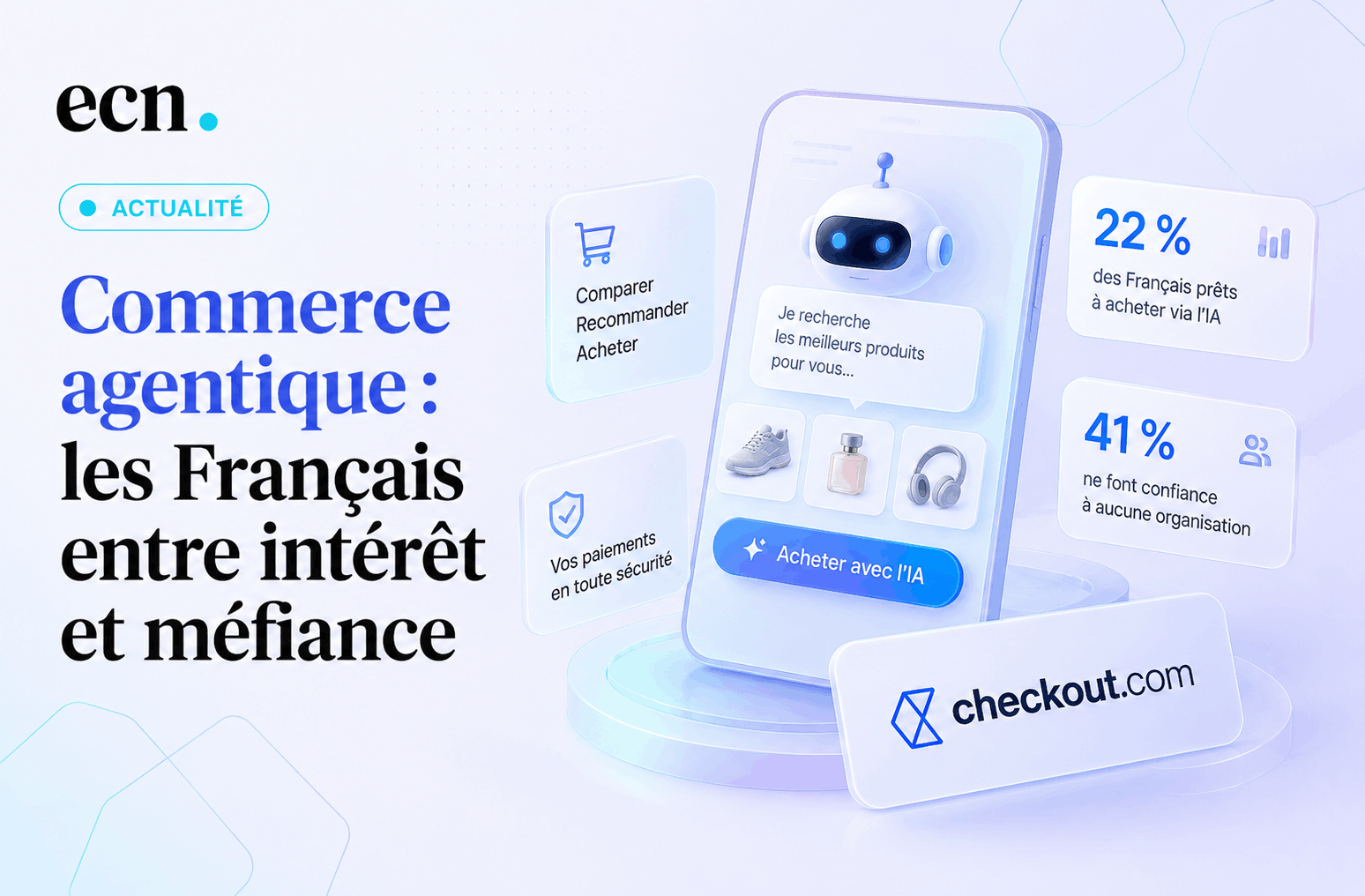
French consumers expect AI-driven shopping to arrive but remain highly cautious about who they would trust to run an agent.
www.ecommerce-nation.frResearch from Checkout.com finds that 22% of French consumers expect at least 10% of their purchases to run through an AI agent within twelve months. That sits alongside 22% in the United States and 23% in the United Kingdom, but well below the global average of 33%.
Distrust is what stands out. Some 41% say no organisation is trustworthy enough to operate an AI shopping agent, 14 points above the global average, and 35% say they will never delegate purchases to AI, against 24% worldwide.
For merchants, the implication is that polished interfaces and accurate recommendations will not be enough to drive adoption. The deciding factor is whether the scope of authority, refunds and cancellation can be presented in terms consumers understand and can reverse afterwards.
Corporate Moves and Partnerships
SHEIN buys Everlane for $80 million in a pivot to acquisition-led growth

Shein is betting on acquisitions such as Everlane to revive growth, broaden its customer base and extend its supply-chain platform.
insideretail.asiaSHEIN is moving into an acquisition-led phase off the back of its Hong Kong listing. Its prospectus sets out a plan to buy US brand Everlane for $80 million, funded from $15 billion in cash reserves plus the $1.74 billion raised in the IPO. A person familiar with the matter told Reuters the deal is a dry run for a strategy of acquiring brands across different price ranges.
Slowing growth sits behind the shift. Revenue growth fell from 8% for 2025 to 1.1% in the first quarter of 2026, with the removal of duty-free access for small parcels into the US still working through the numbers. The stock has traded more than 20% below its offer price. The company points to expanding Xcelerator, the programme through which it sells outside brands access to its manufacturing network, warehousing, logistics and sales platform.
Louise Deglise-Favre, lead apparel analyst at GlobalData, notes that building a meaningful brand portfolio takes years. Investors have yet to price in a successful transition to a brand and platform business.
Global E-commerce
TikTok Shop opens cross-border selling between the EU and the UK

Sellers from eight European Union member states will soon be able to offer their products to British consumers on TikTok Shop.
ecommercenews.euTikTok Shop is opening cross-border selling in both directions between the EU and the UK. Sellers in Belgium, Germany, France, Ireland, Italy, the Netherlands, Poland and Spain will be able to reach British shoppers, and UK sellers will be able to sell into continental Europe.
The platform has been expanding quickly in Europe. It launched in Austria, Belgium, the Netherlands and Poland in mid-June, and with Sell Across Europe it has taken the shape of a pan-European marketplace covering twelve countries. The intra-EU service also makes localising product descriptions easier.
AliExpress makes its IFA debut as August EU sales rise 97% year on year

The role of cross-border e-commerce platforms is transforming from a traffic channel into the infrastructure that supports brands' global expansion.
eu.36kr.comAliExpress exhibited at the IFA 2026 consumer electronics show for the first time, lining up products from nine Chinese brands including AI smart glasses, 3D printers and electric bicycles. Showcasing third-party brands going global rather than discounting hit products signals a change in what a cross-border platform is for.
On the numbers, EU sales rose 97% year on year in August. The driver is Brand+, which handles branded goods, and branded products now account for more than half of sales across eleven European markets. Exports in the AI hardware category doubled.
With EU tax reform unsettling a model built on low prices and high volume, the calculation is that higher-priced branded goods can absorb tariff costs within their margin.
Advertising and Retail Media
YouTube Shopping partners with Amazon as TikTok Shop reaches 2% of US e-commerce

Sales on TikTok Shop accounted for 2% of all US e-commerce sales in July, according to Consumer Edge, more than Costco or Target.
www.thedailyupside.comYouTube has brought on Amazon as a major YouTube Shopping affiliate partner, letting creators tag Amazon products in videos and livestreams and earn commission on resulting sales. It is a move to close the gap with TikTok in live shopping.
The target is not small. Consumer Edge data shows TikTok Shop accounted for 2% of all US e-commerce sales in July, up from 1.2% a year earlier and ahead of online sales at Costco and Target. Charm.io puts first-quarter US sales at $4.9 billion, nearly double the year-ago figure.
Travis Katz, who leads YouTube Shopping, points to 110 million hours of product-related video watched on the platform each day. Around 3 million creators are eligible to join and roughly a million have done so. Gross merchandise volume is up 13 times from the first quarter of 2024 to the first quarter of 2026.
Summary
Lined up together, today's news shows agentic commerce implementation reaching the core of the transaction: payment and identity verification. Swiggy added a wallet, and Okta turned delegated authority into a product. Yet as the Swiggy test showed, clearing a payment and completing a purchase autonomously are still some distance apart.
The gap on the demand side is just as real. French research found 41% with no one they would trust, while ICSC and McKinsey point to a $1 trillion market by 2030. Closing that distance depends less on model performance than on how authority and reversal are designed.
Ahead, watch how identity and payment frameworks connect to one another, and whether the number of retailers starting with post-purchase operations actually grows.