IMF on Agentic AI in Payments and E-Commerce: The Three-Layer Model and Why the Payment Core Must Stay 'Dumb'
The IMF published a note on autonomous AI in payments, proposing an intent-authorization-settlement framework and arguing the core infrastructure must remain deterministic. A guide for e-commerce and fintech teams.

Key Takeaways
- The IMF splits agentic payments into three layers — intent, authorization, and settlement — concentrating probabilistic reasoning upstream and keeping deterministic execution downstream.
- The central concern is letting adaptive systems make irreversible payments without proper controls or accountability, so the core infrastructure should stay deliberately deterministic.
- E-commerce and payment firms need to rebuild human-centric authentication around Know Your Agent (KYA) verification and delegated mandates.
The IMF Tackles Autonomous AI in Payments and E-Commerce
The International Monetary Fund (IMF) has published a note that systematically maps the benefits and risks of agentic AI in payments and e-commerce. It examines how the shift from simple rule-following automation to autonomous systems capable of reasoning and managing tasks will reshape payment systems and online commerce.
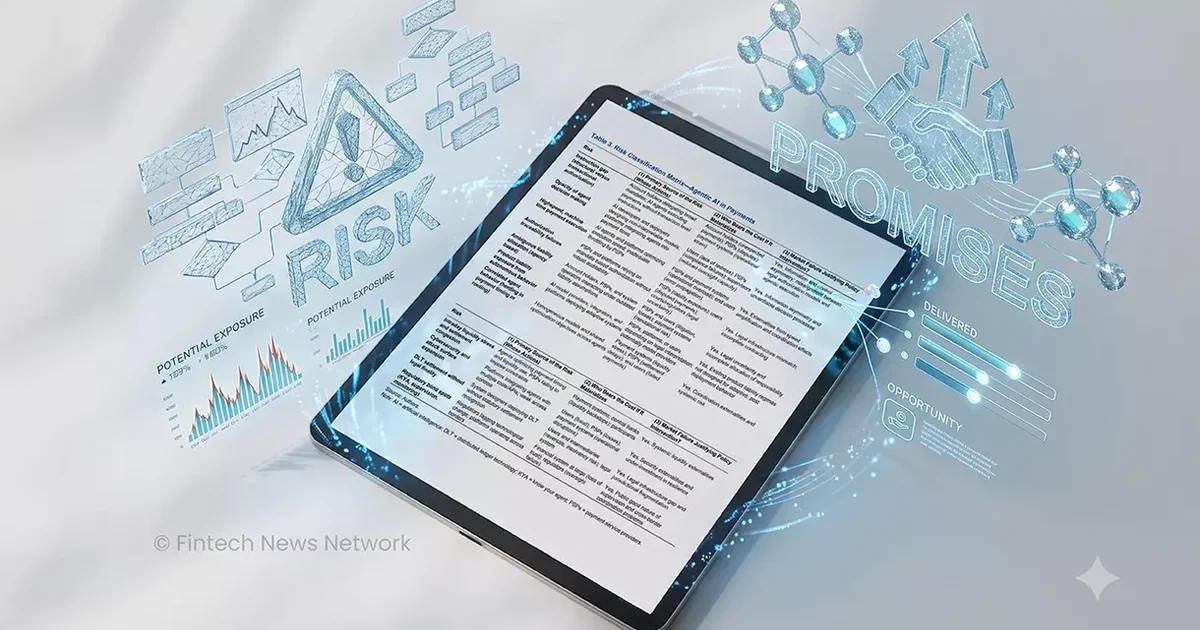
Agentic AI has the potential to transform payment systems and e-commerce by shifting from basic automation to autonomous systems capable of complex reasoning and task management.
fintechnews.chThe note is an official IMF document titled How Agentic AI Will Reshape Payments, released in April 2026. It works across authorization, liquidity management, settlement, compliance, and operational resilience. It is best read as a calm, structural breakdown of changes already underway at the payments frontier, viewed through a financial-stability lens.
What stands out is that the IMF does not debate whether AI belongs in payments. AI has been deployed there for more than four decades. The real question is how to fold autonomous systems into existing payment infrastructure — a matter of design and governance.
From "Click-to-Pay" to "Decide-to-Pay"
Traditional payments rely on a human initiating each transaction. The IMF calls this "click-to-pay." A user selects an item, presses a button, and that act of intent becomes the basis for the payment.
Agentic AI quietly dismantles that premise. Software agents operate under delegated mandates, anticipate when a payment is needed, compare instruments and rails, and coordinate execution. Under certain conditions, the agent may even be authorized to make the payment decision outright.
The IMF frames this as a move toward "decide-to-pay," where execution unfolds at machine speed across several layers of the value chain. Human involvement at each step shrinks. Agent-mediated commerce is already live through OpenAI's Instant Checkout, Google's Universal Commerce Protocol (UCP), and Amazon's Alexa for Shopping.
This surfaces a fundamental tension. Core payment infrastructure is built on deterministic logic, demanding predictability, auditability, and legal enforceability at every step. Agentic AI works the other way, relying on probabilistic reasoning and adaptive decisions that can produce different outcomes under otherwise similar conditions.
The IMF's Three-Layer Model: Where to Separate Intelligence From Certainty
How do you resolve that tension? The IMF proposes a design model that splits payments into three layers. The core principle is clear: concentrate probabilistic, adaptive reasoning upstream, and preserve deterministic authorization and settlement where legal finality and systemic stability are required.
| Layer | Role | Nature | Key technologies / protocols |
|---|---|---|---|
| Layer 1: Intent and orchestration | Translate user objectives into machine-readable instructions | Probabilistic / adaptive | UCP, reasoning, search, negotiation, multi-agent coordination |
| Layer 2: Control and authorization | Decide whether a proposed action may execute | Deterministic | AP2, verifiable mandates, Stripe tokenized authorization |
| Layer 3: Settlement | Execution with legal finality | Deterministic | RTGS, instant payment networks, card clearing, CBDC, DLT |
Layer 1 is where agents reason, search, and negotiate. It converts high-level objectives into structured instructions but carries out no authorization or execution. Pilots such as Visa's Intelligent Commerce and Mastercard's Agent Pay test agents building purchase intent on their own.
Layer 2 is the gate that decides whether an agent's action may proceed. Its core mechanism is the Agent Payments Protocol (AP2), which binds an agent's actions to cryptographically verifiable mandates specifying scope, limits, identity, and permitted conditions. Stripe lets agents use a user's pre-approved payment methods without touching the underlying credentials.
The settlement layer is where instructions execute with irrevocable legal finality. It spans RTGS, instant payment networks, and card clearing engines, plus newer rails such as CBDC platforms and distributed ledgers. The IMF states plainly that agentic algorithms typically do not operate here. Layer 3 accepts only instructions that have cleared Layer 2's deterministic controls and executes them without optimization or reinterpretation. This is the heart of the "keep the payment core dumb" argument.
Where the IMF Sees the Greatest Risk
The note repeatedly stresses that the primary danger is letting adaptive systems "make irreversible payments without proper controls, checks, or accountability." The autonomy, opacity, and non-deterministic behavior of these systems pose material risks to consumer protection, market stability, and regulatory oversight.
On market stability, algorithmic herding is the sharpest concern. If dominant models read identical market signals, they may act simultaneously, bypass safeguards like circuit breakers, and trigger flash crashes. In payments, this can synchronize liquidity demand, amplify procyclical behavior, and create congestion across rails.
Data security is no smaller worry. Autonomous agents depend on third parties such as cloud providers, AI model endpoints, and financial services, and they handle sensitive data like bank credentials, card numbers, and crypto wallet keys. That creates a concentrated point of vulnerability.
Then there is market concentration. Generative AI requires vast data and compute that only a handful of firms can supply. The supply chain — from data centers to cloud to applications — is highly concentrated, raising financial-stability, operational, and reputational risks.
| Risk area | What the IMF flags |
|---|---|
| Consumer protection | Misreading user intent, optimizing provider incentives, objective drift, nudging at scale |
| Market stability | Algorithmic herding, synchronized liquidity demand, congestion on payment rails |
| Data and operations | Third-party dependence for sensitive data, concentrated vulnerability, genAI hallucinations |
| Market concentration | Oligopoly across the AI supply chain, threats to innovation |
When the Premise of Authentication Breaks: From KYC to KYA
Structural gaps also slow adoption, and the hardest is agent authentication and KYC. Traditional KYC and multi-factor authentication are designed around human users who explicitly approve transactions.
When a software agent autonomously initiates payments under delegated authority, that premise no longer holds. You must verify both the agent's identity and the intent of the underlying user, raising hard questions about authentication, accountability, and compliance.
This overlaps with the payments industry's own worries. Mastercard's CEO has noted that agentic commerce revives the consumer-protection questions the industry faced decades ago: what happens if something goes wrong, is the agent truly what it claims to be, and does it act on the user's instructions. Mastercard built a trust layer with Google called Verifiable Intent in response.
A talent gap compounds the problem. A OneStream survey of more than 2,500 corporate finance professionals found 57% see a generational technology divide as a pain point, with the AI skills gap (44%) a leading cause. Many banks still run on legacy infrastructure, a further integration barrier.
What E-Commerce and Payment Firms Should Prepare
The IMF concludes that containing these risks requires coordinated public and private action, and its recommendations translate cleanly into practice.
Financial institutions should invest in governance structures, cybersecurity safeguards, and technical architectures that keep agentic reasoning separate from payment execution — embedding the three-layer logic into their own systems. Payment networks and technology providers will need trusted, interoperable standards for Know Your Agent (KYA) verification and delegated authority.
Regulators are urged to adapt supervisory monitoring frameworks, testing environments, and governance standards for AI-mediated financial activity. The Financial Stability Board also published sound practices for responsible AI adoption in June 2026, so the regulatory side is accelerating.
For merchants, the more purchases flow through agents, the more it matters whether your checkout and compliance workflows still assume explicit human approval. Verifying agent identity, setting spending limits, and placing deterministic controls ahead of irreversible settlement are the practical safeguards.
Conclusion
The question the IMF raises is not whether to adopt autonomous technology. It is how to fold it into payment systems while preserving trust, stability, and accountability. Split intent, authorization, and settlement; put probabilistic intelligence upstream and deterministic execution downstream. That design principle is a practical compass for anyone working in agentic commerce.
What is certain is that the world where agents decide to pay is already in motion. How you harness upstream intelligence while keeping the core deterministic will shape your competitive edge. Stellagent helps build the infrastructure for this kind of autonomous commerce.