Korean E-Commerce Shifts from Price Wars to AI-Driven Differentiation
A paradigm shift is underway in Korean e-commerce. Following Coupang's 2025 data breach, platforms are pivoting to AI-driven differentiation—autonomous trucks, AI live commerce, and art marketing—as the post-price-war era begins.

Key Takeaways
- Post-data-breach "Exit Coupang" movement drove competitor MAU surges, reshuffling Korea's e-commerce landscape
- Each platform is pursuing distinct AI-driven differentiation: autonomous trucks, AI live commerce, and art marketing
- The shift from price wars to AI-powered CX competition offers strategic lessons for e-commerce operators globally
A 33.7 Million User Breach That Reshuffled the Market
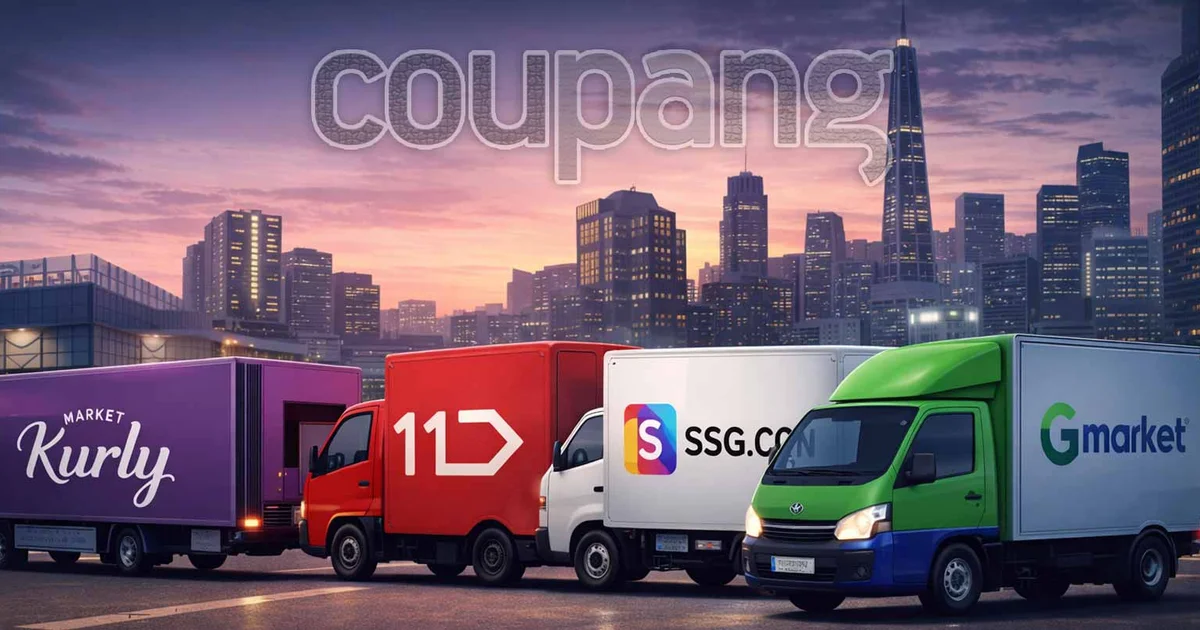
After the 2025 Coupang data breach, subtle but measurable shifts in user traffic, delivery strategies, and membership competition began to surface.
koreatechdesk.comIn November 2025, Korea's largest e-commerce platform Coupang disclosed that personal data of 33.7 million customers had been compromised. A former employee exploited unrevoked cryptographic keys, exposing names, phone numbers, addresses, and order histories. Coupang announced 1.69 trillion won ($1.17 billion) in compensation, but consumer trust was shaken, and the "Exit Coupang" movement surged.
January 2026 MAU data revealed the fallout: Gmarket's MAU jumped +25.4% year-over-year, while SSG.com rose +17.9%. Yet according to The Korea Herald, Coupang's own MAU recovered to 35.03 million by March, suggesting the overall market pie expanded rather than merely shifted. 11st (8.15 million), Naver Plus Store (7.77 million), and Gmarket (6.81 million) trail behind, while Chinese players Temu and AliExpress have each carved out roughly 7 million users.
This market fluidity is precisely what pushed every platform toward AI-driven differentiation.
Coupang's Autonomous Trucks: Attacking the Middle Mile with AI
Having dominated on price, Coupang's next move targets logistics automation.
The Korea Herald reported on April 10 that Coupang has begun testing autonomous driving systems for trucks operating between logistics centers, partnering with domestic firms including RideFlux. Some contracts are already signed, with deployment planned for inter-facility cargo transport and automated loading operations.
The target is "middle mile" logistics — trunk routes between fulfillment centers. As overnight and long-haul driver recruitment grows increasingly difficult, autonomous trucks enabling near-continuous operations would fundamentally reinforce Coupang's signature "Rocket Delivery" (dawn delivery) advantage. "Since Coupang's key advantage is its dawn delivery service, improving logistics efficiency would significantly enhance its competitiveness," an industry official noted.
Korea's regulatory environment has also shifted, with the government expanding autonomous driving pilot programs across the expressway network in 2025. Coupang operated 228 registered logistics facilities as of August 2025, surpassing CJ Logistics to become the country's largest warehouse operator. With 3 trillion won ($2.2 billion) earmarked for logistics infrastructure investment through 2026, autonomous driving is positioned as a core technology in that roadmap.
11st's AI Cooking Show: Turning Live Commerce into Experience
Where Coupang bet on logistics, 11st chose content.
Korea Bizwire reported that 11st launched "Meokgobang," a weekly live-streaming program blending generative AI with live commerce. AI recommends recipes, hosts cook them on camera, and viewers purchase ingredients in real time. The debut episode featured AI-generated recipes for stir-fried webfoot octopus and pork belly, with purchase-confirmed viewers entered into prize draws.
Airing every Wednesday evening on 11st's LIVE11 service, the show goes beyond simple product showcases. AI designs the entire flow — from meal planning to ingredient selection to cooking process — seamlessly connecting to purchase. This end-to-end AI orchestration of discovery-to-transaction represents an early form of agentic commerce in live shopping.
Competition in Korea's live commerce market is intensifying rapidly, and AI-powered content differentiation is becoming the primary battleground.
SSG.com's Art Marketing: An Unconventional Play
SSG.com chose a strikingly different path — culture rather than technology. Korean e-commerce platforms have been deploying art marketing campaigns to build consumer loyalty, seeking differentiation through brand experience rather than price or speed. This strategy appears to contrast with AI-driven efficiency but actually complements it.
As AI streamlines the purchasing process, the deciding factor for "which platform to buy from" shifts from functionality to emotional connection. Art marketing serves precisely this emotional differentiation role.
Implications for E-Commerce Operators
The transformation unfolding in Korea presents three strategic axes.
First, AI-powered logistics automation. Coupang's autonomous trucks address the universal challenges of labor shortages and rising costs. Middle-mile automation directly impacts last-mile delivery SLAs, making it a lever for delivery quality differentiation.
Second, AI content commerce. 11st's AI cooking show represents a new model where generative AI designs the entire journey from product discovery to purchase. The combination of live commerce and AI recommendations is an approach applicable well beyond the Korean market.
Third, emotional loyalty building. Once price and speed are commoditized, the remaining competitive axis is brand attachment. The fact that Coupang's data breach triggered MAU outflows vividly demonstrates how quickly trust can collapse.
Summary
Korea's e-commerce market is transitioning from Coupang's single-player dominance to a "multi-axis competition" era. Autonomous logistics, AI live commerce, art marketing — each platform has chosen a different path, but all share the same imperative: attracting consumers with value beyond price.
Key developments to watch include when Coupang's autonomous trucks move to commercial operations and how much 11st's AI content commerce contributes to GMV. Six months after the data breach, Korea's e-commerce realignment is only just beginning.