Shopify Sets the Standard for AI Commerce with Storefront MCP Servers and Universal Commerce Protocol
Shopify launches Universal Commerce Protocol (UCP) co-developed with Google, provides MCP servers for every store with live ChatGPT/Gemini/Copilot integrations, and opens its new Agentic Plan to non-Shopify brands.

Key Takeaways
- Shopify and Google co-developed the open standard "Universal Commerce Protocol (UCP)" to standardize transactions between AI agents and merchants
- Every Shopify store now gets a Storefront MCP server, enabling direct sales through ChatGPT, Google Gemini, and Microsoft Copilot
- The new "Agentic Plan" allows non-Shopify brands to sell through AI channels using Shopify's commerce infrastructure
Shopify's Vision: Connect Every AI Channel

Shopify now enables native commerce at scale across all major AI channels and built an open standard, co-developed with Google.
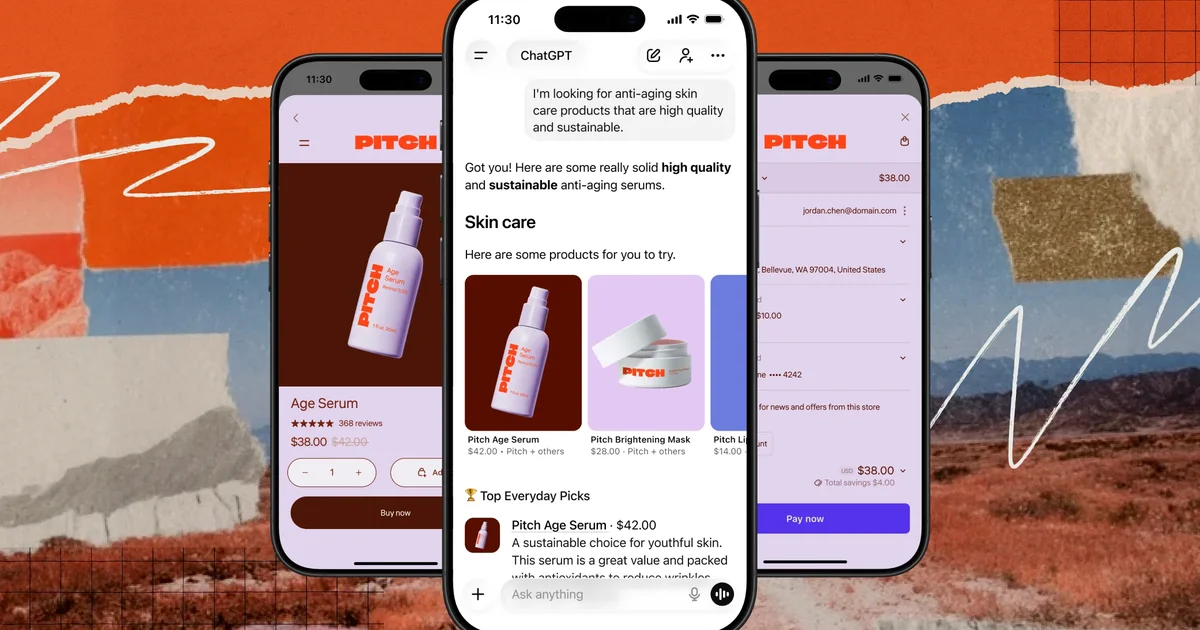
www.shopify.comOn January 11, 2026, Shopify announced an agentic commerce platform designed to "natively connect commerce to every AI conversation." The announcement rests on three pillars: the Universal Commerce Protocol (UCP), an open standard co-developed with Google; Storefront MCP servers deployed to every individual store; and the Agentic Plan, which opens Shopify's infrastructure to brands that don't operate a Shopify storefront.
Live integrations with ChatGPT, Microsoft Copilot, and Perplexity are already running, with direct selling through Google Search AI Mode and the Gemini app rolling out soon. Brands like Monos, Gymshark, and Everlane are among the initial partners.
Why a Protocol Matters
Commerce is anything but monolithic. Discount stacking rules, shipping option permutations, subscription billing cycles—merchant-specific business logic is staggeringly diverse. Shopify's engineering blog frames this as a lesson drawn from over 20 years and billions of transactions: "This complexity is not a bug, it's an emergent property of diverse retailers."
Until now, even when an AI agent could discover products, individual API integrations were needed at checkout. UCP is the open standard designed to eliminate this fragmentation. The UCP specification separates responsibilities into three layers: a Shopping Service layer (checkout sessions, line items, status management), a Capabilities layer (independently versioned Checkout, Orders, and Catalog functions), and an Extensions layer (domain-specific schemas for fulfillment, loyalty, and more). Much like TCP/IP standardized network communication, UCP aims to make commerce transactions programmable.
The shift to agentic commerce will require a shared language across the ecosystem—and the Universal Commerce Protocol provides that framework.
The breadth of supporters is notable. Beyond Google, more than 20 organizations including Etsy, Wayfair, Target, Walmart, and payment network giants Adyen, Visa, Mastercard, and Stripe have already endorsed UCP.
How Storefront MCP Servers Work
If UCP is the "shared language," the Storefront MCP server is the interface that speaks it at each individual store. Every Shopify store is assigned a dedicated MCP server endpoint accessible to AI agents without authentication.
Two primary tools are available: search_shop_catalog for querying the store's product catalog, and search_shop_policies_and_faqs for answering questions about returns, shipping policies, and FAQs. Agents send JSON-RPC requests and can execute the entire flow—from product discovery through checkout session creation, payment completion, and order tracking—in a single conversation.
For cross-ecosystem search, a separate Catalog MCP server covers Shopify Catalog, a database of billions of products enriched by specialized LLMs for categorization and standardization. The two-tier architecture—Storefront MCP for single-store interactions and Catalog MCP for cross-merchant discovery—lets AI agents access commerce at the optimal granularity for any given task.
The Agentic Plan: A Tectonic Shift
The most consequential element of the announcement may be the Agentic Plan. Previously, leveraging Shopify's infrastructure required building your online store on the platform. The Agentic Plan removes that prerequisite entirely.
Brands operating on other platforms can register their product data in Shopify Catalog and immediately sell across every AI channel—ChatGPT, Copilot, Google AI Mode, and Gemini. Set up the data once, and Shopify's "Agentic Storefronts" automatically distributes it to each channel.
The strategic essence here is Shopify positioning itself not as a storefront "tenant" but as the infrastructure layer. In the same way AWS captured the infrastructure layer of the web, Shopify is making a play to own the plumbing of AI commerce.
What E-Commerce Operators Should Know
Existing Shopify merchants can manage connections to ChatGPT, Copilot, and Google AI Mode centrally from the "Agentic Storefronts" settings in Shopify Admin. Storefront MCP servers are automatically assigned to every store, so no additional technical work is required. For Google direct selling, the "Direct Offers" pilot also lets select merchants present exclusive deals within AI Mode.
Merchants on other platforms can join the Agentic Plan to register product data in Shopify Catalog and enter AI channel sales. However, operational design for inventory and price synchronization with existing e-commerce sites requires separate consideration.
Developers and system integrators should start with the UCP specification and Shopify Agents API documentation. UCP supports REST, MCP, Agent Payments Protocol (AP2), and Agent2Agent (A2A) protocols, offering flexible integration with existing commerce stacks.
Outlook and What to Watch
Shopify's move transcends individual AI channel integrations—it is a platform strategy. Open standardization through UCP, per-store connectivity via MCP servers, and non-Shopify brand onboarding through the Agentic Plan form a three-layer structure aimed at becoming the "default infrastructure" of AI commerce.
The fact that AI platforms including Google, Microsoft, and OpenAI are already adopting Shopify's foundation signals that this strategy is working. Going forward, the key questions are how far UCP adoption extends beyond the Google-Shopify coalition, and what countermoves Amazon and Meta—both developing proprietary commerce AI—will make.