Mastercard Tops AI Commerce Ranking: Juniper Research 2026 Reveals Agentic Commerce Vendor Pecking Order
Mastercard ranked #1 in Juniper Research's 2026 Agentic Commerce Competitor Leaderboard. We break down the criteria, how Mastercard outpaced Visa and Stripe, and what it means for merchant vendor selection.


Key Takeaways
- Mastercard secured the #1 spot in the payment infrastructure category of Juniper Research's 2026 Agentic Commerce Competitor Leaderboard
- The deciding factors were the speed of deployment and geographic coverage of "Agent Pay," "Agentic Tokens," and "Agent Suite," placing Visa and Stripe below
- With the market forecast to reach $1.5 trillion by 2030, e-commerce operators can use this ranking as a concrete vendor-selection framework
Juniper Research Crowns Mastercard the Leader

According to Juniper Research's April 2026 report, Mastercard ranked first globally in the payment infrastructure providers category, receiving the highest score across capacity, innovation and market penetration.
techafricanews.comIn May 2026, UK-based analyst firm Juniper Research released its "Agentic Commerce Competitor Leaderboard 2026," placing Mastercard at the top of the payment infrastructure provider category. The company received the highest score across three axes — capacity, innovation, and market penetration — earning the title of "Established Leader."
Juniper Research evaluated 24 leading vendors in the agentic commerce space, splitting them into two leaderboards: 10 AI agent developers and 14 payment infrastructure providers. In the payments category, the top three were Mastercard, Visa, and Stripe in that order. The report also forecasts agentic commerce spending will reach $1.5 trillion globally by 2030.
VP Nick Maynard, who led the evaluation, made the following observation.
Agentic commerce is all about early mover advantage, and indeed, the top players have moved quickly to build the rails needed for agentic commerce payments.
Three Product Pillars That Drove the Top Ranking
The single biggest reason Mastercard pulled ahead is that it launched multiple strategic products in parallel and got most of them into live production. While many vendors remain in pilot phases, Mastercard had completed global deployment of its core products by early 2026.
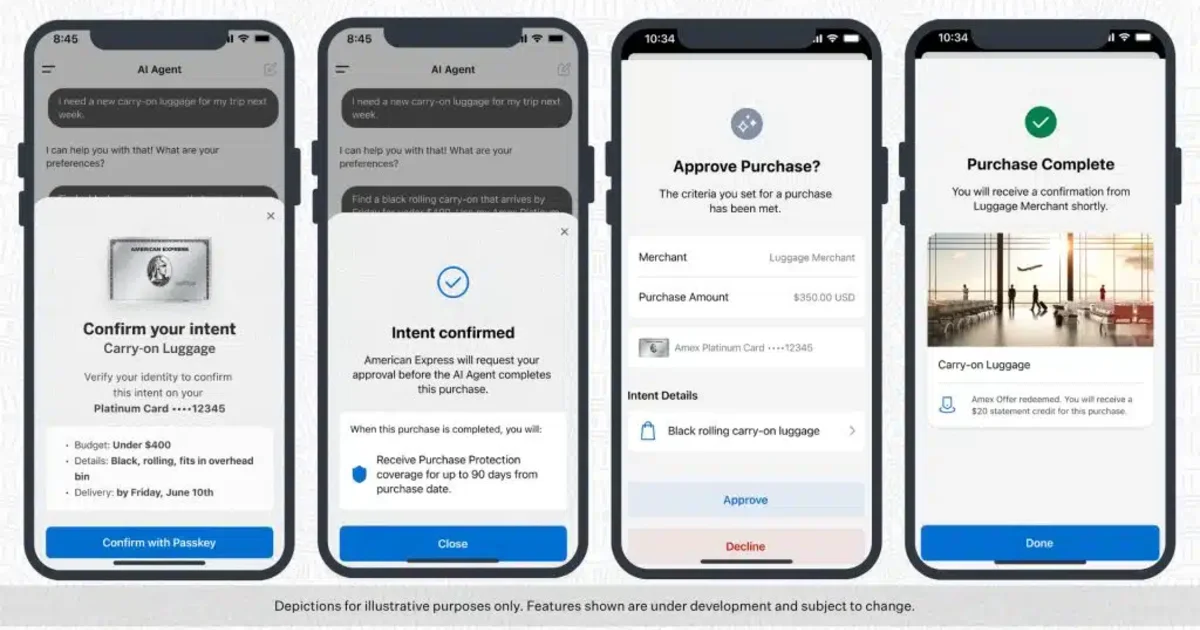
What the report singled out was Agentic Tokens, the new credential type that enables agents to transact safely. Built on the same tokenization technology that secures mobile and online payments today, Agentic Tokens encrypt the user's identity, the spending limit assigned to the agent, and the user's purchase intent (Verifiable Intent). The fact that "what the user actually agreed to" stays attached to the transaction data is, among the top three vendors, the most explicit implementation of intent binding.
The pace of geographic rollout also outclassed competitors. After launching in the US in April 2025, Agent Pay was integrated into the PayPal wallet in October 2025, expanded to Commonwealth Bank in Australia in January 2026, completed New Zealand's first agentic transaction with Westpac in February, and connected with Banco Santander in Spain in March to execute Europe's first end-to-end AI agent payment. Latin America and ASEAN (starting with Singapore and Malaysia) followed, and the "Agent Suite" platform that lets banks and merchants build agentic experiences without complex development was also rolled out in early 2026.
How Mastercard Differs from Visa and Stripe
The top three vendors take meaningfully different architectural approaches. For e-commerce operators evaluating vendors, it's worth laying out each company's strengths.
| Vendor | Architecture | Core Technology | Ecosystem Strength |
|---|---|---|---|
| Mastercard | Network layer | Agentic Tokens + Verifiable Intent | Global coverage, region-by-region launches |
| Visa | Network layer | Trusted Agent Protocol (TAP) | Reuses existing fraud detection, user-facing limit controls |
| Stripe | Processor layer | Shared Payment Tokens (SPT) | Developer experience, branded launches (URBN, Etsy, Coach) |
Stripe rapidly stacked up high-visibility brand launches in 2026 — URBN, Etsy, Coach, Kate Spade, Ashley Furniture, Revolve, Halara, Abt. The report, however, classifies this as "merchant-side adoption" and concludes it doesn't yet surpass Mastercard's network-wide coverage.
Visa centers its approach on the Trusted Agent Protocol (TAP), which issues cryptographic identity credentials to agents. Its advantage is that the existing Visa fraud detection and risk scoring stack can be reused as-is — but it lagged Mastercard on geographic launch milestones.
All three vendors have signed onto the Agent Payments Protocol (AP2), originally proposed by Google and donated to the FIDO Alliance. As of April 2026, a single agent can present a mandate that any of the three frameworks can validate, which materially lowers the difficulty of vendor selection.
How to Use This for Vendor Selection
This ranking isn't just a "Mastercard is best" story. What matters is that it lays out the evaluation criteria for agentic commerce vendor selection itself.
First, prioritize confirming whether live production deployments actually exist. The biggest reason Mastercard beat the field in Juniper Research's evaluation is that it completed real transactions in Europe, LATAM, and ASEAN. Don't take press release announcements at face value; confirm whether the implementation is actually live for cardholders in a specific region. This is how vendor strength becomes visible.
Second, the question of whether consent and intent leave a trace in the transaction record is decisive. Mastercard's Verifiable Intent cryptographically proves "what the user agreed to on the agent's behalf." When erroneous purchases or disputes occur, this becomes the basis for allocating responsibility between merchant, issuer, and consumer.
Third, match your customer distribution against each vendor's geographic coverage. If you're US- or Europe-centric, both Mastercard and Visa are at production scale. For operators with significant Latin America or ASEAN exposure, however, Mastercard's lead carries real weight in selection.
Given that AP2-based interoperability is becoming the baseline assumption, it's also worth designing for a "multi-rail" architecture that adopts multiple vendors in parallel.
Conclusion
Juniper Research's #1 ranking for Mastercard signals that agentic commerce has moved into the "implementation phase." The evaluation axes have shifted from test announcements to concrete results — region-by-region launches, live transactions, and bank-merchant partnerships.
For e-commerce operators, this ranking isn't an abstract industry update. It's a vendor-selection checklist you can use directly: live production track record, presence of intent trails, and geographic coverage. Evaluating vendors along these three axes is the starting point for building a payment strategy fit for the agentic commerce era.