Meesho's 75% AI-Driven Orders: Inside the India E-Commerce Player's Q4 FY26 Loss Cut and AI Stack
Meesho's Q4 FY26 results show 75%+ of orders now originate from AI-powered personalised feeds, net loss narrowed 88% YoY, and revenue rose 47%. We unpack PRISM, Vaani, GeoIndia LLM, and TrustMesh and how each rewrote unit economics.

Key Takeaways
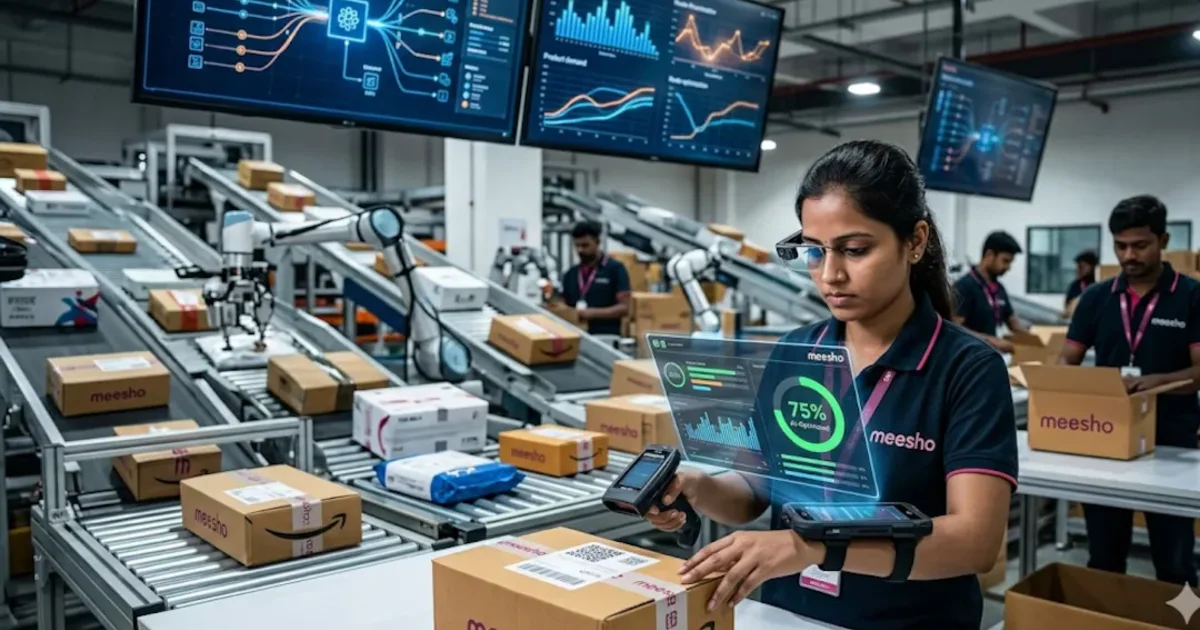
- Over 75% of orders on Meesho now originate from AI-personalised feeds rather than search, and more than 70% of platform code is AI-generated according to Q4 FY26 disclosures
- Net loss narrowed 88% YoY to Rs 166 Cr, revenue grew 47% to Rs 3,531 Cr, NMV rose 43% to Rs 11,371 Cr, and annual transacting users reached 264 million
- India-specific AI components such as PRISM, Vaani, GeoIndia LLM, and TrustMesh are improving delivery success and fraud control, lifting older cohorts close to adjusted EBITDA breakeven
How Meesho's Q4 FY26 Print Marks a Shift to AI-Led Discovery
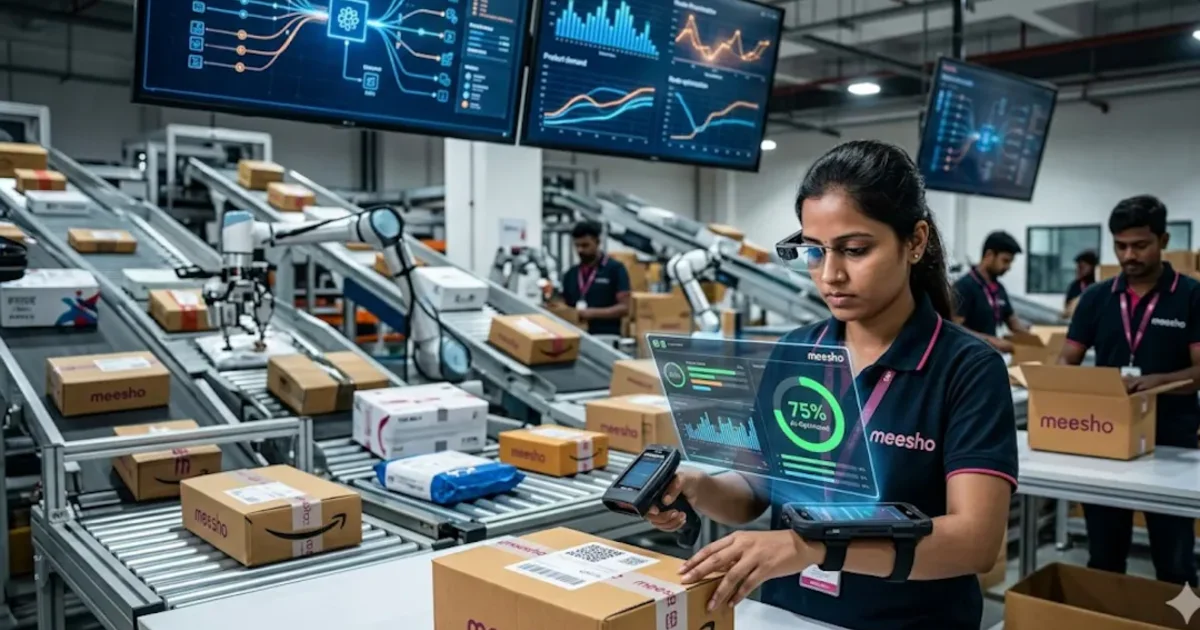
The data suggests that AI-led efficiencies are not just improving user experience but also strengthening unit economics.
www.ndtvprofit.comTwo numbers stood out from Meesho's Q4 FY26 print on May 6, 2026: 75% and 88%. More than 75% of orders on the Indian social-commerce marketplace now come from AI-personalised feeds rather than keyword search, and net loss narrowed 88% year over year to Rs 166 crore. The mix of those two data points signals that Meesho's primary shopping motion has quietly switched from search-driven discovery to AI-curated feed discovery.
At the centre is Meesho's in-house recommender, PRISM (Personalised Ranking and Intent Signal Module). Founder and CEO Vidit Aatrey said feeds, not search, now drive the bulk of orders, calling it "a fundamentally different way to think about e-commerce" (NDTV Profit). He also disclosed that more than 70% of Meesho's code is now AI-generated and that platform experiments have nearly doubled year over year.
The financials tell a parallel story. Q4 revenue hit Rs 3,531 crore, up 47% YoY. NMV reached Rs 11,371 crore, up 43%. Quarterly orders climbed 43% to 717 million, and annual transacting users grew 33% to 264 million (NDTV Profit Q4). For full-year FY26, revenue rose 34.5% to Rs 12,626 crore and net loss narrowed roughly 66% to Rs 1,357 crore (Inc42). The redesign of order flow is moving both the top and bottom lines.
PRISM Plus Three India-Specific AI Components
Meesho's disclosed AI stack splits cleanly into four components, each targeting a different unit-economics lever. PRISM gets the headlines, but reading them together is the only way to understand how the loss cut happened.
PRISM merges intent signals and ranking into a single recommender. Meesho's user base skews toward Tier-2 and Tier-3 cities, where typing exact product names is itself a friction. Aatrey's framing that "every order becomes a training example, every interaction makes the next one sharper" describes a self-reinforcing loop that works precisely because users are not constrained by what they can articulate in a search box.
The second component is Vaani, a conversational shopping agent for first-time internet users. Vaani guides voice and multi-language ordering. It crossed 1.5 million users in its first month and reportedly delivered a 22% conversion lift among adopters. The "user opens the app and doesn't know what to do next" cohort has long been the hardest segment for Indian e-commerce; Vaani lowers that barrier through dialogue rather than UI.
Third, GeoIndia LLM is a location intelligence model fine-tuned for Indian addressing. Meesho says it outperforms global geocoding systems on Indian pincodes. Delivery success rate is one of the few variables that directly moves marketplace unit economics in low-priced commerce, and absorbing address ambiguity inside the model is a structurally cheaper fix than adding manual ops.
Fourth, TrustMesh is the risk engine. The company disclosed that TrustMesh blocked 9 million high-risk transactions in FY26. For a high-volume, low-AOV marketplace, returns, chargebacks, and counterfeits are exactly where margin erodes. Automating credit and fraud decisions covers ground that manual review cannot.
How Unit Economics Actually Moved
Stack the components and the cohort math starts to make sense. Meesho disclosed that "older cohorts contributing roughly 75% of NMV are already at positive or close-to-breakeven adjusted EBITDA in Q4 FY26" (Inc42). As cohorts mature, profitability compounds through higher delivery success, stronger conversion, lower serving cost, and operating leverage.
There is a counterweight worth noting. Standalone marketplace adjusted EBITDA loss widened to Rs 198 crore in Q4 FY26 from Rs 109 crore a year earlier, and full-year FY26 adjusted EBITDA loss for the marketplace ballooned to Rs 1,178 crore, up roughly 9x. Meesho attributes the widening to (1) third-party logistics consolidation that shaved earlier cost benefits, (2) indirect marketing for new-user acquisition rising to Rs 990 crore from Rs 489 crore in FY25, and (3) AI infrastructure investment, including server, software, and AI engineer headcount.
Read together, AI-driven profit is showing up first in older cohorts while acquisition and infrastructure spend masks it on the consolidated print. That Q4 net loss also fell 66% sequentially suggests this investment cycle may be moving past its peak. Aatrey reframing Meesho as "a technology company that starts with the user and builds whatever it takes" doubles as a signal that AI reinvestment will continue.
Meesho's Place in India's E-Commerce Stack
These numbers fit a specific market structure. Aatrey noted that "in emerging markets like China, Southeast Asia, and Latin America, more than 80% of smartphone users shop online; in India, that number is around 30%." The remaining 70% is the addressable market Meesho is built for.
While Flipkart and Amazon India dominate metro and Tier-1 premium demand, Meesho has captured low-AOV, long-tail demand in fashion, household, and daily-use categories outside Tier-1. Long-tail SKUs at low prices leave little gross margin per unit, so unit economics has to improve through non-price levers: recommendation quality, delivery success, and fraud suppression. The AI stack targets those three exact levers.
The IPO context is also relevant. Meesho listed on BSE and NSE in December 2025; the issue priced at Rs 111 opened at Rs 162.50 and traded as high as around Rs 193 (TechCrunch). Aatrey's 11.1% stake briefly crossed the $1 billion mark. Q4 FY26 is the first post-IPO full-year print, and how aggressively those proceeds get redeployed into AI infrastructure and acquisition will be a structural input to where the equity story goes.
Three Takeaways for E-Commerce Operators
The Indian context has unique drivers, but several observations apply broadly. Three points stand out as design considerations.
1. Treat the Search-to-Feed Shift as a Real Migration
If 75%+ of orders flow through feeds rather than search, then product-page SEO and keyword bidding cannot remain the only acquisition design. Meesho's data forces a reweighting toward feed-ranking-friendly product data, behavioural data capture, and cohort-level attribution. These need to be operating at the same level as classic search optimization, not below it.
2. Plan for Asymmetric Payback on AI Infrastructure
The Meesho print shows that AI-driven profit lands first in older cohorts while acquisition and infra spend simultaneously expands the loss line. Boards and operators should track marketplace-only adjusted EBITDA by cohort and indirect marketing spend separately, not just consolidated net loss. Building an internal indicator set that tells a structural story is the practical way to keep AI investment funded across short-term PL noise.
3. Attack the Non-Price Levers (Logistics, Fraud, Language) First
Recommendation gets the press, but the unit-economics work was done by GeoIndia LLM and TrustMesh. Re-deliveries from address ambiguity, C2C fraud, and Tier-2 user drop-off all show up in margin in any market, not just India. Picking off delivery, credit, fraud, and CS one by one tends to be a better long-run AI investment than chasing recommendation gains alone.
Conclusion
Meesho's Q4 FY26 print is a clean case study of how an India-tailored AI stack can move e-commerce unit economics, in both the income statement and the cohort math. Feeds making up 75%+ of orders, an 88% net-loss narrowing, and 264 million annual transacting users together suggest AI reinvestment is a structural-improvement driver rather than a pure cost line. At the same time, the widening marketplace adjusted EBITDA loss is a reminder that AI payback arrives on a lag. The three patterns worth borrowing — the search-to-feed shift, cohort-level profitability tracking, and AI investment in non-price operational levers — generalize beyond India even when market conditions diverge.