Nike Joins Google's Agentic Commerce Push: Universal Cart, Gemini, and the Run-Up to the 2026 World Cup
Nike is investing in Google's Universal Commerce Protocol to bring its products into Gemini and AI Mode in June 2026 — a flagship brand-side move into agentic commerce timed for the FIFA World Cup.

Key Takeaways
- Nike is formally integrating with Google's agentic commerce stack, launching a multi-item Universal Cart experience inside the Gemini app and AI Mode in U.S. Search in June 2026
- The timing is anchored to the FIFA World Cup 2026, targeting peak demand for football boots, federation kits, and fan apparel — and lining Nike up as the flagship launch partner alongside Walmart, Sephora, Target, and Wayfair
- Nike's framing of the integration as a strategic "investment" in Universal Commerce Protocol signals a broader pattern: brands are starting to put real engineering and merchandising resources behind AI surfaces, forcing every retailer to rethink product data, inventory, and post-purchase CRM
A Nike Shelf Inside the AI Conversation

The experience aims to help consumers move more quickly from product discovery to checkout directly within conversations with AI agents.
consumergoods.comNike, the largest sportswear brand in the world, is stepping directly onto Google's agentic commerce stack. As Consumer Goods Technology reported on May 21, 2026, U.S. consumers will be able to discover and purchase Nike products from inside the Gemini app and Google Search's AI Mode starting in June 2026. The company itself frames the move not as an ad partnership but as a strategic "investment" in Google's new commerce infrastructure.
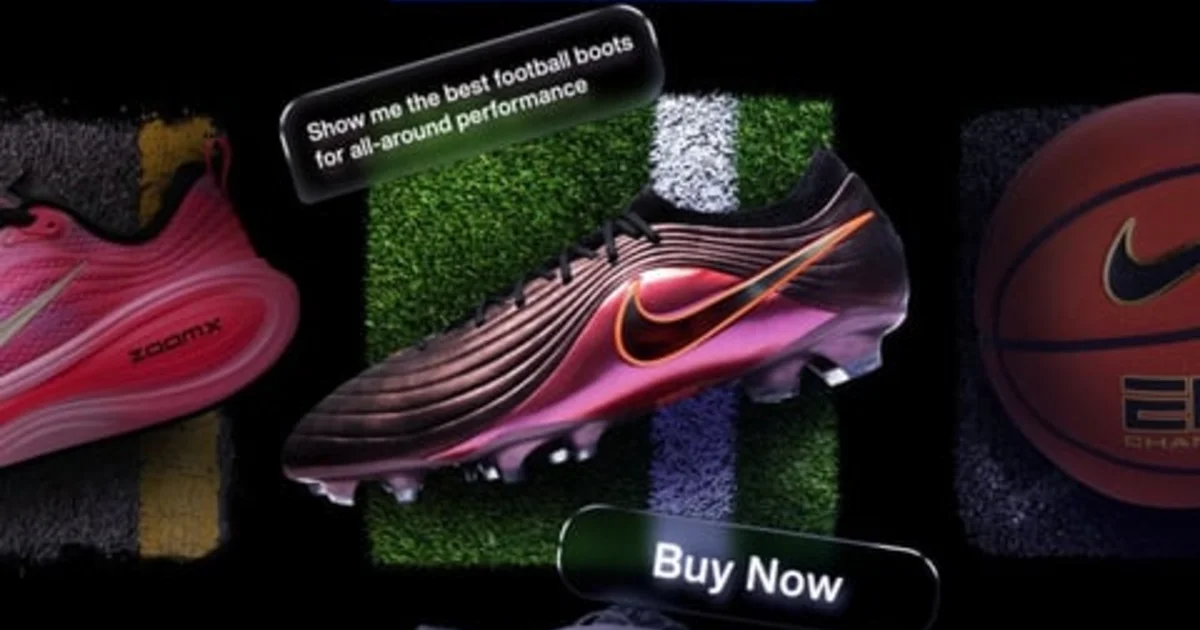
According to Nike's official release, Nike Is Serving Athletes Faster Through AI-Powered Shopping on Google, the integration uses multi-item checkout running on the Universal Commerce Protocol (UCP). Inside a Gemini conversation, a shopper can assemble football boots, federation kits, and fan apparel into a single cart and check out using payment and shipping information stored in Google Wallet. In effect, Search and Gemini become a new front door sitting one layer above Nike.com — a meaningful extension of the company's existing Direct-to-Consumer strategy.
Why June 2026 Matters for Nike
The timing is no accident. The FIFA World Cup 2026, jointly hosted by Canada, Mexico, and the United States, kicks off on June 11, and global search behavior tilts heavily toward football for the following two months. Shannon Glass, VP of Nike Direct, stated in the press release that "there's no better time than the world's biggest global football moment for us to show up with innovation that meets athletes when they're inspired and when sport is at its peak." The launch is bound to the sports marketing calendar by design.
For Nike, the World Cup is not just a sponsorship moment but the peak commercial window inside its Triple Double strategy (Innovation, Speed, Direct). Replica kits go viral immediately after matches, and social-driven impulse buys cluster into very narrow time windows. Where Nike would historically funnel that demand into Nike.com, the Nike App, or SNKRS, it has now chosen to plug its catalog directly into Gemini and AI Mode — one step upstream of any owned surface.
Stocktwits and AskTraders noted that NKE shares jumped in pre-market trading on the announcement, with the market reading "Google AI shopping × World Cup demand" as a clear combination. With the broader sports-apparel sector relatively soft in North America, Nike is being rewarded for treating AI commerce as a demand-creation lever, not just an efficiency play.
What "Investment" Really Means Here
The most telling word in the news is the one in the headline: "Google Agentic Commerce Investment." Consumer Goods Technology deliberately uses "investment" rather than "ad deal" or "marketing partnership," signaling that Nike is putting engineering resources, data work, and merchandising commitment into Google's new commerce infrastructure.
Google's official blog lists Nike alongside Sephora, Target, Ulta Beauty, Walmart, Wayfair, and Shopify-based brands like Fenty and Steve Madden as the first set of merchants supported by Universal Cart's checkout features. These are not casual early adopters; they are launch partners that have been involved in shaping UCP itself — feeding back on the protocol, integrating product feeds, and adapting their checkout flows for an agentic context.
Nike's release frames the move as part of its ongoing exploration of "world-class partnerships and leading-edge technologies that expand access to sport and style," and is explicit that Nike remains the Merchant of Record while expanding distribution into AI surfaces. The structural pattern echoes what L'Oréal has been doing with Beauty Genius and its own agentic commerce build-out — a brand-led investment into AI surfaces, rather than a passive listing exercise. Sports apparel is now following beauty into that same playbook.
Slotting Into Nike Direct as a Fourth Channel
Look closely at Nike's own statement and a deliberate framing emerges. The release lists the new capability in parallel with the rest of Nike Direct: "nike.com — celebrating its 30th anniversary this year — Nike's suite of apps including the Nike App, SNKRS and activity apps, and AI-powered shopping on Google."
Nike Direct is the umbrella term for the D2C investments Nike has been making since the 2017 Consumer Direct Offense and the 2020 Consumer Direct Acceleration. It is now a core revenue engine. Nike.com is celebrating thirty years; the Nike App ecosystem — running, training, SNKRS, and more — has become the company's main post-purchase engagement and loyalty surface. By naming a Gemini/AI Mode storefront on the same line, Nike is publicly redefining "Direct" to include not only its owned apps and sites but also its presence on AI platforms it does not own.
Crucially, this is not a lock-in to Google. As Fibre2Fashion notes, UCP is an open protocol — the same product feeds and inventory data can power other AI surfaces, including OpenAI/Stripe ACP integrations or Amazon's agentic experiences. Nike is choosing to ride the first wave so it can accumulate implementation know-how and behavioral data before the rest of the field catches up.
Reading the Launch Partner Lineup
The set of brands joining Universal Cart at launch tells you a lot about which categories Google wants this infrastructure to win in first.
| Category | Brands | Strategic angle |
|---|---|---|
| Sports | Nike | World Cup demand × global brand awareness |
| Beauty | Sephora, Ulta Beauty, Fenty | High intent, high-margin discovery |
| Mass retail | Target, Walmart | Long-tail SKUs from staples to bulky goods |
| Home & fashion | Wayfair, Steve Madden | Comparison-heavy, multi-item purchases |
Sports, beauty, mass retail, and home/fashion form a four-pillar coverage of consumer shopping, with the most globally recognized sports brand sitting at the top of the list. Nike is, in effect, becoming the showcase for Google's vision of agentic commerce — the brand whose performance during the World Cup will determine how aggressively other brands invest in their own UCP-based launches.
There is also a reinforcing incentive for early movers. Discovery rankings in AI Mode and Gemini will be driven by product data quality, real-time inventory accuracy, and checkout success rate. Brands that integrate earlier shape their catalogs into something AI can use cleanly, and stand a real chance of being one step ahead of competitors in agentic search results for several quarters.
Implications for Brands and Retailers
Nike's launch is not a far-off story even for merchants that will never be a UCP launch partner. The underlying challenge — becoming a brand that AI agents can see — is universal.
The first pressure point is product data. Universal Cart pulls in real-time catalog, inventory, pricing, and promotion data, and Gemini uses that to surface contextually relevant items inside a conversation. If product names, variants, fit details, and conversational attributes are missing or stale, the AI will not pick those products. The new AI performance insights tool in Merchant Center — which compares a brand's share of voice on AI surfaces against similar brands — is the first widely available diagnostic for this gap and worth adopting early.
The second pressure point is the post-purchase relationship. Because the brand remains the Merchant of Record even when checkout happens via Google Pay, customer data, fulfillment, and returns stay on the brand side. Discovery and payment move to Google's surface; retention has to be rebuilt from the brand's owned channels. Nike's careful framing — listing the Google integration alongside Nike App, SNKRS, and Nike.com — reflects exactly this asymmetric design, and the importance of pulling first-time AI-acquired customers back into owned engagement loops.
The third pressure point is operational. Universal Cart only works smoothly when catalog, inventory, payments, and customer support move in lockstep. Forrester's research notes that agentic purchases are still nascent at the consumer level, but the launch-partner cohort will set the operational baseline the rest of the industry is measured against over the next several quarters.
Closing Thoughts
Nike's framing of its Google integration as an "investment" in agentic commerce marks a turning point. Brands are now actively putting engineering, data, and merchandising resources behind AI platforms they do not own — and the launch is timed to the biggest sports-marketing moment of the year. Product data readiness, Universal Cart integration, and post-purchase CRM redesign are the questions every merchant should be working on, regardless of scale.
Whether Nike's World Cup play translates into measurable revenue and behavioral data will tell us a great deal about how the second half of 2026 plays out. There is a good chance this is the moment agentic commerce stops being an experiment and starts being a primary channel in serious brand plans.