Shinsegae Drops OpenAI Partnership After 11 Days — Pivots to 'AI Factory' with Reflection AI
South Korea's retail giant Shinsegae cancels OpenAI MOU just 11 days after signing, pivoting to Reflection AI for backend retail transformation. Walmart's ChatGPT checkout failure looms over the decision.

Key Takeaways
- South Korea's Shinsegae Group canceled its OpenAI MOU just 11 days after signing on April 6, pivoting to an "AI factory" partnership with US AI company Reflection AI
- The decision follows Walmart's experience with ChatGPT Instant Checkout, which converted at less than one-third its own website's rate, leading to partnership termination. ChatGPT integration alone no longer provides competitive differentiation
- Shinsegae is targeting infrastructure-level transformation with Reflection AI — covering sourcing, ordering, pricing, logistics, and inventory — marking a broader shift in retail AI strategy from "frontend integration" to "backend revolution"
11 Days with OpenAI — What Happened

Retail conglomerate Shinsegae is pivoting on its plans to deploy AI in its businesses, canceling a partnership with OpenAI.
www.koreatimes.co.krOn April 6, Shinsegae Group's Chief Strategy Officer Lim Young-rok signed an MOU with OpenAI Korea Country Manager Kim Kyung-hoon at The Westin Josun Seoul. The vision: co-develop "AI commerce" — an e-commerce model with advanced personalization powered by ChatGPT, positioning Shinsegae to lead Korea's retail market. The plan included deploying an AI shopping agent with "ultra-personalization" on the Emart online app (Korea's largest supermarket chain) within the year.
Just 11 days later, Shinsegae scrapped the MOU. The official explanation: "We decided to pursue a select-and-focus strategy to rapidly expand collaboration with Reflection AI into the retail sector and efficiently advance construction of an AI data center."
Walmart's Lesson Casts a Long Shadow
Shinsegae's abrupt reversal is heavily influenced by a high-profile predecessor's failure.
Walmart, the world's largest retailer, launched an "Instant Checkout" feature inside ChatGPT in November 2025 through its OpenAI partnership. The goal was an AI-first shopping experience from search through personalized recommendations to direct purchase. However, ChatGPT-driven checkouts converted at less than one-third the rate of Walmart's own website. Walmart executives described the experience as "unsatisfying," and the company terminated the partnership last month.
Industry experts cited by The Korea Times note that ChatGPT-based "AI commerce" is a concept already explored by multiple companies and would not give Shinsegae a competitive edge. The approach of leveraging ChatGPT's broad consumer awareness is being pursued simultaneously by several retailers, making it difficult to differentiate.
The Reflection AI 'Factory' Vision
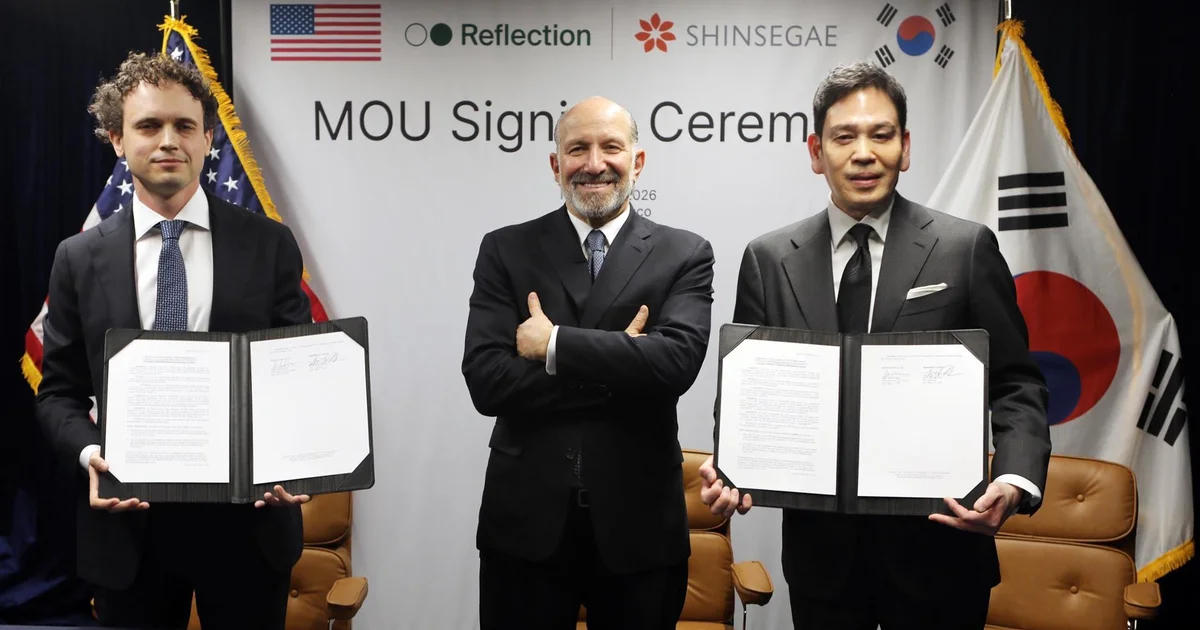
Shinsegae's new partner, Reflection AI, is a US-based AI company led by CEO Misha Laskin. Shinsegae Group Chairman Chung Yong-jin had already met Laskin and US Commerce Secretary Howard Lutnick in San Francisco on March 16, signing an MOU for building an "AI factory" in Korea.
Where the OpenAI partnership was fundamentally a frontend play — making ChatGPT the customer-facing shopping interface — the Reflection AI collaboration targets deeper structural transformation. Shinsegae has framed it as "AI retail innovation" encompassing product sourcing, ordering, pricing, logistics, inventory management, and customer management.
A Reflection AI delegation is scheduled to visit Seoul later this month to discuss concrete project initiation with Emart counterparts.
The Pivot Point — From Frontend to Backend
Shinsegae's strategy shift symbolizes a turning point in how major retailers approach AI.
From late 2025 through early 2026, many retailers experimented with general-purpose AI integrations for customer-facing shopping experiences — Shopify's agentic storefronts, David's Bridal's in-chat purchases, Salesforce's multi-AI integrations. But these "frontend integration" approaches share common challenges: low CVR, unsatisfying experiences, and limited differentiation.
What Shinsegae is pursuing with Reflection AI focuses not on the consumer-visible interface but on fundamentally rebuilding retail operations at the backend. Sourcing optimization, demand-driven dynamic pricing, and autonomous inventory management — these are more measurable and more defensible competitive advantages than frontend chatbots.
In Korea, Naver is accelerating its search-to-commerce transition with shopping AI agents, while Coupang and SSG pursue their own AI strategies. Shinsegae's "11-day pivot" may appear hasty, but it can also be read as rapid learning from others' failures, redirecting toward more fundamental AI investment.
Summary
ChatGPT integration alone won't create winners in retail AI — this recognition is spreading rapidly from Walmart to Shinsegae. The next phase of agentic commerce is shaping up to be a competition not over consumer-facing AI chat experiences, but over redesigning retail infrastructure itself with AI. Whether the Reflection AI "factory" delivers remains to be seen, but at least the question being asked is pointing in the right direction.