Shopify's Agentic Commerce Masterplan: Evolution Into AI Shopping Infrastructure and Stock Outlook
Shopify is transforming into an AI shopping infrastructure company. With AI-driven orders surging 15x and a platform processing $378B in GMV, we analyze the full picture.


Key Takeaways
- Shopify's AI-driven orders surged 15x from January 2025 to January 2026, accelerating its transformation into an agentic commerce infrastructure company
- Processing $378B in GMV (roughly 14% of U.S. e-commerce), the platform now connects to all major AI channels including ChatGPT, Google, and Microsoft
- The new "Agentic Plan" opens Shopify's AI commerce infrastructure to non-Shopify brands, signaling the shift from e-commerce platform to AI commerce infrastructure
Shopify's Grand Vision for Agentic Commerce

As consumers increasingly rely on AI to act as their personal shoppers, Shopify is ensuring its merchants capture every transaction.
www.tikr.comInvestment analysis platform TIKR has published a comprehensive report analyzing Shopify's agentic commerce strategy. At the March 2026 Morgan Stanley Technology Conference, Shopify President Harley Finkelstein declared that "agentic commerce could be one of the most exciting new paradigms for commerce, maybe since the Internet," making the company's strategic direction unmistakably clear.
This article goes beyond TIKR's analysis, incorporating Shopify's official announcements and reporting from TechCrunch and PYMNTS to provide a comprehensive view of Shopify's agentic commerce strategy.
AI-Driven Orders Surge 15x
The most compelling data point underpinning Shopify's strategy is that AI-driven orders increased 15x between January 2025 and January 2026. This isn't merely a traffic increase; it signals an actual shift in purchasing behavior toward AI channels.
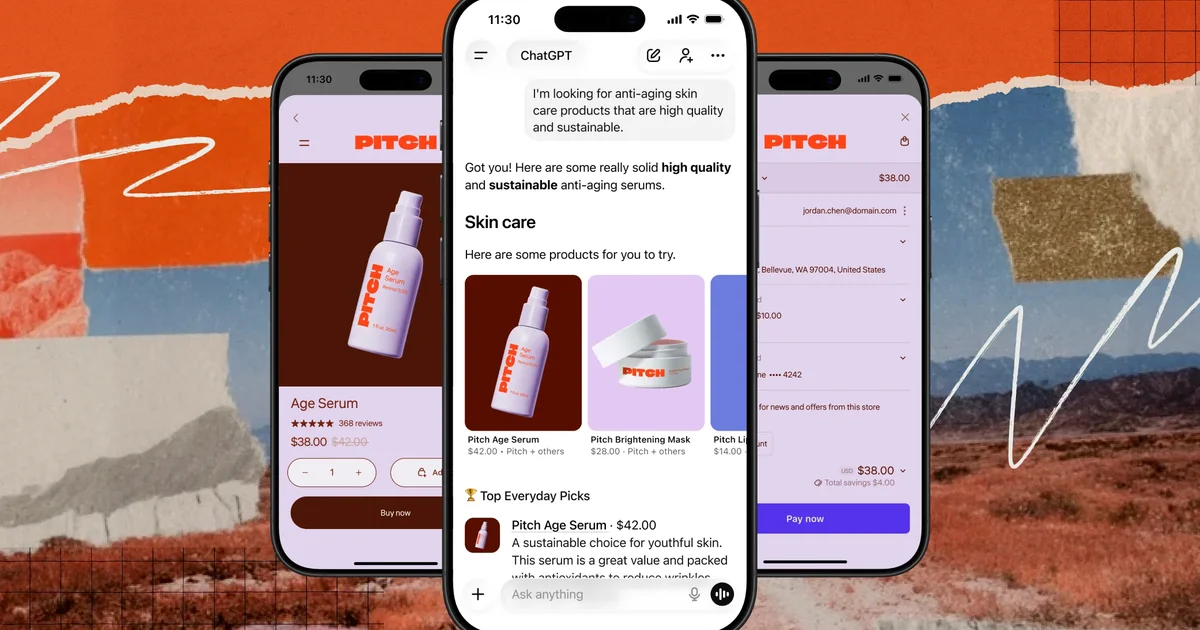
According to Shopify's official announcement, Agentic Storefronts began rolling out to millions of merchants during the week of March 24, 2026. An environment is taking shape where ChatGPT's "hundreds of millions of users" can purchase from Shopify merchants without ever leaving their chat.
The currently supported AI channels include ChatGPT, Microsoft Copilot, Google Search's AI Mode, and the Gemini app. Merchants need only configure settings once in their Shopify admin to publish their products across all channels.
The Power of $378 Billion in GMV
What TIKR's analysis particularly highlights is Shopify's sheer scale. The platform processes $378 billion in annual GMV, representing approximately 14% of all U.S. e-commerce. Full-year 2025 revenue reached $11.5 billion (up 30% year-over-year), with free cash flow of approximately $2 billion.
Agentic commerce will create so much opportunity not only for large retailers but also for the long tail of merchants.
The significance of a platform at this scale functioning as AI commerce infrastructure cannot be overstated. For AI agents, Shopify represents the most efficient counterparty, offering unified access to product data, inventory, payments, and fulfillment.
Universal Commerce Protocol (UCP) and Agentic Storefronts
The technical foundation of Shopify's agentic commerce strategy is the Universal Commerce Protocol (UCP), co-developed with Google. UCP functions as a "translation layer" that enables AI agents to access real-time inventory data, subscription discounts, loyalty points, and more, converting recommendations into executable transactions.
Over 20 companies support UCP, including Walmart, Target, Etsy, American Express, Mastercard, Visa, and Stripe. UCP will also power checkout in select Meta experiences.
Meanwhile, Agentic Storefronts are the concrete product built on UCP. Merchants simply enable the feature with one click in their admin dashboard to syndicate their product catalog across multiple AI channels. As of March 2026, this is enabled by default for all Shopify stores.
Opening to Non-Shopify Brands: The Agentic Plan
Perhaps the most strategically significant move is the "Agentic Plan." This allows companies without a Shopify e-commerce store to register products in Shopify Catalog and sell through AI channels. Estee Lauder, Birkenstock, and Starbucks are among the major brands already participating.
This symbolizes Shopify's transformation from an "e-commerce platform" to an "AI commerce infrastructure company." Even businesses using competing e-commerce platforms can now choose to leverage Shopify's infrastructure solely for the AI commerce layer.
Stock Impact and Investor Perspective
TIKR's analysis notes that against Shopify's current stock price of $118, Wall Street's consensus price target stands at $160.15. TIKR's own model projects $414 by late 2030, implying an annualized return of approximately 30%.
The NTM (next twelve months) EV/Revenue multiple sits at 10.08x, a significant premium over Wix (2.24x) and GoDaddy (2.60x). TIKR attributes this gap to the fundamentally different nature of Shopify's transaction-based revenue model compared to flat-fee competitors. A structure where revenue scales automatically with transaction volume becomes even more advantageous in the agentic commerce era.
What E-Commerce Businesses Should Consider Now
What Shopify's moves demonstrate is that the competition for AI commerce infrastructure has already begun.
According to TechCrunch's reporting, Finkelstein explained that "while a search engine might display generic results when searching for sneakers, an agentic system would learn individual preferences and deliver optimal recommendations." If this kind of "personalized purchase delegation" becomes reality, the accuracy and structure of product data will become even more critical than traditional SEO.
Businesses currently on Shopify are already participating in AI commerce, since Agentic Storefronts are enabled by default. The depth of product data and optimization of metadata will increasingly determine whether AI agents select their products.
While the timeline for expansion beyond the U.S. market remains unclear, infrastructure development is advancing rapidly. E-commerce businesses worldwide should begin preparing their product data structures for AI agent compatibility.