Shopify Agentic Storefronts — What AI-Enabling Millions of Stores Really Means
Shopify Agentic Storefronts auto-connect 5.6 million stores to ChatGPT, Gemini, and Copilot, driving an 11x surge in AI-attributed orders. From co-developing UCP to the Agentic Plan, here is the full picture.

Key Takeaways
- Shopify Agentic Storefronts auto-connect 5.6 million stores to ChatGPT, Gemini, and Copilot, with AI-attributed orders growing 11x since January 2025
- Co-development of UCP with Google, a proprietary Catalog API, and three MCP servers form the infrastructure that lets AI agents handle the full search-to-checkout flow
- The free Agentic Plan opens the door to non-Shopify brands, signaling a shift from e-commerce platform to AI commerce infrastructure company
Shopify Agentic Storefronts Open a New AI Commerce Channel
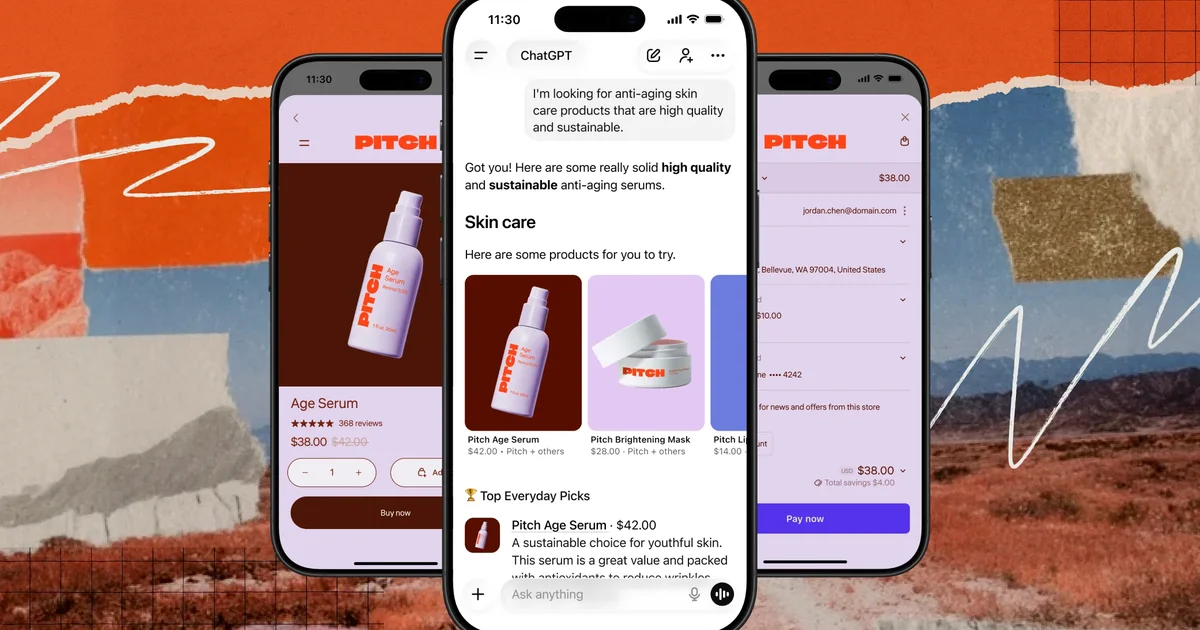
On March 24, 2026, Shopify began the full rollout of Agentic Storefronts across its approximately 5.6 million merchants. Products are now discoverable and purchasable inside conversations on ChatGPT, Microsoft Copilot, Google Search AI Mode, and the Gemini app.
What makes this noteworthy is that it goes beyond simple channel addition. Unlike traditional marketplace integrations, AI agents narrow down products through dialogue with consumers and guide them all the way to checkout. The search-compare-buy journey now completes outside the browser. This structural shift, known as agentic commerce, has been met by Shopify with a platform-scale response: connecting millions of stores at once.
The Story Behind the 11x Order Surge
So how significant is the impact? The numbers Shopify disclosed in March 2026 speak for themselves.
Between January 2025 and March 2026, AI-attributed orders grew 11x. AI referral traffic rose 7x over the same period. The fact that order growth far outpaces traffic growth deserves attention. AI agents use conversation to narrow down budgets, sizes, and shipping requirements, presenting a short, ranked list of buyable options. As a result, AI chatbot referral conversion rates reach 7%, roughly eight times higher than social media traffic.
This dynamic is fundamentally different from SEO or paid search. Instead of consumers choosing from a list of search results, the agent returns a single answer: "This is the best option for you." Whether a product gets selected depends on data quality, which is why data readiness is becoming a decisive competitive advantage.
The typical Shopify store provides 5 to 8 structured product attributes, but AI agents need 30 or more to make confident recommendations. This gap exists, and the merchants who close it will capture outsized share of the AI channel.
The Strategic Logic of Opt-Out by Default
A defining feature of the Agentic Storefronts rollout is Shopify's choice of an opt-out model — enabled by default. Merchants are connected to AI channels without lifting a finger. No additional apps, no extra transaction fees.
The reasoning is straightforward. Under an opt-in model, adoption stays low, AI platforms lack sufficient product coverage, consumer experiences remain limited, and channel growth stalls. Shopify solved this chicken-and-egg problem in one stroke by onboarding 5.6 million stores at once.
Shopify VP of Product Mani Fazeli stated that "agentic commerce is not something we're chasing — it's a vision we're building toward." Two decades of unifying commerce infrastructure made this massive rollout possible.
Technical Foundation: The UCP, MCP, and Catalog API Stack
Behind Agentic Storefronts lies a sophisticated technical stack connecting AI agents to stores. Here is a closer look at the three-layer architecture.
Universal Commerce Protocol (UCP)
UCP is an open standard co-developed by Shopify and Google. It serves as a common protocol for AI agents to execute product search, cart management, and payment processing.
Technically, UCP employs a layered design: Shopping Service (transaction primitives such as checkout sessions, line items, totals, and status), Capabilities (independently versioned functional blocks), and Extensions (domain-specific schemas). Merchants publish profiles at /.well-known/ucp on their domains, and agents match supported capabilities through a mutual negotiation mechanism.
Checkout defines three states: incomplete (missing required information), requires_escalation (human intervention needed), and ready_for_complete (ready for programmatic finalization). This design cleanly separates what agents can handle autonomously from what requires human involvement.
Over 20 organizations support UCP, including Walmart, Target, Etsy, Wayfair, American Express, Mastercard, Stripe, and Visa, positioning it as an industry standard rather than a single-company specification.
MCP (Model Context Protocol) Servers
Shopify provides three MCP servers, each targeting a different use case.
| MCP Server | Purpose | Target Users |
|---|---|---|
| Dev MCP | Documentation search, API schema exploration, code generation | Developers |
| Storefront MCP | Product search, cart management, checkout processing | AI Agents |
| Catalog MCP | Cross-store product graph search across all of Shopify | AI Agents |
The Dev MCP server can be set up in five minutes with a single CLI command, giving AI coding tools like Claude Code and Cursor direct access to Shopify documentation, API schemas, and development resources. A full Storefront MCP integration (backend plus chat UI) takes roughly 2 to 4 weeks.
Shopify Catalog API
The Catalog API is an index that enables cross-store search across billions of product listings on Shopify. What sets it apart is automated data enrichment via dedicated multimodal LLMs. According to Shopify Engineering, the system executes 40 million LLM inferences per day (approximately 16 billion tokens), automating category inference, attribute extraction, and variant consolidation.
Raw product data uploaded by merchants is automatically enriched with usage context, compatibility logic, and policy information by the Catalog API. This enables AI agents to deliver precise recommendations against natural-language queries like "casual jacket for a 30-year-old man, budget under $400."
Supported AI Channels and Checkout Flows
As of April 2026, Agentic Storefronts connect to four live AI channels plus one in preparation.
| AI Channel | Connection Method | Checkout Flow | Status |
|---|---|---|---|
| ChatGPT | Via ACP | Mobile: in-app browser / Desktop: redirect to store | Live |
| Google AI Mode / Gemini | Via UCP | Embedded Checkout Protocol (ECP) | Live |
| Microsoft Copilot | Proprietary API | In-Copilot checkout (Shop Pay coming soon) | Live |
| Shop App | Shopify internal | Shop Pay | Live |
| Meta | Via UCP | TBA | In preparation |
Across all channels, inventory and pricing sync in real time. Branding, pricing logic, and checkout experience can be centrally customized from the Shopify admin. Orders appear in the admin with per-channel attribution, enabling granular AI channel performance measurement.
The relationship with OpenAI has also evolved. OpenAI initially promoted "Instant Checkout" for direct in-chat payments, but subsequently pivoted to prioritize product discovery and search experience. Checkout now redirects to the merchant's own storefront, meaning post-purchase upsell tools fire normally and customer data ownership stays with the merchant.
The Agentic Plan: Opening the Door to Non-Shopify Brands
Among the announcements in Shopify's official release, the Agentic Plan stands out. This subscription targets brands that do not use Shopify as their e-commerce platform. It is free per month — merchants pay only payment processing fees.
The plan is designed for brands on Magento, Salesforce Commerce Cloud, custom stacks, or any other non-Shopify infrastructure. Without migrating their existing e-commerce setup, they can register product data in Shopify Catalog and start selling on ChatGPT, Copilot, Google AI, and the Shop App.
The strategic implications are significant. Shopify is expanding its role from e-commerce platform to AI commerce infrastructure layer. As platform competition shifts from store lock-in to data distribution network building, Shopify's masterplan is taking concrete shape.
Actions E-Commerce Merchants Should Take Now
Finally, here is a practical checklist for Shopify merchants and e-commerce businesses.
Expand product data attributes to 30 or more (material, use case, target age, compatibility, etc.)
Review the Agentic Storefronts settings in Shopify admin and confirm per-channel enable/disable configuration
Register brand policies, FAQs, and brand voice in the Knowledge Base App to improve AI response accuracy
Regularly review ChatGPT referral attribution data and measure AI channel ROI
Non-Shopify merchants: evaluate the Agentic Plan and assess the cost of entering AI channels
Whether an AI agent "recommends" your product comes down to data quality and structure. The infrastructure is in place with Agentic Storefronts. The competition now is about how you present your products on top of it.