Tiger Research's 'Payments 3.0' — Reading the AI Agent Payment Standards War Across Two Markets: Agentic Commerce and Pay-Per-Call
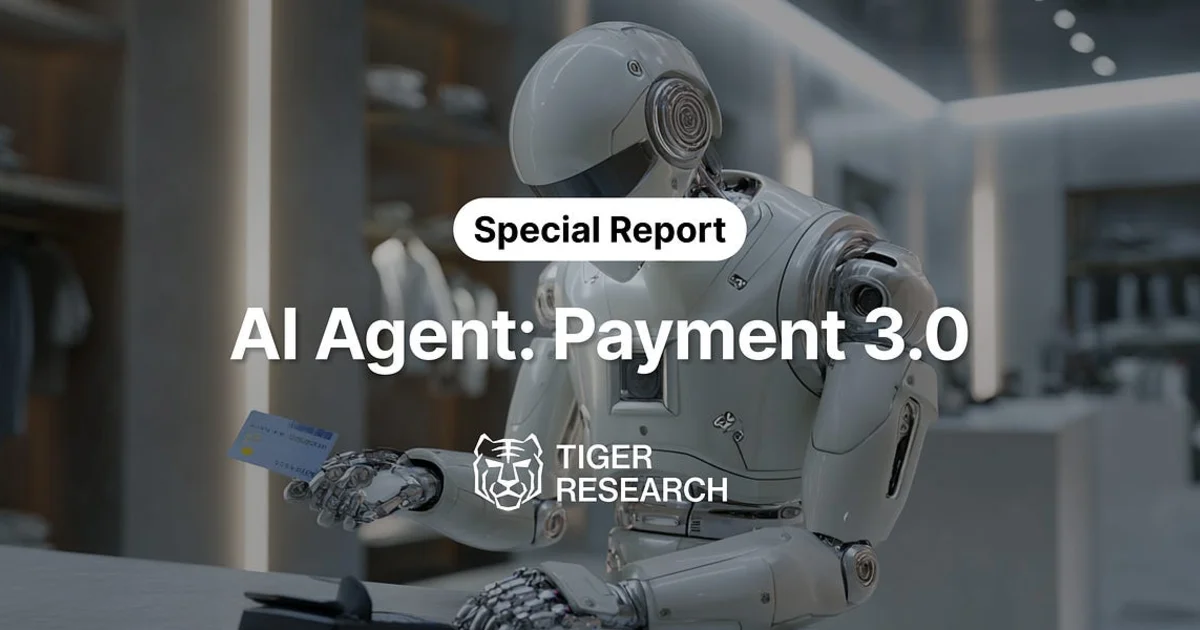
Tiger Research's 'Payments 3.0' splits the AI agent payments market into Agentic Commerce and Pay-Per-Call, and breaks down how Google AP2, OpenAI ACP, Visa, Mastercard, Stripe MPP, Coinbase x402, and Circle USDC are positioning to win.

Key Takeaways
- Tiger Research's 'Payments 3.0' (April 27, 2026) splits AI agent payments into Agentic Commerce (humans delegating shopping to agents) and Pay-Per-Call (agent-to-agent API micropayments), and tracks the eight standard protocols launched in 2025 alone
- Card networks (Visa, Mastercard) are not betting on a single protocol but staying neutral so they collect fees on whichever standard wins; Stripe covers both markets via ACP+SPT and MPP+Tempo; Coinbase and Circle anchor Pay-Per-Call on stablecoin rails
- The conclusion is sharp: Agentic Commerce is already taking shape on top of existing systems, while Pay-Per-Call's winners will only be decided once the market actually opens — merchants and PSPs need a dual-track strategy and delegated-payment operations now
Protocol Sprawl Has Finally Earned the Word 'War'
The agent payment standards war has begun. Google, OpenAI, Visa, Mastercard, Stripe, Coinbase, and Circle have each rolled out their own protocols.
reports.tiger-research.comOn April 27, 2026, Korea-based research house Tiger Research published 'Payments 3.0 The AI Agent Payments Market,' a structural read of where AI agent payments stand today. The report opens by noting that eight agent payment standards launched in 2025 alone, and frames the moment as a structural transition similar to when Visa and Mastercard locked in card payments for offline commerce. The standards battle for the AI agent era, in other words, is happening right now.
What stands out is how Tiger Research carves the market in two. One side is Agentic Commerce, where humans delegate shopping to agents within a defined budget. The other is Pay-Per-Call, where agents pay other agents autonomously for APIs, data, and compute. The first is the near future already in motion; the second is a more distant world. Each player's moves only make sense when read against which of these two markets they are building for.
Agentic Commerce — A Fight Between the Discovery and Payment Layers
Agentic Commerce is the world where you tell an agent 'prepare my Tokyo trip next week' and it sequentially books flights, hotels, transfers, and insurance within your budget. The market splits into two layers: the Discovery layer, where the agent finds products on the user's behalf, and the Payment layer, where settlement happens within the user's authorized scope.
Google is going after both layers at once. UCP (Universal Commerce Protocol) standardizes how agents talk to merchants on the Discovery side, while AP2 (Agent Payments Protocol) functions as the authority standard, recording 'who authorized what, up to how much' as a tamper-proof Mandate. AP2 is geographically continuous with Google's existing Android, Chrome, and Google Pay footprint — a stack designed to keep purchases end-to-end inside Google's infrastructure. Tiger Research argues this is a rerun of Google's 2008 Android playbook: open the standard, build the ecosystem, monetize through Play Store and Google Pay.
OpenAI's posture is the inverse. The ACP (Agentic Commerce Protocol), co-built with Stripe, never hands the user's card number to the agent — instead, the PSP issues a single-use Delegate Payment token scoped to one merchant, one amount, one expiry, and one checkout session. But ChatGPT's Instant Checkout, launched in September 2025, ran into inventory sync, tax, and conversion issues, and OpenAI wound it down in March 2026, returning payment to merchants and narrowing ChatGPT's role to product Discovery. This is recalibration rather than retreat — the Hiro Finance acquisition is expected to rebuild the financial backbone before re-entry. (See our BTIG analyst breakdown for the merchant impact.)
The harder reality for OpenAI is that, unlike Google, it has no advertising or cloud business to buy time with. The whole bet rides on whether ChatGPT can replace the starting point of shopping the way it replaced search.
Why the Card Networks' 'Neutral Strategy' Is So Strong
Visa and Mastercard reveal the deep logic of the standards war by refusing to enter it. Neither is trying to win with its own protocol.
Visa rolled out Visa Intelligent Commerce in April 2025, with Intelligent Commerce Connect explicitly designed to accept competing protocols. Buyer-side platforms like OpenAI, Anthropic, and Perplexity sit on one end; Shopify and Stripe sit on the other. Tiger Research's framing is sharp here: the protocol war is zero-sum for participants, but Visa collects fees from both winners and losers. With 4.8 billion cards and 150 million merchants in place, only Visa can credibly take this position. The 'embrace strategy' isn't yielding ground — it is the most advantageous slot on the board.
Mastercard plays the same game on a single front. Mastercard Agent Pay, in partnership with Cloudflare, distinguishes 'trusted agent vs. malicious bot' at the merchant's edge automatically, so merchants accept agent traffic without writing a line of new code. Visa is already broadening its line by responding to stablecoins (Bridge acquisition, Tempo validator participation), while Mastercard can still concentrate on the merchant-acceptance layer.
The variable for both is the same. If agent-to-agent payments settle directly on-chain in stablecoins, the card network is bypassed entirely. Visa's earlier movement on this front reflects how seriously it is taking that risk.
Stripe's Full Coverage — Open the Protocol, Close the Rails
Stripe's strategy is the most ambitious player in the report. It is the only payment company embedding its own standards into both Agentic Commerce and Pay-Per-Call.
On the Agentic Commerce side, Stripe co-released ACP with OpenAI as an open standard, but pairs it with its own payment primitive, SPT (Shared Payment Token). The moment a merchant adopts SPT, Stripe's adjacent services — fraud, tax, subscription management — bind in as a bundle. On the Pay-Per-Call side, Stripe published MPP (Machine Payments Protocol) in tandem with Tempo's mainnet on March 18, 2026. MPP differs from x402 on two decisive points. First, payment-method neutrality: stablecoins, cards, and Lightning all sit on the same protocol. Second, Sessions support: an on-chain escrow at the start, off-chain voucher exchanges in the middle, one final on-chain settlement at the end — a design that targets 1M+ transactions per second.
The most telling moment in the report is that Visa joined MPP as a card-rail extension partner. Visa was previously building an independent ecosystem with its own Trusted Agent Protocol; with MPP's launch, it pivoted to embedding card rails inside a rival's protocol. Cuy Sheffield, Head of Crypto at Visa, described MPP as 'another way to clearly define how agents and merchants communicate.'
Stripe's vulnerability is structural. Today's revenue still rides on top of the Visa and Mastercard networks. Tiger Research's metaphor lands hard: 'If Visa and Mastercard run the highway, Stripe is the most successful logistics company on top of it.' The OpenAI relationship is also not permanent — if ChatGPT pulls in another PSP after enough volume accumulates, Stripe loses its largest AI channel.
Pay-Per-Call Belongs to Crypto-Native Players — Coinbase vs. Circle
Pay-Per-Call is the world where agents pay other agents in $0.01 or $0.005 units for API calls, image classification, or one minute of GPU time. Card networks ($0.30 + 2.9% per transaction) cannot hold this unit economics, so stablecoins become the default rail.
Coinbase released x402 in May 2025, finally activating the dormant HTTP 402 'Payment Required' status code. When an agent calls an API, the server returns a 402 with price, recipient address, asset, and network details; the agent signs the payment with its own wallet and re-requests. Payment itself functions as authentication. Coinbase doesn't monetize x402 directly — the play is the infrastructure underneath the standard: Base (Coinbase's L2 with sequencer revenue) and the Coinbase Developer Platform (Facilitator, wallets, gas sponsoring, analytics). Tiger Research likens this to Google's Android model.
Circle plays a different layer entirely. As the only full-stack player holding USDC issuance rights, Circle vertically integrates payment primitives (Nanopayments), settlement chain (Arc), and wallets (Developer-Controlled Wallets). USDC running on Tempo is also issued by Circle. Whoever wins the chain race, when stablecoin payments grow, Circle's reserves grow with them. Of Circle's $2.7B total revenue and reserve income for 2025, more than 95% comes from interest on those reserves. The structure compounds with agent payment volume regardless of which protocol or chain wins.
Two more players come at the market from different angles. The Ethereum Foundation's ERC-8004 is a 'trust layer rather than payment' standard, recording agent identity, reputation, and validation results on-chain. Whichever payment protocol prevails, the evidence accrues in an ERC-8004 environment. Kite AI takes the opposite path — designing chain, identity, sessions, and reputation as one stack from scratch, purpose-built for agents, with both PayPal and Coinbase Ventures as backers.
Protocol Comparison — Where Each Camp Is Actually Fighting
Boiled down to one view, the positioning becomes clear.
| Protocol / Camp | Provider | Target Market | Differentiator |
|---|---|---|---|
| UCP / AP2 | Agentic Commerce (Discovery + Payment) | Layers the standard onto AI Mode, Android, and Google Pay to lock in both layers | |
| ACP | OpenAI (with Stripe) | Agentic Commerce (Discovery-leaning) | Recalibrating ChatGPT to be the start of shopping while handing payment back to merchants |
| Intelligent Commerce | Visa | Agentic Commerce (payment-neutral) | Accepts rival protocols so Visa earns fees regardless of which standard wins |
| Agent Pay | Mastercard | Agentic Commerce (merchant acceptance) | Cloudflare integration lets merchants accept agent payments without changing a line of code |
| ACP+SPT / MPP+Tempo | Stripe | Both markets (cards + stablecoins) | Open the protocol, close the rails: pulls payments and chains into Stripe-native infrastructure |
| x402 | Coinbase | Pay-Per-Call | Activates HTTP 402 as a real payment layer, monetized via Base L2 and CDP |
| USDC / Arc / Nanopayments | Circle | Pay-Per-Call (asset layer) | Vertically integrates issuance, chain, and wallets so USDC demand grows whoever wins |
| ERC-8004 | Ethereum Foundation | Trust layer for both markets | Standardizes agent identity and reputation rather than payments, anchoring EVM as the default |
The takeaway is that the battle plays out on different layers. Discovery (who is the start of shopping) is Google vs. OpenAI. Payment Authority (who owns the approval standard) is Google AP2 vs. OpenAI ACP. Settlement (where money actually moves) is card networks vs. stablecoins. Trust (the evidence of the transaction) is led by Ethereum's ERC-8004. The standards war is not a single front — it is a set of parallel battles per layer, and reading it as one is the source of most strategic confusion.
Tiger Research's Bottom Line — Agentic Commerce First, Pay-Per-Call Later
The report's closing argument is unambiguous. Agentic Commerce will succeed; the question is no longer 'will this market open?' but 'who will capture it?' With Walmart, Etsy, and Shopify aligned as Google and OpenAI partners and the payment networks behind them, the market-formation risk is now low.
Pay-Per-Call is a different story. OpenAI, Anthropic, and AWS already run on monthly subscription or postpaid usage billing. If an agent calls an API and the platform aggregates it into a card-billed monthly invoice, the result is functionally identical to existing SaaS billing. From a corporate finance team's perspective, there is no incentive to switch to a structure that doesn't yet exist in their workflow. x402 and MPP only become genuinely necessary when agents need to procure resources from unregistered, unsigned-up providers at dozens of calls per second with sub-$0.001 unit prices — speeds and price points the subscription model physically cannot handle.
Pay-Per-Call's winners will only be decided once trust and autonomy in agents have accumulated through Agentic Commerce. Agentic Commerce winners are already in the race; Pay-Per-Call winners get crowned when the market actually opens.
What Merchants and PSPs Should Be Doing Now
Three implications matter for e-commerce operators and payment-strategy teams.
First, supporting both UCP and ACP on the Agentic Commerce side is becoming a baseline requirement. Last week, Amazon, Meta, and Microsoft joined Google's UCP Tech Council (see our breakdown), while OpenAI's ACP shifted weight toward Discovery after Instant Checkout's pullback. The two specs are converging more than expected, and betting solely on one no longer makes sense.
Second, PSP selection criteria need revisiting. Visa Intelligent Commerce Connect and Mastercard Agent Pay both emphasize protocol neutrality, but Stripe's SPT/MPP, Checkout's agentic stack, and Adyen's moves each pull in different sets of standards with different operational frictions. Tokenization, 3DS, dispute handling, and loyalty program integration over agent-driven transactions become selection axes that go well beyond rate sheets.
Third, how aggressively to track Pay-Per-Call varies sharply by business model. Companies selling LLM APIs, data APIs, or compute should be early on x402 or MPP — share will follow first movers. Consumer e-commerce operators do not need to act this quarter. Circle's structural lock on USDC issuance is worth keeping in the watch list as a hedge for the day stablecoins do become the dominant payment rail.
Wrapping Up
Tiger Research's 'Payments 3.0' moves the conversation about AI agent payments from 'future story' to 'this quarter's decision'. The two-market framing, the rationality of card networks staying neutral, Stripe's full-coverage stance, the layer-by-layer plays of Coinbase and Circle, and Ethereum's bet on the trust layer — all of these are essential reference lines for redrawing the front line.
For merchants and PSPs, the practical answer is not to plant a flag in one camp but to build operations that quietly handle multiple standards in parallel across catalog, payments, identity, and trust. Standards reward early adopters at the testnet stage, not those who wait until the dust settles. By the time AI agents are seriously holding consumers' wallets, the operational muscle built in the messy middle is what will decide who wins.