
- 01
Conversational support flows (chat, LINE, automated replies, chatbots) were confirmed at 5 of 7 companies. Of those, flows that advance to a next action such as repair or inquiry were found at 4 companies.
- 02
Natural-language AI chat was confirmed at only 1 company (Nojima), and Phase 4 — where a repair-intake chat drives the actual procedure — at only 1 company (Yamada HD).
- 03
No company reached Phase 5, the "agent type" that links to purchase history, warranties, and personal information to semi-automatically complete a procedure. Public support flows currently center on a combination of FAQ search, chat/LINE, automated replies, and inquiry forms.
- Survey name
- Support-Site AI Readiness Survey of 7 Major Electronics Retailers
- Subjects
- The public support sites or public support flows of seven major Japanese electronics retailers
- Companies
- Yamada HD, Nojima, Bic Camera, Yodobashi Camera, EDION, K's HD, Joshin
- Survey date
- July 10, 2026
- Method
- Audit of public flows across official support sites, official FAQs, inquiry pages, and official LINE accounts
- Data captured
- FAQ/search, chat/LINE, natural-language consultation, next-action support, linkage with purchase history and warranties, and phase
- Aggregation
- Assigned the highest reachable point confirmable on official pages as a phase, and counted companies out of seven
- Conducted by
- Stellagent Inc.
Summary
Stellagent Inc. surveyed the state of AI chat, automated replies, FAQ search, and repair/inquiry flows across the public support sites and public support flows of seven major Japanese electronics retailers. Using a single standard, we checked how far a consumer can get within a support flow, and whether the experience is approaching an agent-type experience that links to purchase history and warranty information.
| Metric | Result |
|---|---|
| Subjects | 7 major electronics retailers |
| Companies with a conversational flow (chat/LINE/automated reply) | 5 of 7 |
| Companies with natural-language AI chat | 1 of 7 (Nojima) |
| Companies with next-action support (repair, inquiry, etc.) | 4 of 7 |
| Companies linking AI/chat with purchase history, warranty, repair intake, etc. | 0 of 7 |
| Phase 5 "agent type" | 0 companies |
The survey found that conversational flows including chat, LINE, and automated replies were confirmed at 5 of 7 companies, and next-action support such as repair and inquiries at 4 of 7 companies. Meanwhile, the "agent type" (Phase 5) — where AI/chat links to purchase history, warranties, and repair intake to semi-automatically complete or hand off an inquiry or procedure — could not be confirmed in any public flow (0 companies).
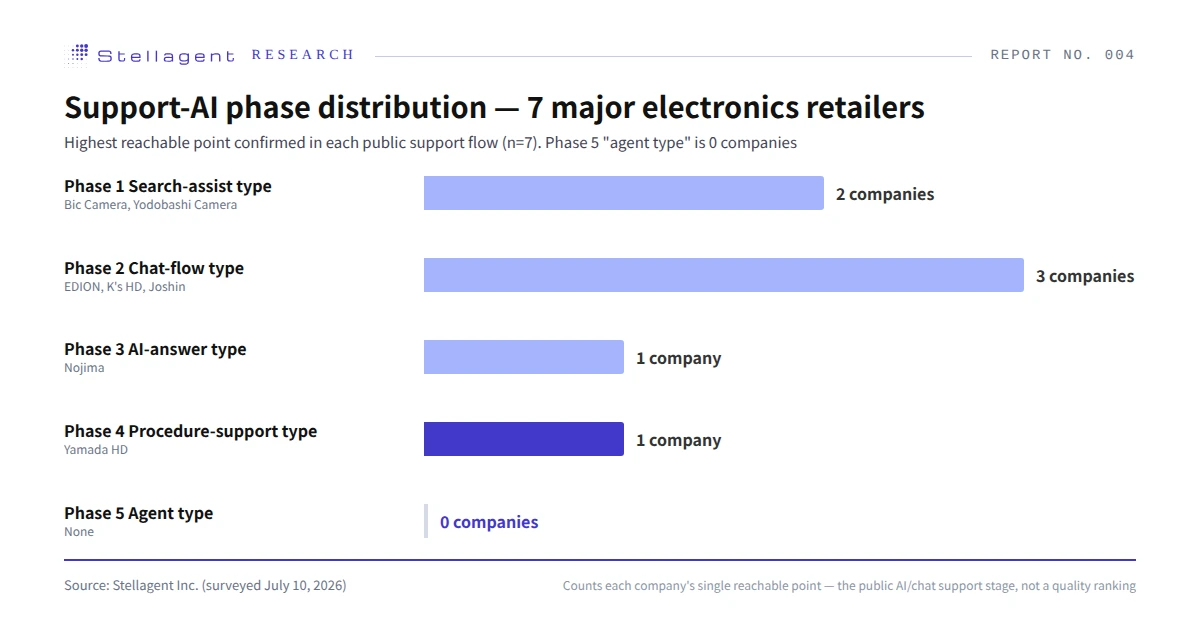
The chart above may be reproduced as-is in media coverage, articles, and other materials, provided that you credit "Stellagent Inc." as the source and include a link to this page.
Natural-language AI chat was confirmed at only 1 company (Nojima), and Phase 4 — where a repair-intake chat provides procedure support — at only 1 company (Yamada HD). For now, public support flows center on a combination of FAQ search, chat/LINE, automated replies, and inquiry forms.
Background
In the age of AI agents, the shopping experience does not end with finding, comparing, and buying a product. For goods used over a long time, post-purchase questions arise: "It broke," "I want to know if the warranty applies," "I want to request a repair," "I want to check delivery and installation." For agentic commerce to gain acceptance among consumers, it is important to handle not only pre-purchase recommendation but also post-purchase support in a consistent way.
From that perspective, electronics retailers are a subject where checking AI readiness is especially meaningful. According to the latest "FY2024 Survey on E-Commerce Market" released by Japan's Ministry of Economy, Trade and Industry in August 2025, the BtoC-EC ratio for "household appliances, AV equipment, PCs, peripherals, etc." in 2024 was 43.03%, a high level even among physical-goods categories. Precisely because comparison and purchase have progressed online in this category, the next point in the customer experience is shifting to how far AI and chat can support post-purchase care.
Home appliances have relatively high unit prices, and post-purchase touchpoints are split across delivery, installation work, extended warranties, manufacturer repairs, in-store consultation, and EC orders. Users must choose different desks and procedures depending on product category, time of purchase, warranty conditions, installation environment, and fault symptoms — an area where simple FAQ search alone often fails to resolve issues.
Electronics retailers also have customer touchpoints both online and in stores, so the state of their support flows offers a clue to where AI adoption stands in retail overall. Beyond whether chat or automated replies exist, whether they can organize an inquiry and connect it to a next action such as repair, warranty, or human support is an important point in considering whether AI can support the actual post-purchase experience.
Stellagent develops agentic commerce infrastructure that supports purchasing and booking experiences in the age of AI agents. That is exactly why, in this survey, we checked not "whether the word AI appears" but how far a consumer can get within a support flow and whether the experience is approaching an agent type that links to purchase history and warranty information. This is not to evaluate the relative merits of the retailers, but to make visible what preparation retail support touchpoints will need as AI agents are implemented in society.
In this survey, we checked the public support flows of seven major Japanese electronics retailers on a single standard, and organized how far each company has advanced its AI/chat support.
Method
| Item | Content |
|---|---|
| Survey name | Support-Site AI Readiness Survey of 7 Major Electronics Retailers |
| Conducted by | Stellagent Inc. |
| Subjects | The public support sites or public support flows of seven major Japanese electronics retailers |
| Selection criteria for companies | Company groups organized as the top 7 in the electronics-retailer sales ranking updated in June 2026 |
| Survey date | July 10, 2026 |
| Data captured | FAQ/search, chat/LINE, natural-language consultation, next-action support, linkage with purchase history and warranties, and phase |
| Aggregation | Assigned the highest reachable point confirmable on official pages as a phase, and counted companies out of seven |
The subject companies are Yamada HD, Nojima, Bic Camera, Yodobashi Camera, EDION, K's HD, and Joshin, organized as the top 7 in the electronics-retailer sales ranking by Cross Co., Ltd. Kojima, Sofmap, Best Denki, and others were excluded because they overlap when compared at the company-group level. Company names follow the ranking naming used by the source (Cross Co., Ltd.).
Phase definitions
| Phase | Name | Criteria |
|---|---|---|
| Phase 0 | Static support | Centered on FAQ, category lists, and phone/inquiry forms. Site search exists, but no AI, chat, or natural-language responses are confirmable |
| Phase 1 | Search-assist type | Keyword search, suggestions, FAQ recommendations, etc. assist self-resolution. Does not advance to answer generation or dialogue |
| Phase 2 | Chat-flow type | Chatbots, LINE inquiries, choice-based chat, etc. exist. Mainly limited to FAQ routing or organizing before a human inquiry |
| Phase 3 | AI-answer type | Users can ask in natural language, and the AI answering based on FAQ/support information is confirmable in an official flow |
| Phase 4 | Procedure-support type | The AI or chat guides users to a next action such as symptom check, product-category identification, repair, inquiry, or in-store consultation |
| Phase 5 | Agent type | Links with login information, purchase history, warranty, in-store stock, repair intake, etc. to semi-automatically complete or hand off an inquiry or procedure |
Each company's phase is a single-stage judgment of the highest reachable point confirmable in its public flow. "Whether a conversational flow exists" and "whether next-action support exists" are checked per company, separately from the phase. Phase 4 is assigned only when the chat or AI itself drives a procedure such as repair intake.
Controlling for context
This survey was conducted as a public-website audit, not an AI-answer experiment. We did not log in to personal accounts, reference purchase history, enter personal information, or submit inquiries.
Scenarios
| ID | Scenario | Condition |
|---|---|---|
| S1 | Entry-point check | From the support top or inquiry page, check entry points such as FAQ, search, chat, AI chat, and LINE inquiry |
| S2 | Natural-language check | See whether a flow that answers natural-language questions is confirmable on the public site |
| S3 | Procedure-support check | See whether a flow that advances to a next action — repair, returns, delivery, warranty, order confirmation, in-store consultation, etc. — is confirmable within AI or chat |
| S4 | Linkage check | Check for linkage close to user-specific information or procedure completion, such as connection to login information, order history, repair intake, or human inquiry |
Phase distribution
| Phase | Companies | Applicable companies |
|---|---|---|
| Phase 1 Search-assist type | 2 | Bic Camera, Yodobashi Camera |
| Phase 2 Chat-flow type | 3 | EDION, K's HD, Joshin |
| Phase 3 AI-answer type | 1 | Nojima |
| Phase 4 Procedure-support type | 1 | Yamada HD |
| Phase 5 Agent type | 0 | None |
Of the seven companies, Phase 1 (centered on FAQ search and inquiry forms) was 2 companies, and Phase 2 (where chat/LINE/automated replies were confirmed) was 3 companies. Phase 3 (where a natural-language consultation flow was confirmed) was 1 company, and Phase 4 (where a chat flow connecting to repair intake and post-intake inquiry was confirmed) was 1 company.
The reason the number of companies with confirmed next-action support (4) differs from Phase 4 "procedure-support type" (1) is that a phase is each company's single reachable point, while next-action support is checked on a different axis from the phase. Of the 4 companies with confirmed next-action support, Yamada HD is Phase 4 because the chat itself drives repair intake, while the remaining 3 (EDION, K's HD, Joshin) are Phase 2 because their conversational flows stay within FAQ routing or organizing for human connection.
Judgment by company
| Company | Main confirmed flows | Conversational flow | Next-action support | Phase | Reason |
|---|---|---|---|---|---|
| Yamada HD | Inquiry page, online repair intake, YAMADA SELECT repair chat | Yes | Yes | Phase 4 | Confirmed a chat flow connecting to repair intake and post-intake inquiry |
| Nojima | Nojima Online inquiry, AI chat, FAQ, form | Yes | No | Phase 3 | Confirmed a flow to consult in natural language before inquiry; individual orders and personal information are separated into a form |
| Bic Camera | FAQ, inquiry, service & support | No | No | Phase 1 | Consumer-facing public flows center on FAQ and forms. The chat noted on the business-only site is out of scope |
| Yodobashi Camera | Customer support, FAQ, inquiry form | No | No | Phase 1 | Centered on FAQ search and inquiry forms. No chat flow was confirmed |
| EDION | LINE inquiry, automated reply, operator | Yes | Yes | Phase 2 | Confirmed automated replies and operator support via LINE inquiry |
| K's HD | FAQ, chatbot for the online shop, inquiry form | Yes | Yes | Phase 2 | Confirmed a chatbot flow for the online shop within the official FAQ |
| Joshin | Official inquiry, on-site repair, official LINE account | Yes | Yes | Phase 2 | Confirmed automated replies on the official LINE account. However, the range of natural-language answers and procedure linkage were not confirmed |
The gap between conversational flows and agentification
| Metric | Companies | Applicable companies |
|---|---|---|
| Confirmed chat/LINE/automated reply | 5 of 7 | Yamada HD, Nojima, EDION, K's HD, Joshin |
| Confirmed a natural-language consultation flow | 1 of 7 | Nojima |
| Confirmed next-action support (repair, inquiry, etc.) | 4 of 7 | Yamada HD, EDION, K's HD, Joshin |
| Confirmed AI/chat linkage with purchase history, warranty, repair intake, etc. | 0 of 7 | None |
All figures are out of the 7 surveyed companies.
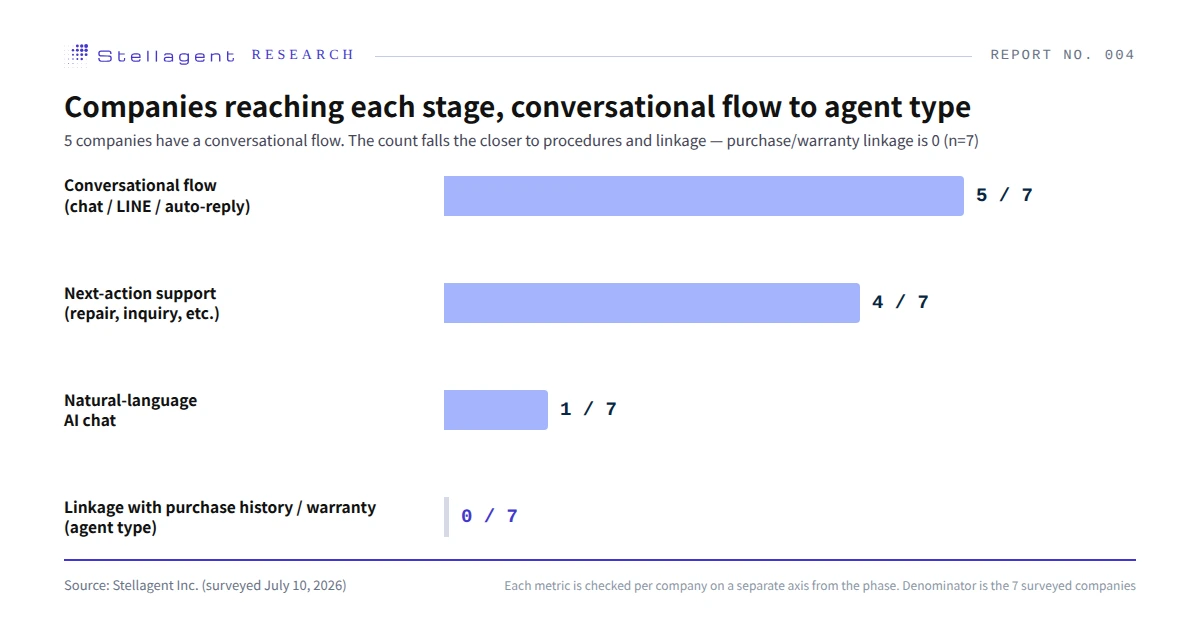
The chart above may be reproduced as-is in media coverage, articles, and other materials, provided that you credit "Stellagent Inc." as the source and include a link to this page.
Including chat, LINE, automated replies, and chatbots, 5 of 7 companies had some kind of conversational support flow. However, most of them stay within organizing before an inquiry, FAQ routing, or connection to human support, and have not reached the agent type that references purchase history or warranty information to advance a procedure.
Non-applicable items and notes on extraction
In this survey, we did not, in principle, include business-only sites, group-affiliated brands, post-login member pages, or in-app-only features in the judgment. For example, the business-only Biccamera.com notes an AI chatbot, but it is excluded from the comparison of consumer-facing public support sites.
Also, while official LINE accounts are not completed within the website, users can access them as a support flow that each company makes public, so we counted them as a chat/LINE flow.
Implications for businesses
The support experience at electronics retailers is shifting from FAQ search to conversational support. However, maturity cannot be measured by the mere presence of AI. What matters to users is not only being able to "ask a question," but also being able to "understand what to do next based on their own purchase situation."
The first thing to work on is organizing FAQ, repair, warranty, delivery, returns, and in-store inquiries into a form that AI and chat can easily reference. Because appliance inquiries branch by product category and purchase situation, placing AI on top of an ambiguous knowledge structure will only send users back to forms and phone calls.
Next, chat/LINE, human support, inquiry forms, and repair intake must be designed as a flow that carries the same inquiry context without fragmentation. In public flows, no company currently demonstrated this linkage sufficiently.
Finally, the future area of differentiation is the Phase 5 agent type. When AI can safely reference purchase history, warranty periods, delivery/installation history, and repair-intake status, and take on classifying inquiries and organizing the information needed, the support site will shift from "a place to search" to "a companion for procedures."
Notes on the survey
- This is an exploratory survey of the public support sites and public support flows of 7 companies, and is not intended for statistical generalization.
- Results are based on public pages as of July 10, 2026. Chat availability, LINE account display, and FAQ structure may change.
- This is an exploratory survey based on official support flows public as of the survey date. Actual responses inside chatbots or LINE, the range of handling for free-text input, conditions for human connection, and post-login features are out of scope.
- We did not conduct actual free-text input tests inside chatbots, AI chat, or LINE.
- We did not log in to personal accounts, or check purchase history, warranty information, inquiry submission, or repair-intake completion.
- This survey does not evaluate the relative quality of each company's support. It organizes the AI/chat support phase confirmable in public flows.
- Product and service names in this report are trademarks or registered trademarks of their respective companies.
Update history
- July 14, 2026: First published
You are free to cite or reproduce the findings of this report in articles, media coverage, and other materials, provided that you credit “Stellagent Inc.” as the source and include a link to this page.
Want to know how AI answers present your company?
We research how AI assistants read, answer and recommend in commerce. Tell us what you would like to find out about your own products and services.
Contact us