

- 01
All 9 major home-appliance retail brands had confirmable official support information for returns, warranties, repairs, delivery/installation, and points. Meanwhile, the provisional judgment was Phase 1 "stops before being read" for 2 brands, Phase 2 "stops before being understood" for 6 brands, and Phase 3 "stops before being chosen" for 1 brand.
- 02
Product/Offer microdata on a product page was confirmed at only 1 of 9 brands (Yodobashi Camera). At many brands the official pages themselves were readable, but the structured data needed to make product attributes, price, stock, delivery, and returns/warranty machine-readable was limited.
- 03
For none of the 9 brands could we confirm public information on AI-channel measurement, such as AI-referred traffic or product-feed/API integration. Because these areas are hard to confirm from the outside, we do not conclude they are unprepared from a public-information audit alone.
- Survey name
- LLMO/GEO Bottleneck Audit of 9 Major Home-Appliance Retail Brands' Official Sites
- Subjects
- The official EC sites, official support pages, official FAQs, official brand/store information pages, and technical files of 9 major home-appliance retail brands
- Brands
- Yamada Denki, Nojima, Bic Camera, Yodobashi Camera, EDION, K's Denki, Joshin, Kojima, Best Denki
- Survey date
- July 28, 2026
- Method
- Public-information audit of official EC sites, official support pages, official FAQs, technical files, and the search index (machine fetch plus Chrome-browser fetch)
- Judgment axis
- The four gates of read / understand / choose / buy (5-stage Phase)
- Aggregation
- Assigned an auxiliary score out of 100 across 5 items, then judged the first gate at which a brand largely stops as its Phase
- Conducted by
- Stellagent Inc. (conducted using Codex)
- 01Summary
- 02Background
- 03Method
- 04Result 1: Phase distribution across the 9 major brands
- 05Result 2: Score and main bottleneck by brand
- 06Result 3: Cases that stop at "being read"
- 07Result 4: Cases that stop at "being understood"
- 08Result 5: No public information on AI-channel measurement was confirmed
- 09Implications for businesses
- 10Notes on the survey
- 11Update history
- 12Appendix A. Key URLs Audited
- 13Appendix B. Observation Items and Audit Procedure
Summary
Stellagent Inc. audited, from public information and on a single standard, whether product information at 9 major home-appliance retail brands is in a state to be "read, understood, chosen, and bought" by generative-AI search and AI answer engines, covering their official EC sites, official support pages, official FAQs, and store/brand sites. Auditing the 9 major brands from public information, this survey found that 2 brands stop "before being read" and 6 brands "before being understood," where their main bottleneck lay. Official information was confirmable at all brands, while the readiness for AI to understand products in a machine-readable way and handle recommendation and purchase flows was limited.
| Metric | Result |
|---|---|
| Subjects | 9 major home-appliance retail brands |
| Brands | Yamada Denki, Nojima, Bic Camera, Yodobashi Camera, EDION, K's Denki, Joshin, Kojima, Best Denki |
| Survey date | July 28, 2026 |
| Judgment axis | Read, understand, choose, buy |
| Phase 1 "stops before being read" | 2 of 9 brands |
| Phase 2 "stops before being understood" | 6 of 9 brands |
| Phase 3 "stops before being chosen" | 1 of 9 brands |
| Phase 4 "stops before being bought" | 0 of 9 brands |
| Phase 5 "connected through to AI-mediated purchase" | 0 of 9 brands |
| Brands with confirmable official support information | 9 of 9 brands |
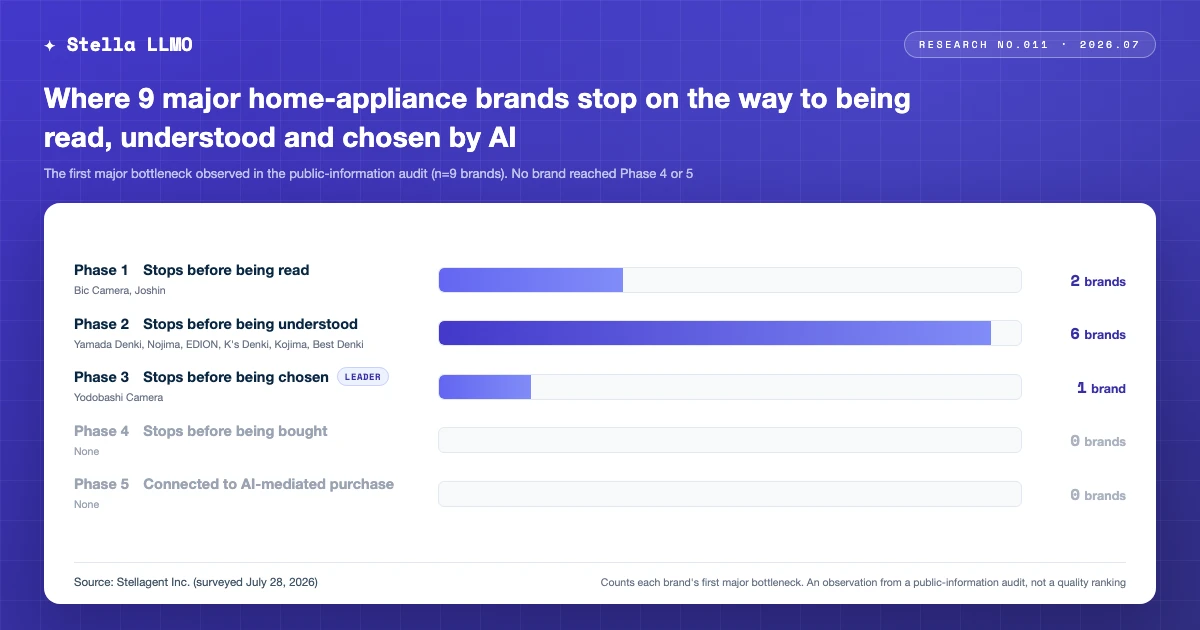
The chart above may be reproduced as-is in media coverage, articles, and other materials, provided that you credit "Stellagent Inc." as the source and include a link to this page.
At all 9 major home-appliance retail brands, we confirmed official support information for returns, warranties, repairs, delivery/installation, points, and more. In this audit environment, 2 brands (Bic Camera, Joshin) had unstable reach to the EC top page or product pages, a state where products could stop "before being read." Meanwhile, at 6 brands the official pages themselves were readable, but the structured data for AI to understand product attributes, price, stock, delivery, and returns/warranty in a machine-readable way — such as Product/Offer and FAQPage — was limited, so we judged their main bottleneck to be "before being understood." Within the product pages we could reach, Product/Offer microdata was confirmable at only 1 brand, Yodobashi Camera. In other words, only 1 brand reached the point of being "understood" by AI, and the remaining 8 brands stopped short of it. In addition, for none of the 9 brands could we confirm public information on AI-channel measurement, such as AI-referred traffic or product-feed/API integration.
Note that this survey judges how each site is prepared, as observed from public information. It does not measure whether AI actually cites or recommends these brands in its answers.
The observation items, reach-check procedure, AI-crawler check tokens, and self-containment keywords actually used in this survey are provided in Appendix B (Observation Items and Audit Procedure) at the end of the article, and the main URLs audited for each brand in Appendix A (Key URLs Audited).
Background
When generative-AI search and AI answer engines enter consumers' product choices, competition among EC sites no longer ends on the search-results screen. For a product to be treated by AI as a candidate, AI or the search crawler must first be able to reach the product page and support information. On top of that, if the machine cannot obtain the product name, model number, price, stock, delivery, warranty, return conditions, and so on in a form it can understand, the product may be dropped from conditional purchase consultations.
Home-appliance retailers are an important subject for observing this change. Beyond price and stock, appliances involve much information needed for a purchase decision — delivery, installation work, long-term warranties, returns, repairs, points, and in-store pickup. Even when this information exists as human-facing pages, it is not necessarily in a state that AI can use for product recommendation or purchase support.
In this survey, we did not treat LLMO/GEO measures merely as an extension of content production or SEO, but organized them as a series of gates from a product being "read," "understood," "chosen," and "bought" by AI. We audited the public sites of 9 major home-appliance retail brands on a single standard and visualized at which gate each brand tends to stop.
This survey does not assert the relative superiority of each company's service quality or corporate stance. It organizes, from public information as of the survey date, what room for improvement there is in EC sites, product data, and support information in the age of AI.
Method
| Item | Content |
|---|---|
| Survey name | LLMO/GEO Bottleneck Audit of 9 Major Home-Appliance Retail Brands' Official Sites |
| Conducted by | Stellagent Inc. |
| Team | Conducted by Stellagent Inc. using Codex |
| Objective | To audit from public information whether the official sites of 9 major home-appliance retail brands are in a state to be "read, understood, chosen, and bought" by AI |
| Subjects | Official EC sites, official support pages, official FAQs, official brand/store information pages, and technical files |
| Brands | Yamada Denki, Nojima, Bic Camera, Yodobashi Camera, EDION, K's Denki, Joshin, Kojima, Best Denki |
| Selection criteria | Selected brands that are large in sales scale, store network, and consumer awareness as home-appliance retailers and that publish an official EC or official brand flow |
| Survey date | July 28, 2026 |
| Procedure & recording | Confirmed robots.txt, Sitemap, llms.txt, the official EC top, product or category pages, and support pages for returns, warranties, repairs, delivery, points, etc. via machine fetch, Chrome-browser fetch, and the search index, saving results to logs and a tally table |
| Analysis & aggregation | Assigned an auxiliary score out of 100 across 5 items, then judged the first gate at which a brand largely stops as its Phase |
| Deviations, re-runs, exclusions | Some URLs returned 403, HTTP/2 error, timeout, or Access Denied. These were not treated as "the information does not exist," but recorded as reach friction for AI and search crawlers |
| External sources & evidence | Each company's official site, official FAQ, official support pages, robots.txt, Sitemap, official pages in the search index, and the brand-selection reference materials |
This survey is desk research and a public-site audit. We did not log in to personal accounts, reference purchase history, enter personal information, submit inquiries, make payments, or place orders. EC flows were evaluated only within the range confirmable on public pages.
For Best Denki, its official site on its own domain centers on store, brand, and support information, and the purchase flow links from the official site to the "Best Denki Yahoo! Store," so we checked the own domain and the official Yahoo! Store flow separately.
As reference materials for selection, we consulted Gakujo's "Industry Research News: Home-Appliance Retailers" and Kenseisha's "Home-Appliance Retailer Store-Count Ranking." Each brand's judgment is based not on third-party materials but on each company's official pages and public technical files.
The main URLs audited for each brand are summarized in Appendix A (Key URLs Audited), and the observation items, reach-check procedure, AI-crawler check tokens, and self-containment keywords actually used in Appendix B (Observation Items and Audit Procedure).
Brands and the unit of counting
The unit of counting here is not the corporate group but the brand and official flow that consumers recognize. Kojima is a subsidiary of Bic Camera (a separate legal entity), and Best Denki is a brand operated by Yamada Denki (formerly Best Denki Co., Ltd., integrated into Yamada Denki in 2021), but because their brand names, official sites, and support flows are separate, we counted them as individual brands.
| ID | Brand | Main official flow | Notes |
|---|---|---|---|
| YAMADA | Yamada Denki | Yamada Web.com | Yamada Denki's official EC flow |
| NOJIMA | Nojima | Nojima Online, Nojima Online user guide | EC and guide are on separate subdomains |
| BIC | Bic Camera | biccamera.com | Kojima counted as a separate brand |
| YODO | Yodobashi Camera | yodobashi.com | Product page and support flow confirmed |
| EDION | EDION | EDION official store, EDION FAQ | FAQ subdomain included as an official flow |
| KS | K's Denki | K's Denki Online Shop | Official EC targeted |
| JOSHIN | Joshin | Joshin web shop, Joshin FAQ | FAQ subdomain included as an official flow |
| KOJIMA | Kojima | Kojima.net, Kojima FAQ | A subsidiary of Bic Camera but counted as a separate brand |
| BEST | Best Denki | Best Denki official site, Best Denki Yahoo! Store | Own domain centers on brand/support; EC is the official Yahoo! Store flow |
Phase definitions
In this survey, we defined the gates until a product is handled by AI in the following 5 stages. These gates are not the evaluation criteria of a specific service, but an analytical framework that stages the general flow by which generative AI discovers, understands, recommends, and supports the purchase of a product. A Phase does not assert maturity; it indicates the main bottleneck observable from public information.
| Phase | Name | Meaning of the judgment |
|---|---|---|
| Phase 1 | Stops before being read | AI/search crawlers cannot stably reach product pages, support pages, or key data, or friction is large due to bot measures, JS, or index control |
| Phase 2 | Stops before being understood | Pages are readable, but Product/Offer, product attributes, delivery/return policies, FAQ, etc. are not present in a machine-readable form |
| Phase 3 | Stops before being chosen | Product information is somewhat understandable, but the external evidence, reviews, comparison articles, and consistency of official claims that AI recommends or cites are insufficient |
| Phase 4 | Stops before being bought | The product appears as a candidate in AI answers, but stock, price, purchase flow, cart, payment, and order linkage are hard to handle via AI |
| Phase 5 | Connected through to AI-mediated purchase | AI display, product data, stock/price, cart/payment/order, and measurement are connected and can be continuously improved |
Scoring
The auxiliary score was aggregated out of 100 points. The final Phase is judged not from a score band but from the first major bottleneck observed. The score is merely an auxiliary indicator of how well the observation items are satisfied; rank and point gaps do not evaluate each company's sales efforts or internal data readiness. The main scoring conditions for each item are as follows.
| Item | Points | Main content confirmed and scoring conditions |
|---|---|---|
| Read | 25 | Retrieval of main EC/support pages (10), discoverability via robots.txt/Sitemap (5), exposure in the search index (5), small friction from bot/JS/HTTP errors etc. (5) |
| Understand | 25 | Product name/model/attributes (5), price/stock/sales status (5), delivery/installation (5), return/warranty/repair policy (5), structured data such as Product/Offer/FAQ (5) |
| Choose | 20 | Externalizable evidence such as official news (5), decision support such as comparison/how-to-choose/reviews (5), consistency of product name, model, and claims (5), independent URLs/descriptions AI can easily cite (5) |
| Buy | 20 | Purchase/cart flow from the product detail (5), ease of checking stock, price, delivery/in-store pickup (5), proximity of warranty/returns to the purchase flow (5), ease of reach for automated browsers/AI agents (5) |
| AI channel & measurement | 10 | Valid llms.txt/AI-facing policy (3), public information on product feed/API/external integration (3), measurement of bot/search/AI-referred traffic etc. (2), public information on continuous improvement (2) |
Result 1: Phase distribution across the 9 major brands
| Phase | Name | Brands | Brand names |
|---|---|---|---|
| Phase 1 | Stops before being read | 2 | Bic Camera, Joshin |
| Phase 2 | Stops before being understood | 6 | Yamada Denki, Nojima, EDION, K's Denki, Kojima, Best Denki |
| Phase 3 | Stops before being chosen | 1 | Yodobashi Camera |
| Phase 4 | Stops before being bought | 0 | None |
| Phase 5 | Connected through to AI-mediated purchase | 0 | None |
Of the 9 brands, 2 had friction reaching the EC top or product pages in this audit environment, so we judged them Phase 1 "stops before being read." Of the 9 brands, 6 had confirmable official pages and support information, but were limited in making Product/Offer, FAQPage, product attributes, delivery/return policies, etc. machine-readable, so we judged them Phase 2 "stops before being understood."
For Yodobashi Camera, on the confirmed product page https://www.yodobashi.com/product/100000001008897902/ we could confirm Product/Offer microdata, price, stock, delivery, and points, so in this static audit we judged it Phase 3 "stops before being chosen." However, because we did not conduct an AI-answer experiment this time to check whether AI actually recommends or cites it, the judgment from Phase 3 onward is limited to the scope of the public-information audit.
Result 2: Score and main bottleneck by brand
| Rank | Brand | Score | Phase | Main strength | Main bottleneck |
|---|---|---|---|---|---|
| 1 | Yodobashi Camera | 70 | Phase 3 stops before being chosen | Confirmed Product/Offer microdata, price, stock, delivery, and points on the product page | External recommendation evidence and AI-display/citation experiment unconfirmed |
| 2 | Kojima | 67 | Phase 2 stops before being understood | Many Sitemaps in robots.txt, return/repair guides, Corporation/ContactPoint JSON-LD | Direct confirmation of product-page Product/Offer insufficient |
| 3 | Yamada Denki | 64 | Phase 2 stops before being understood | Sitemap in robots.txt, standalone pages for returns/warranty/delivery-installation | Product/Offer, FAQPage, and llms.txt unconfirmed |
| 4 | EDION | 62 | Phase 2 stops before being understood | Strong shopping guide and FAQ, with basic JSON-LD on the FAQ | Product-page Product/Offer and a valid llms.txt unconfirmed |
| 5 | Nojima | 59 | Phase 2 stops before being understood | Guide, returns, and warranty pages are readable, with some structuring | Product structuring and stability of EC-domain retrieval unconfirmed |
| 6 | K's Denki | 57 | Phase 2 stops before being understood | Returns, repair, and long-term free-warranty pages are self-contained | Structured data and explicit AI-facing measures unconfirmed |
| 7 | Best Denki | 47 | Phase 2 stops before being understood | Organization etc. JSON-LD on brand/support pages, long-term warranty/repair pages | Product EC/product structuring on own domain limited. EC is the official Yahoo! Store flow |
| 8 | Bic Camera | 42 | Phase 1 stops before being read | Strong official information for after-service, returns, repair, long-term warranty | EC product-page reach unstable in the audit environment |
| 9 | Joshin | 41 | Phase 1 stops before being read | Detailed FAQ; returns, initial-defect, repair, etc. confirmable at independent URLs | EC top 403 in Chrome. Large friction before reaching product information |
The score is an auxiliary indicator based on this survey's items. It does not evaluate each company's sales efforts or actual internal data readiness. Also, because access blocks and timeouts may depend on the execution environment, re-confirmation in a separate environment is needed before publication.
Result 3: Cases that stop at "being read"
For Bic Camera and Joshin, the support information itself was confirmable. Meanwhile, in this audit environment there was friction reaching the EC top or product pages.
Bic Camera's after-service page was viewable in Chrome, and official information for repairs, long-term warranty, installation work, etc. was also readable. On the other hand, product-page candidates timed out with curl, and the first Chrome probe showed an access-block display on the EC top or a product page. In a later probe the EC top was readable with a 200, so we do not conclude a permanent block, but because product-page reach was unstable in the audit environment, we placed it in Phase 1.
Joshin's FAQ top and return FAQ were viewable in Chrome. On the other hand, the EC top returned 403 in Chrome, weakening direct confirmation of product information. Even if the FAQ is readable, if AI/search crawlers cannot stably reach product pages, products may stop before entering the pool of AI-answer candidates.
Result 4: Cases that stop at "being understood"
Yamada Denki, Nojima, EDION, K's Denki, Kojima, and Best Denki had confirmable official pages and support information. On the other hand, the structuring for AI to understand product information in a machine-readable way, and explicit AI-facing measures, were limited.
Yamada Denki's Sitemap was confirmable in robots.txt, and standalone pages for returns, warranty, and delivery/installation were readable. However, no JSON-LD or microdata was found in the browser probe, and Product/Offer and FAQPage could not be confirmed either.
Kojima's many Sitemaps were confirmable in robots.txt, and return/repair guides were readable as official pages. The EC top was also retrievable with a 200. On the other hand, in the browser probe a navigation error occurred while checking the refrigerator category, so we could not directly confirm the product page's Product/Offer.
Best Denki's brand site and support pages had confirmable JSON-LD such as Organization, WebSite, and BreadcrumbList. On the other hand, product EC and product structuring on its own domain were limited, and the configuration connected from the official site to the Best Denki Yahoo! Store as the product-purchase flow. That brand information and product-purchase data are split across different domains is itself a point of discussion for AI to understand a product and advance into the purchase flow.
Result 5: No public information on AI-channel measurement was confirmed
For none of the 9 brands could we confirm public information on product feeds/APIs, AI-referred traffic, bot/search data, or measurement of AI display/citation. A way to measure how AI handles your own product information is a prerequisite for verifying whether any countermeasure works.
That said, because these are areas that are hard to confirm from the outside, we do not conclude "unprepared" from a public-information audit alone.
Implications for businesses
First, LLMO/GEO measures are not complete with content production alone. In this survey, even at brands with official support information, differences appeared in whether product pages and product data are stably read by AI, and whether product attributes and warranty/return conditions are machine-readable. If products do not reach AI, they are hard to include as candidates even if you increase comparison articles and content.
Second, home-appliance retailers need to develop product information and support information together, not separately. In appliance purchases, price, stock, delivery, installation, warranty, returns, and points all become decision factors at once. If these are scattered across separate pages and not structured, AI has difficulty accurately comparing candidates for conditional questions.
Third, external evidence also matters for being chosen by AI. Even if a product page is readable and understood via Product/Offer, if reviews, comparison articles, official news, how-to-choose content, and the consistency of product name, model, and claims are weak, it is hard to form a reason to recommend within AI answers. Because this static audit did not measure this area sufficiently, the next survey needs an AI-answer experiment and an audit of external recommendation evidence.
Fourth, the AI-mediated purchase experience is a future area of differentiation. When AI can check stock and price and advance from the product page to cart, in-store pickup, delivery, and returns/warranty confirmation, the EC site changes from "a place where humans search and read" into "a purchase platform AI can also use." On public information, no brand reached this stage this time.
Notes on the survey
- This survey is an exploratory desk-research audit of the public web pages of 9 major home-appliance retail brands, and is not intended for statistical generalization.
- Results are based on public information as of July 28, 2026, and on retrieval results in the same day's audit environment. Site structure, bot measures, FAQ, product pages, and structured data may change.
- Access blocks, HTTP/2 errors, timeouts, and 403s may depend on the source IP, browser, User-Agent, time of day, and the site's bot measures. This survey did not treat these as "the information does not exist," but recorded them as reach friction for AI and search crawlers.
- Because the reachability of the 2 brands judged Phase 1 "stops before being read" (Bic Camera, Joshin) is highly likely to depend on the audit environment, we will re-confirm reachability on a separate network and a normal browser just before publication to verify it is not a permanent block.
- Product-page structured data depends on the product or category confirmed this time. It does not cover the entire product template across the whole brand.
- "Chosen" and "bought" from Phase 3 onward cannot be sufficiently measured without adding an AI-answer experiment, an audit of external recommendation evidence, and a purchase-flow audit. This time's Phase is a provisional judgment based on a public-information audit.
- This survey does not evaluate each brand's actual internal data infrastructure, ad operations, SEO/LLMO measures, AI-channel integration, or purchase conversion rate.
- This survey was conducted by Stellagent Inc., which develops agentic commerce infrastructure that supports purchasing and booking experiences in the age of AI agents. Product and service names in this report are trademarks or registered trademarks of their respective companies.
Update history
- July 29, 2026: First published
Appendix A. Key URLs Audited
Below are the main official flows used to judge each brand. In the judgment, we also confirmed product or category pages, support-related pages, in-HTML structured data, robots.txt, Sitemap, and llms.txt. For Yodobashi Camera's product page, for example, we confirmed Product/Offer microdata at https://www.yodobashi.com/product/100000001008897902/.
| Brand | Official EC / brand flow | Support/FAQ etc. examples confirmed | Technical files etc. |
|---|---|---|---|
| Yamada Denki | Yamada Web.com | Returns/exchange, free long-term warranty | robots.txt, sitemap_index.xml |
| Nojima | Nojima Online | User guide, cancel/returns | EC-domain retrieval was unstable, including 403, in the audit environment |
| Bic Camera | biccamera.com | After-service, repair | Timeout confirmed when retrieving product-page candidates |
| Yodobashi Camera | yodobashi.com | Inquiry desk, member/service | Confirmed Product/Offer microdata at a product-page example |
| EDION | EDION official store | Shopping guide, FAQ | robots.txt, sitemap.xml |
| K's Denki | K's Denki Online Shop | Returns/exchange/cancel, long-term free warranty | EC top confirmed in Chrome; timeout with curl |
| Joshin | Joshin web shop | FAQ top, return FAQ | robots.txt; EC top 403 in Chrome |
| Kojima | Kojima.net | Returns/exchange, repair | robots.txt, Sitemap |
| Best Denki | Best Denki official site, Best Denki Yahoo! Store | Service list, long-term warranty, repair | robots.txt, sitemap.xml |
Appendix B. Observation Items and Audit Procedure
So that readers can reproduce this survey with the same procedure, we provide the observation items, reach-check procedure, AI-crawler check tokens, self-containment keywords, and Phase-judgment logic actually used. For each brand, we confirmed the official EC top, product or category pages, support/FAQ, company/store information, robots.txt, Sitemap, llms.txt, and in-HTML structured data. We recorded confirmed facts and unconfirmed facts separately, and judged the first major bottleneck observable from public information as the Phase. Actual confirmation of the official site, the official FAQ, official pages in the search index, and third-party selection-reference information were handled as distinct categories.
Observation items (G1–G5)
| ID | Item | Content confirmed |
|---|---|---|
| G1 | Read: crawl/index foundation | robots.txt, Sitemap, bot access control, index eligibility, JS rendering, duplicate/canonical URL management, reach to product and support pages |
| G2 | Understand: product/brand data foundation | Product identifier, model number, product attributes, Product/Offer, price, stock, delivery, returns, warranty, page/feed consistency |
| G3 | Choose: external information/recommendation evidence | Press releases, news, comparison articles, reviews, how-to-choose content, consistency of product name, model, and claims |
| G4 | Buy: AI-mediated purchase flow | Product page, stock/price, cart flow, in-store pickup/delivery, returns/warranty flow, ease of reach from automated browsers |
| G5 | Explicit AI channel/measurement | llms.txt, AI-facing policy, product feed/API, bot/search data, AI-referred traffic, public information on continuous improvement |
Reach-check procedure
We started the audit from each brand's official EC top and, against the resolved URL (origin), retrieved /robots.txt, /llms.txt, and /sitemap.xml. We extracted the Sitemap lines listed in robots.txt and checked the <loc> count within the Sitemaps and the presence of product-type and support-type URLs. From the top-page HTML, we extracted same-host links and identified product-page candidates by patterns such as /item/, /product/, /goods/, /ec/product, /shop/goods, and /bc/item, and support-page candidates by patterns such as support, guide, faq, help, warranty, repair, return, returns, warranty, and repair.
Machine fetch used the User-Agent "Mozilla/5.0 (compatible; StellagentGeoAudit/1.0; +https://stellagent.co.jp/)" with an 8-second timeout (following redirects). URLs that returned 403, HTTP/2 error, timeout, or Access Denied on machine fetch were re-retrieved via a Chrome/Playwright browser probe, where we confirmed a DOM summary, JSON-LD types (@type), microdata, and in-body keywords. Retrieval failures were not treated as "the information does not exist," but recorded as reach friction for AI and search crawlers.
AI-crawler check tokens
In robots.txt, we checked whether the following representative AI/search-crawler User-Agents were explicitly blocked site-wide (Disallow: /).
GPTBot,ChatGPT-User,OAI-SearchBotClaudeBot,Claude-User,anthropic-aiPerplexityBotGoogle-Extended,Applebot-Extended
Self-containment keywords
Whether a product page can present product information in a self-contained way was checked by the appearance of "price," "stock," "delivery," "installation," "work," "warranty," "points," "model number," and "manufacturer" in the body. The self-containment of support pages was checked by the appearance of "returns," "cancel," "warranty," "repair," "delivery," "installation," and "points." Structured data was checked by the presence of JSON-LD @type (Product, Offer, FAQPage, Organization, WebSite, BreadcrumbList, etc.) and product-page microdata.
Phase-judgment logic
We assigned an auxiliary score out of 100 across 5 items (Read 25, Understand 25, Choose 20, Buy 20, AI channel & measurement 10). However, the final Phase is judged not from a score band but from the first major bottleneck observed from public information. If there is friction reaching product/support pages or key data, Phase 1; if reach is possible but product attributes, price, stock, delivery, returns/warranty, Product/Offer, FAQ, etc. are not machine-readable, Phase 2; if product understanding is somewhat possible but external recommendation evidence and comparison context are insufficient, Phase 3 — in this way, we set the gate at which a brand stopped as that brand's Phase.
You are free to cite or reproduce the findings of this report in articles, media coverage, and other materials, provided that you credit “Stellagent Inc.” as the source and include a link to this page.
Want to know how AI answers present your company?
We research how AI assistants read, answer and recommend in commerce. Tell us what you would like to find out about your own products and services.
Contact us