AGL's Tabi Golf and the Transaction-First Playbook: Building Agentic Commerce from Inventory and Payments Up
Korea's AGL launched Tabi Golf, an AI travel agent that books and pays for golf trips from a single sentence. We read it as an agentic commerce case study: real-time inventory connectivity, the payment-execution dividing line, and a vertical-first path past the trust gap.

Key Takeaways
- Korean golf and travel platform company AGL launched Tabi Golf on July 2, 2026 — an AI travel agent that goes from itinerary design to booking and payment from a single sentence
- Beneath the conversational layer sits seven years of transaction infrastructure: the TIGER GDS real-time inventory backbone and payment execution already supplied to Google and Apple Maps — a transaction-first build order that makes this a notable agentic commerce case study
- The takeaways carry over directly to retail and e-commerce: machine-readable inventory as a condition of participation, payment execution as a deliberate business-model dividing line, and a vertical-first path to earning transactional trust
A Single Sentence That Runs Through to Payment

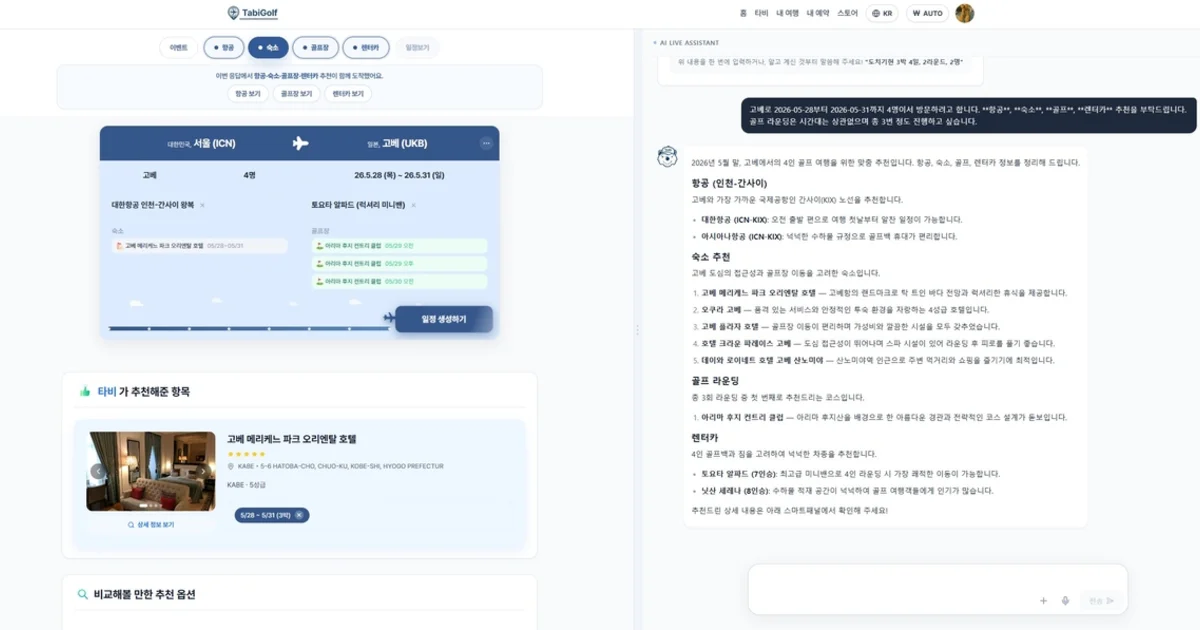
AGL launched Tabi Golf, an AI travel agent that plans, books and pays for global golf trips from a single sentence using real-time inventory and prices.
en.sedaily.com"Create a one-week golf trip in Scotland centered on the world's top 100 golf courses." According to Seoul Economic Daily, AGL, a global golf and travel platform company, officially launched Tabi Golf on July 2, 2026 — an AI travel agent that turns that single sentence into a full itinerary of flights, hotels, golf courses, restaurants, attractions, and routes, organized around budget and preferences. The company says the service does not stop at a proposal: it completes the bookings and payments as well. The name "Tabi" comes from the Japanese word for travel.
This article reads Tabi Golf not as a new travel product but as a vertical implementation of agentic commerce — the model of commerce in which an AI agent handles discovery, comparison, booking, and payment on the user's behalf. While most conversational AI stops at suggesting an itinerary, Tabi Golf is notable for claiming, per the launch reporting, to execute the transaction itself.
The reported capabilities are concrete. Given an instruction like "Plan a 54-hole golf itinerary in Da Nang for two people with a budget of 2.5 million won and book restaurants too," the service is said to proceed to the actual booking rather than merely presenting a plan. Nor is it limited to golf: it handles general travel requests such as "Recommend a five-day, four-night trip to Hokkaido with my family next month," covering destinations across Japan, Vietnam, Thailand, the United States, and Europe. It currently operates in Korean and English, with expansion to Japanese, Chinese, and other languages planned.
Tabi Golf is not an AI that simply recommends travel itineraries, but one that builds schedules based on bookable real-time inventory and prices. It will become an era in which, rather than users searching and comparing, the AI understands the traveler's intent, designs the entire trip and then carries out the booking.Source: Jim Hwang (AGL CEO)
Seven Years of Transaction Infrastructure Beneath the Chat
Treating Tabi Golf as just another AI travel planner misses the point. AGL's starting position was not conversational AI but inventory and payment infrastructure. Founded in 2019, the company built TIGER GDS, which brought the Global Distribution System — the distribution backbone long used to query and book airline and hotel inventory across suppliers — to golf course tee-time reservations. According to Global Golf Times, by its 30 million dollar Series B in March 2024 it was handling real-time reservations at more than 1,300 golf courses across over 30 countries, with the venture arms of Korea's four major financial groups — KB, Shinhan, Hana, and Woori — among the investors.
That inventory backbone was never confined to AGL's own app. In July 2024 the company went live with Reserve with Google, letting users book golf courses in more than 25 countries via the "Book Online" button on Google Search and Maps (Golf Business News). The flow shows the total price upfront — green fees and cart fees included — and runs through payment to real-time confirmation on the spot. In February 2026 it extended the booking path to iOS Maps, letting users move from a map search straight into a tee-time reservation.
In other words, AGL built its track record as a supplier of inventory and payments to external channels — Google and Apple — and only then stood up its own AI agent as a direct channel. The transactional foundation of machine-queryable inventory and executable payments came first; the conversational interface is the last layer added on top. As CEO Hwang put it, "Thanks to close cooperation with the golf course, hotel, airline and rental car industries since the company's founding, we were able to stay one step ahead in developing a travel agent." The sequence illustrates a broader point about agent-mediated commerce: competitiveness is determined by connected inventory and payment execution, not conversational polish.
The 2 Percent Trust Wall and the Vertical Answer
The push toward transaction-executing agents is accelerating across travel. Google has begun agentic restaurant reservations in AI Mode in the United States and has previewed hotel and flight booking with partners including Booking.com, Expedia, and Marriott. Travel distribution giant Sabre has teamed up with PayPal and Mindtrip on agentic flight booking that completes everything from search to payment within a conversation. Research firm IDC forecasts that 30 percent of travel bookings will be executed by AI agents by 2030.
Consumers, however, remain cold. According to Skift's reporting, only 2 percent of leisure travelers are willing to let AI book a trip on their behalf. The absence of a framework for who bears responsibility when a booking goes wrong stands as the trust wall around delegation. A wide gap separates supply-side investment from user trust.
Tabi Golf's vertical focus reads as a realistic answer to that gap. Golf travel has conditions well suited to delegated purchasing: tee times are structured inventory, requests translate cleanly into concrete parameters like "54 holes" and "a budget of 2.5 million won," and every trip requires bundling flights, lodging, rounds, and dining. The more complex the arrangements and the more specific the demands, the higher an agent's precision — and the stronger the user's motivation to delegate. While general-purpose agents wrestle with the infinite question of "where to go," a specialized agent can build trust by reliably completing the transaction in front of it.
The Design Decisions That Carry Over to Retail
Map Tabi Golf's structure onto physical goods and the decisions separate into three layers.
The foundation is real-time API access to inventory. For an agent to present only options that can actually be purchased, availability and prices must be machine-queryable — a state AGL spent seven years reaching in the form of a GDS. In retail, structured SKUs, prices, stock levels, and delivery windows play the same role. For capturing agent-driven demand, machine-readable product and inventory data is becoming less a marketing tactic and more a condition of participation. Worth noting is that the same inventory backbone supports both AGL's supply to Google and Apple Maps and its own agent: machine-readable data, once built, is an asset that works on whichever channel a business chooses to compete.
Above that sits the dividing line of payment execution. An AI that assists discovery and comparison and an AI that executes payment differ completely in business model and scope of responsibility. An agent that completes transactions captures fee revenue and transaction data, but also takes on the heavy post-purchase obligations of mis-orders, cancellations, and refunds. Travel makes these obligations especially weighty given cancellation policies and date changes; in retail, returns and exchanges play the equivalent role. Tabi Golf chose to cross that line; choosing not to cross it is an equally legitimate design decision, one that should be weighed against a company's own customer-support capacity.
Sequencing is part of the design as well. AGL consolidated inventory and payments in the bounded market of golf and is now extending toward general travel, such as family trips to Hokkaido. Establishing transactional trust in a vertical before expanding horizontally is a more realistic entry path than launching a general-purpose agent across every category at once. One caveat: AGL's inventory and payment connections are bespoke integrations built around its own GDS, and no announcement of support for shared protocols such as MCP (a specification for connecting AI to external tools) or UCP has been confirmed. Whether to open its inventory to external AI agents remains an open question for the company itself.
Conclusion
AGL's Tabi Golf is an AI agent that executes everything from trip design to booking and payment from a single sentence. Behind it lie the TIGER GDS inventory connections built up since 2019 and the booking and payment execution supplied to Google and Apple Maps. The conversational entry point is the last layer added; the foundation of machine-queryable inventory and executable payments came first. That build order is the lesson of this case.
With willingness to delegate bookings still at 2 percent, starting transactional delegation in a vertical where demands are specific and arrangements are complex — and earning trust through completed transactions — points to a realistic entry path into agentic commerce. Make inventory machine-readable, decide deliberately whether to cross the payment-execution line, and expand outward from a vertical: these three design decisions travel well beyond travel, to any business that holds products and inventory. Whether the multilingual rollout and the expansion into general travel proceed as planned makes this a service worth watching, not least because it directly touches the Japanese market.