AI Search Engines Compared: Sources, Citation Counts and Actual Referrals
ChatGPT, Google, Perplexity, Copilot and Claude compared on how they source information, how many citations each answer carries, how accurate the answers are, and how many people each actually sends to a site. In our purchase studies the top-recommended retailer split by service, and in our own GA4 the referral mix did not match market share.

Key takeaways
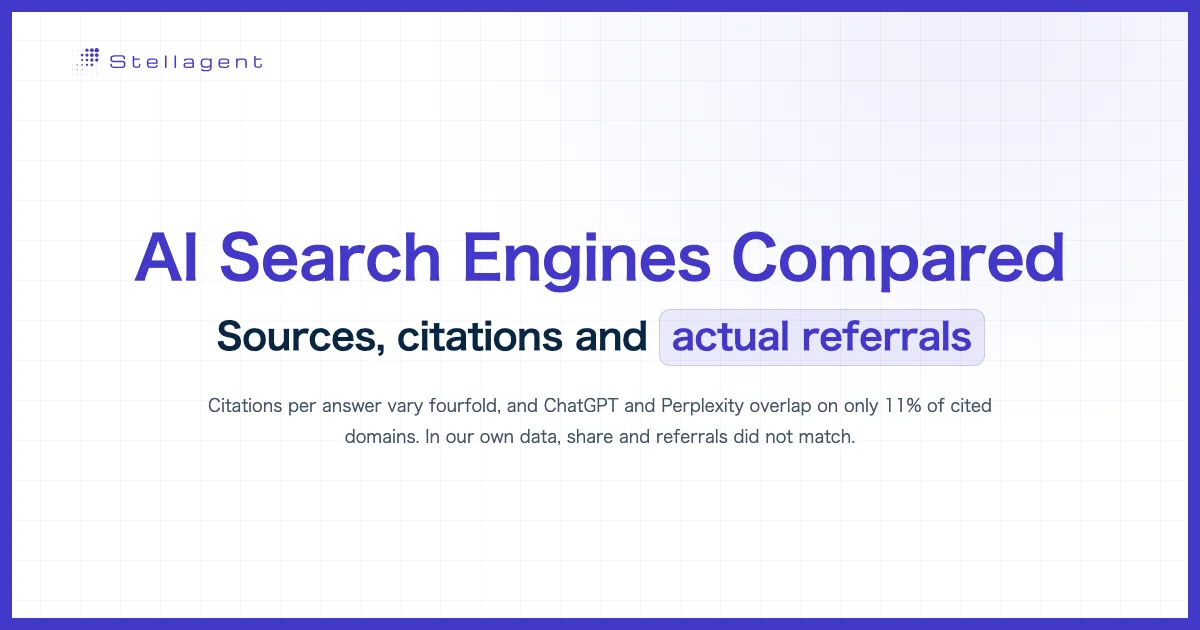
- The major AI search services differ in both sourcing and citation behavior. Citations per answer vary by a factor of four, and ChatGPT and Perplexity overlap on only 11% of cited domains
- Ask the same question and the company named first changes by service. Measuring on one AI and generalizing will mislead you
- The service with the largest share is not necessarily the one that sends the most people. In our own measurements, the referral mix did not match market share
They differ in sourcing and in how they cite
The term "AI search" covers services with quite different internals. Here is where each takes information from, how many sources it cites per answer, and what it is good at.
| Service | Information source | Crawler | Citations per answer | Best suited to |
|---|---|---|---|---|
| ChatGPT | Own crawler + Bing index + partner data | OAI-SearchBot (search), GPTBot (training) | 10.4 | Research where you want a readable summary |
| Google (AI Overviews, AI Mode, Gemini) | The Google Search index | Googlebot (the only line that executes JavaScript) | Not in the study | Fresh information, moving between AI and normal results |
| Perplexity | Primarily its own crawler | PerplexityBot | 21.9 | Research where you want to verify sources yourself |
| Microsoft Copilot | The Bing index | Bingbot | 6.89 | Use inside Microsoft 365 |
| Claude | Search integration + trained knowledge | ClaudeBot | 5.67 | Reading and analyzing long documents |
The real difference is which index each one stands on. Google's line uses its own search index, Copilot uses the Bing index, ChatGPT combines its own crawler with Bing and partner data, and Perplexity works primarily from its own crawler. That difference decides whether the same page reaches each service or not.
Citation counts and selection styles differ sharply
An analysis of 118,000 AI answers between January and March 2026 found average citations per answer of 21.9 for Perplexity, 10.4 for ChatGPT, 6.89 for Copilot and 5.67 for Claude — roughly a fourfold spread between highest and lowest.
The gap in count reflects a gap in policy. Perplexity lines up several sources behind a single claim, while ChatGPT narrows down. For a reader, that means Perplexity when you want to verify sources yourself and ChatGPT when you want a readable summary.
For a business, the more important number is the overlap. An analysis of 680 million citations found that ChatGPT and Perplexity share only 11% of cited domains. Ranking well in one AI makes it more likely than not that you are absent from another.
How each one sources information
For anyone planning work, this is the section that matters most in practice.
ChatGPT: a hybrid of its own crawler, Bing and partners
OpenAI runs OAI-SearchBot for search and GPTBot for training as separate agents. A blanket block in robots.txt removes you from the search side as well as the training side.
The Bing index still matters, but it is not the whole picture. Treating ChatGPT as simply Bing-dependent is out of date; it combines its own crawler with partner data. The ChatGPT-specific routes are covered in getting your products recommended in ChatGPT.
Google (AI Overviews, AI Mode, Gemini): grounding in the search index
Google's generative features stand on the Google Search index. A page that is not indexed cannot become a candidate at all. Existing SEO carries over directly as a precondition here.
There is a second difference that gets overlooked. Google's line is the only one that executes JavaScript. Where other AI crawlers read HTML only, Googlebot renders. That is why a page ranking well in Google can look empty to ChatGPT.
AI Mode adds a fan-out step, expanding one question into several search queries. The effect is to widen the surface a given phrasing can reach.
Copilot: dependent on the Bing index
Microsoft Copilot stands on the Bing index, which makes the work straightforward: sitemap submission through Bing Webmaster Tools and update notification via IndexNow both apply directly. Fewer companies check Bing than Google, which is what makes it a place where differences open up.
Perplexity: its own crawler, multiple sources per claim
PerplexityBot crawls independently. The high citation count and the habit of lining up several sources behind one claim mean niche sources get picked up more readily.
The same question gets different answers
Now to the measurements. In our washing machine purchase study, the retailer named first split by service: ChatGPT and Gemini named one, Claude another, and Perplexity and Copilot a third.
The refrigerator study showed the same structure. What stands out is that each service is stable internally while disagreeing with the others. ChatGPT put the same retailer first in 15 of 15 runs. This is not random variation; each AI has its own occupied seat.
One practical conclusion follows. Do not measure on one AI and generalize. To understand where you stand, run the same prompts across at least three or four services.
Accuracy differs too
There is another axis comparison articles rarely cover.
In our study putting 100 question patterns about returns and warranties to five services, 60.0% of answers were correct against the official information. The handling of sources was worse: 62 answers cited a URL that did not exist, was unofficial, or belonged to a different brand. For Microsoft Copilot, 19 of 20 answers (95.0%) had a source problem.
In a study measuring how well each service caught limited-time campaigns, the catch rate ranged from 27.8% to 55.6% — 27.8% for ChatGPT and Gemini, 50.0% for Claude, 55.6% for Perplexity and Copilot. How quickly new information is picked up also varies by service.
For readers, the implication is to open the sources and check them. For businesses, it is to prepare official information on the assumption that misstatements will occur. Publishing pages free of internal contradiction is a defensive measure that comes before any push for exposure.
Which one actually sends people
Plenty has been written about market share, and much less about which service actually delivers visitors, so here are our own numbers.
Reading GA4 as of July 2026, AI-referred sessions over the trailing 90 days broke down as roughly 290 from chatgpt.com, 271 from claude.ai, about 81 from Perplexity, about 71 from Gemini and 14 from Copilot. Together, AI referrals were about 4.7% of all sessions.
Two things stand out. First, share and referrals do not match. ChatGPT dominates global usage share, yet Claude is nearly level in referrals to our site. Second, that skew probably reflects the subject matter: our articles lean technical and B2B, which likely overlaps with who uses Claude.
This is one site's measurement, not an industry trend. What does generalize is that your own referral mix is something only you can measure.
AI referrals frequently arrive without a referrer and get absorbed into "direct". Without a channel configuration that separates them, you see neither the breakdown nor the total.
Choosing one to use
Briefly, from a reader's point of view.
For research where you want to verify sources, Perplexity suits: high citation counts and a design that makes the trail easy to follow. For a readable summary, ChatGPT, which narrows down and gives a clear conclusion. For fresh information as an extension of ordinary search, Google's AI Mode, which lets you move between AI answers and normal results. For reading long documents and analysis, Claude.
In every case, open the sources when facts are at stake. As the accuracy section shows, the source itself is sometimes wrong.
Where a business should start
You cannot do everything at once, so here are three ways to set priority.
Not assumption — GA4 channel separation and prompt measurement. B2B and B2C mixes differ substantially
This covers Google's line plus ChatGPT and Copilot. While it is blocked, nothing downstream works
Placement in comparison articles and review sites works across several AI services at once. The low overlap in cited domains is exactly what makes shared tactics valuable
Our overview of LLMO gives the full map. To work through this as an audit, use our 22-item checklist; to work through it as a process, see the ten steps for AI search.
Frequently asked questions
It depends on use. Perplexity for following sources, ChatGPT for readable summaries, Google for continuity with normal search, Claude for long-document analysis. From a business standpoint, which one your customers use matters more than which is best.
They can. Model generation and the number of searches allowed per answer differ. When measuring how you appear, use the conditions your customers would — usually the free tier.
They differ in how much Japanese-language material they pick up. In our measurements, the catch rate for recent Japanese information such as limited-time campaigns ranged from 27.8% to 55.6%.
This article covers search over public information. Internal use is decided by data handling policy and by what already runs in your environment, so use different criteria.
No. Opening the index foundations and building third-party exposure work across several services at once. Doing that first reduces how much service-specific work remains.
Published share figures move considerably with the population surveyed and the period. Always cite both alongside the number. What matters for your business is not market share but your own referral mix.
Summary
AI search is not one category. Sourcing, citation counts, accuracy and how fast new information is absorbed all differ.
Two conclusions for businesses. First, do not measure on one AI and generalize — answers split by service while staying stable within each. Second, start with what works across all of them: opening the index foundations and building third-party exposure.
And your own referral mix is something only you can measure. In ours, share and referrals did not match. The same may be true for you. We offer a free AI visibility assessment for retail and e-commerce businesses.