Getting Your Products Recommended in ChatGPT: There Are Only Three Routes
How your products reach ChatGPT, split into three routes: search, product feed and third-party surfaces. Identify which one is failing before you start work. In our refrigerator purchase study, ChatGPT named the same retailer first in 15 of 15 runs, and repeating the question did not move the order. Also covers where things stand after Instant Checkout ended.

Key takeaways
- There are three routes by which your products reach ChatGPT: search, the product feed, and third-party surfaces. What matters is the sum of all three, not any one of them
- In our measurements, ChatGPT named the same retailer first in 15 of 15 refrigerator consultations. Asking repeatedly does not move the order
- Purchase has moved back to your own site. Discovery through AI, purchase on your storefront, is where things currently stand
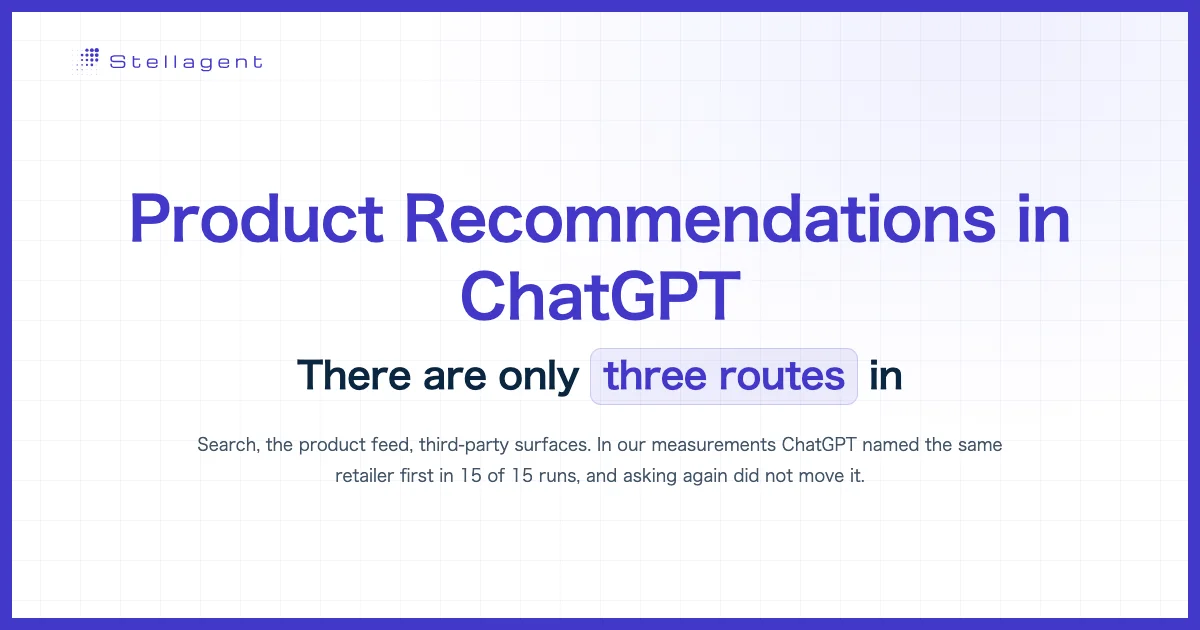
There are only three routes in
Search — picked up through OAI-SearchBot and the Bing index. Product feed — submitted directly through the merchant program. Third-party surfaces — comparison articles, reviews and press releases getting cited.
The outcome is the sum of all three. However well you prepare your own site, being absent from every comparison article makes it hard to enter the candidate set. And however visible you are on third-party surfaces, if your own pages depend on JavaScript, the AI that comes to verify details retrieves nothing.
If your products are not appearing, identify which of the three is failing before you start. The work differs by route, so attacking all three blind wastes effort.
| Route | How you get in | How to check | Time to effect |
|---|---|---|---|
| Search | Picked up through OAI-SearchBot crawling and the Bing index | Read robots.txt, open the page with JavaScript disabled, run a site: search on Bing | Weeks |
| Product feed | Submit product data directly through the merchant program (US-only as of July 2026) | Apply at chatgpt.com/merchants, then check format, update frequency and required attributes in the Product Feed Spec | Weeks, after review |
| Third-party surfaces | Comparison articles, review sites and press releases get cited | Search your category and see whether you appear in the leading comparison articles | Months |
What ChatGPT looks at when choosing products
The sequence runs: receive the question, decide whether a search is needed, generate search queries, retrieve results, integrate what the pages say. The point that matters is that if no search is judged necessary, the answer is built from trained knowledge alone. For a question like "which store should I buy a refrigerator from", a search usually runs.
The search itself is a hybrid: OpenAI's own OAI-SearchBot crawler, the Bing index, and partner data. Treating ChatGPT as simply Bing-dependent is out of date. The Bing index still matters, but preparing only for it leaves half the route unaddressed.
Our overview of LLMO covers the full mechanism.
Measured: the recommendation does not change when you ask again
In our refrigerator purchase study, ChatGPT named the same retailer first in 15 of 15 runs. Rewording the question and separating sessions did not move the order.
In the washing machine study, the top position split by service. ChatGPT and Gemini named one retailer, Claude named another, and Perplexity and Copilot named a third — each consistent within itself. Each AI has a seated occupant, and the seat does not change hands easily.
One conclusion follows. "Maybe we'll show up if we ask a few more times" does not happen. A store that is not seated now will not be seated by waiting. The order moves only when something changes on one of the three routes.
Route 1: Getting picked up through search
Start with the technical checks. If this route is blocked, work on the other two produces nothing.
First, confirm that robots.txt does not block OAI-SearchBot. GPTBot (training) and OAI-SearchBot (search) serve different purposes. Declining to be used for training is a reasonable position, but a blanket block removes you from the search side as well. Handle them separately.
Second, confirm that key information reads without JavaScript. Major AI crawlers do not execute JavaScript and read only the HTML that comes back. On a page where price, stock or specifications are drawn by JavaScript alone, the information effectively does not exist. Disabling JavaScript in your browser answers this in ten seconds.
Third, the Bing index. Search "site:yourdomain" on Bing and see whether key pages appear. If they do not, submit your sitemap through Bing Webmaster Tools and notify updates via IndexNow. Fewer companies check Bing than Google, which is exactly why it is a place where differences open up.
Route 2: Submitting a product feed
Where search waits for a crawler to come and fetch your pages, the feed hands product data over directly. ChatGPT accepts product feeds through its merchant program.
The merchant program is limited to US-based merchants. OpenAI has said it will expand outside the United States during 2026, but no date has been published for Japan. If you operate in Japan, routes 1 and 3 are where the work is for now.
Applications go through the merchant portal at chatgpt.com/merchants, and the feed specification is documented in OpenAI's Product Feed Spec. Once approved, you are given a destination to push product data to on an ongoing basis.
Four things to settle: submission format, update frequency, required attributes, and whether a review process applies. Specifications change, so check those documents at the time you start. Feed mechanics are the fastest-moving area covered in this article, including what is written here.
For merchants outside the eligible regions, having submission-ready data matters more than rushing an application. Product data prepared for Merchant Center serves as the foundation, so working through our product feed guide first means you can move as soon as the route opens. As a framework for handing product data to an external party, this also connects to the Agentic Commerce Protocol (ACP) discussion.
A feed carrying tax-inclusive prices against a site showing tax-exclusive ones reads as a contradiction. A source holding contradictions is treated as a low-confidence candidate. Reconcile the two before you submit.
Route 3: Appearing on third-party surfaces
ChatGPT does not only cite your own site. If anything, comparison articles, review sites and press releases are cited more readily.
In Japanese, the domains cited most by AI include YouTube, note, Wikipedia and PR TIMES — none of them your own. In B2B, one study found that 100% of the tools ChatGPT recommended were listed on the review site Capterra. Different category, same structure.
There is a region you cannot reach by improving your own site. Appearing in comparison articles, accumulating reviews, and issuing press releases demand very different kinds of effort, so assign them to different owners internally.
Purchase has moved back to your own site
The route changed substantially over the past year, so it is worth stating where things stand.
OpenAI launched Instant Checkout on 29 September 2025, allowing a purchase to complete inside ChatGPT. It ended in March 2026, with the focus returning to discovery and recommendation — roughly five months of experiment. Today ChatGPT recommends products and sends the purchase to the merchant's storefront or app.
Two implications. The first is that the division of labor is now discovery through AI, purchase on your own site. The experience on the page someone lands on determines the sale. A recommendation that lands on a confusing page is where the funnel breaks.
The second is that this is not the final shape. As protocols like ACP mature, the purchase experience will move again. Which is why feed and data work is not wasted: whatever the route, the quality demanded of the data is the same.
How to check how you appear
Phrase them as a customer would — "which store should I buy a [category] from?" — and leave your company name out
ChatGPT and Gemini both offer a temporary chat that ignores history and memory. Use it so results shaped by past conversations are not mistaken for your actual standing. Three runs show whether the answer is stable
Whether you appeared, in what position, and which URLs were cited. Put these three in a table
If every citation is a third-party surface, route three is not your problem. If your own URLs are never cited, suspect route one
To work through this as a comprehensive audit instead, use our 22-item checklist.
Frequently asked questions
No general mechanism for purchasing a recommendation slot inside answers exists at the time of writing. Preparing the three routes is the only method available.
Yes. Large companies often leave routes two and three unattended, so narrow categories remain accessible. Rather than aiming for first place everywhere, aim to appear reliably in a narrow category.
Not as of July 2026. The merchant program is limited to US-based merchants. Expansion beyond the United States is stated for 2026, but no date has been published for other markets including Japan.
Routes one and three carry across almost entirely. Route two differs by service, since each runs its own framework. Our comparison of AI search engines covers those differences.
Clearing a technical fault on route one can change answers within weeks once pages are re-fetched. Winning third-party placement on route three takes months.
Not on its own. What decides it is whether people can buy on the page they land on. Separate AI referrals into their own channel and make conversions traceable before you judge the result.
Summary
Three routes lead into ChatGPT: search, the product feed, and third-party surfaces. Identify which one is failing before you start work.
In our measurements, ChatGPT's first recommendation was the same store 15 times out of 15. The seat is taken, and waiting does not change that. It moves only when something on one of the routes changes.
Purchase has returned to your own site, but that is not the final shape. Being ready to be discovered, and being ready to sell to whoever arrives — prepare both, and the work survives the next change of route. We offer a free AI visibility assessment for retail and e-commerce businesses.