AI Commerce News Digest (April 23, 2026)
Ulta Beauty and Google Gemini launch the first industry-scale agentic beauty commerce. Prove unveils an Identity Trust Layer for agents. Topsort introduces 'Sponsored Prompts,' the first agentic retail-media ad format. Accenture and Google Cloud expand their Gemini Enterprise partnership.

Key Takeaways
- Ulta Beauty announced "Ask Ulta" in partnership with Google Gemini, delivering the first industry-scale agentic commerce implementation in beauty retail and joining Bunnings as a flagship Google Cloud showcase
- Prove launched an Identity Trust Layer for the agentic era while Topsort introduced "Sponsored Prompts," the first agentic retail-media ad format. Identity verification and retail-media advertising are both being redesigned for agents
- Accenture and Google Cloud expanded their Gemini Enterprise partnership, accelerating enterprise agentic transformation. After consumer-facing deployments, full-scale B2B enterprise adoption is now underway
Today's Top Stories
Ulta Beauty launches agentic beauty commerce via Google Gemini

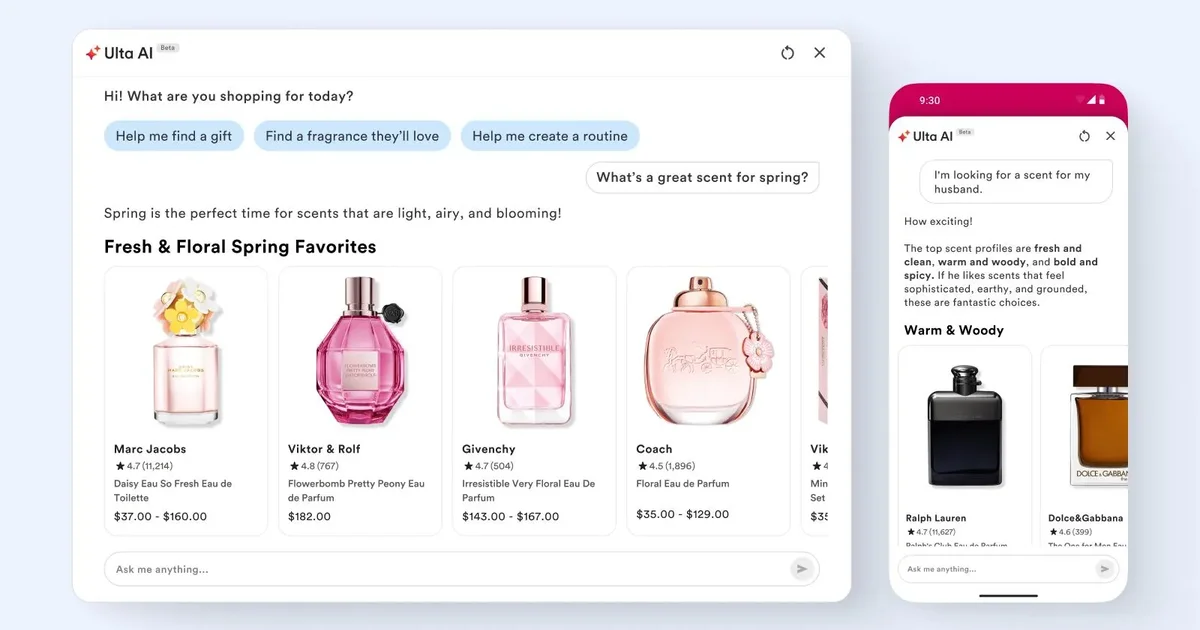
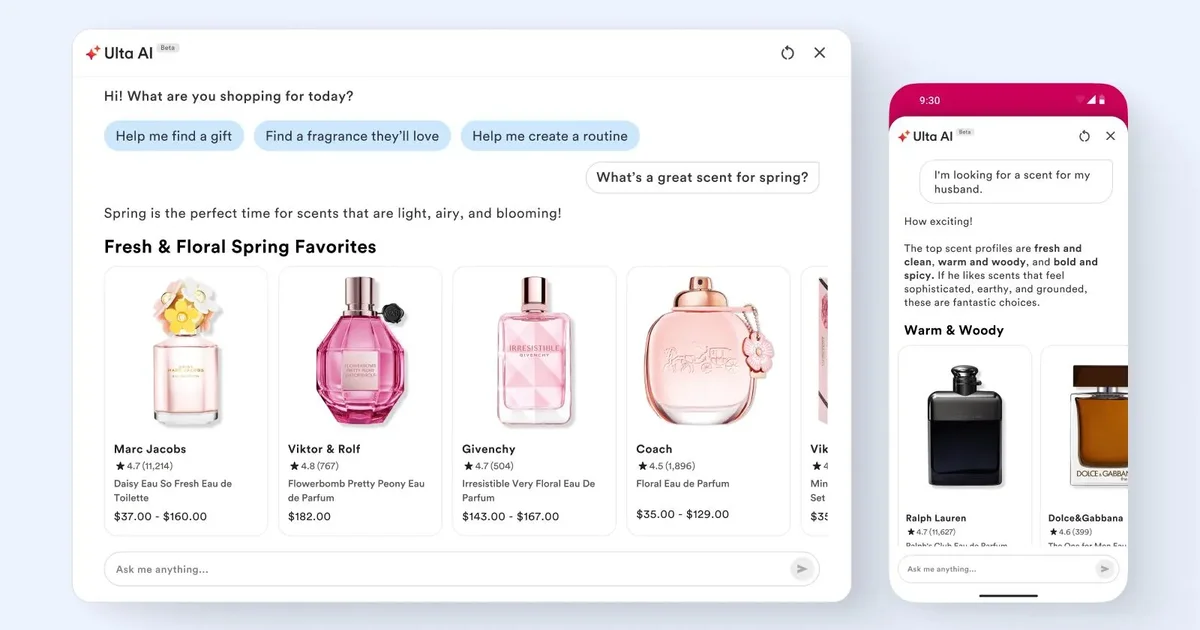
Ulta Beauty is integrating Google's Gemini AI into its website and app, and extending its catalog across Google's platforms giving it a competitive edge in retail beauty.
www.forbes.comUlta Beauty, one of America's largest beauty specialty retailers, announced a partnership with Google Cloud to integrate Gemini AI into its website and app as a conversational shopping experience called "Ask Ulta." The assistant recommends products by skin type, hair type, and preference, letting shoppers discover, compare, and buy entirely through dialogue. Ulta's catalog will also be distributed across Google Search, Google Shopping, and the Gemini app, securing visibility even outside Ulta's owned surfaces.
At the same Google Cloud retail showcase, Australian hardware chain Bunnings unveiled a similar AI shopping assistant, signaling that direct partnerships between vertical retailers and foundation-model providers are becoming the emerging standard. After Alipay (China), Amazon (US), and Shopify (merchants), category-specialist retailers building their own agentic experiences on their own domains is now an unmistakable pattern.
Prove unveils "Identity Trust Layer" for the agentic era

Prove, the leader in digital identity, today launched the Prove Identity Platform℠, a unified platform that transforms identity from a one-time verification into an ongoing trust layer.
www.businesswire.comProve, a leading digital-identity verification provider, officially launched the Prove Identity Platform, positioned as the "Identity Trust Layer" for agentic commerce. Rather than a one-shot onboarding check, the platform issues continuous trust signals and verifies both humans and AI agents across their entire lifecycle.
Announced on April 22, Prove's platform joins Fime's "FACT (Framework for Agentic Commerce Trust)" and HUMAN Security's "Agentic Visibility" as emerging players in the trust-layer category. While payment and platform standards are still fighting for share, the third-party verification layer that answers "who authenticates which agent as real" is rapidly forming.
Deep dive: Prove Identity Platform launch — what "continuous trust layer" means for the agentic era
Topsort launches first agentic retail-media ad format: "Sponsored Prompts"

Silicon Valley AI-native Commerce Infrastructure Company Topsort launches an AI-native ad format, turning conversational moments into product discovery with a new agentic ad format.
www.accessnewswire.comSilicon Valley AI-native commerce infrastructure company Topsort unveiled "Sponsored Prompts," the retail-media industry's first agentic ad format. Advertisers can now sponsor contextually relevant products inside AI-agent conversations.
Traditional sponsored search and sponsored product ads assume a keyword query, but agents now return recommendations directly, so ad formats must also be redefined. For Amazon Ads and the broader retail-media network world, this raises an urgent question about revenue-model design for the agentic era and could force a wholesale reconfiguration of the category.
Deep dive: Topsort's "Sponsored Prompts" — a new retail-media economy for the agentic era
Accenture × Google Cloud expand Gemini Enterprise partnership
Accenture and Google Cloud today announced a significant expansion of their partnership, with the launch of a first-of-its-kind program focused on helping enterprises drive AI-powered reinvention and business value faster and at scale.
newsroom.accenture.comAccenture and Google Cloud announced an expanded partnership centered on Gemini Enterprise, launching a joint program dedicated to enterprise agentic transformation. The program bundles best practices, reference architectures, and vertical solutions for enterprise agent adoption, making it a core vehicle for scaling enterprise AI agent rollouts through one of the world's largest systems integrators.
While Ulta and Bunnings are Google Cloud's consumer-facing showcases, Accenture × Google is the B2B enterprise equivalent. Taken together with today's Ulta announcement, Google Cloud is clearly positioning Gemini Enterprise as the common backbone for owning the agentic layer from B2C through B2B.
Agentic Commerce
Bunnings showcases AI shopping agent at Google Cloud retail event

The Australian hardware chain has gone from digital laggard to e-commerce pioneer, teaming up with Google Cloud to launch a conversational AI assistant that turns simple queries into DIY project plans.
www.computerweekly.comBunnings, Australia's largest DIY hardware chain, showcased a conversational AI shopping assistant built with Google Cloud. Given an open-ended request like "I want to build a deck," the agent produces a full project plan — materials, tools, and step-by-step guidance — pushing category-specific DIY project planning into agent territory.
Once described as a digital laggard, Bunnings' leap to e-commerce frontrunner via AI is striking, and it now stands alongside Ulta Beauty as a flagship Google Cloud showcase.
Contractor Commerce launches AI conversational buying for home-services
Contractor Commerce, a leading e-commerce and sales enablement platform built specifically for home service contractors, announces the next generation of AI-powered conversational buying.
www.prnewswire.comContractor Commerce, a US e-commerce platform for home-service contractors (HVAC, plumbing, etc.), announced an AI conversational buying experience. Field technicians can run quote-to-order workflows through dialogue at the customer's home, showing that vertical-specific agentic commerce is now reaching niche B2B2C segments.
OPINION: Agentic commerce is reshaping delivery options

How agentic commerce reshapes the choice of delivery options at checkout for consumers and merchants.
www.parcelandpostaltechnologyinternational.comParcel and Postal Technology International argues that when agents pick delivery options by weighting price, speed, and carbon impact, carriers must expose agent-friendly APIs for each option. A consequential read for logistics operators.
AI Commerce Tools
Mountain Warehouse moves to composable commerce

A U.K.-based global outdoor clothing and equipment retailer is partnering with an e-commerce platform to enable more flexible digital retail operations.
chainstoreage.comUK-based outdoor retailer Mountain Warehouse announced a migration to a composable commerce stack, shifting from monolithic e-commerce to headless, API-driven infrastructure to secure agent connectivity and multi-brand flexibility — a textbook infrastructure replatforming for the AI-native era.
Mirakl Connect accelerates Lacoste's premium marketplace expansion
Lacoste selects Mirakl Connect, the AI-powered multichannel selling solution, to accelerate its growth on major fashion marketplaces while preserving its brand standards.
www.mirakl.comLacoste adopted Mirakl Connect's AI-powered multichannel selling solution to accelerate expansion across premium fashion marketplaces. AI optimizes simultaneous distribution to multiple marketplaces while enforcing brand standards — a reference case for luxury and premium brand marketplace strategy.
Corporate & M&A
Alibaba weighs DeepSeek stake amid social-commerce push
Alibaba Group Holding (NYSE:BABA) is reported to be in talks with Tencent to invest in Chinese AI startup DeepSeek, aiming to reinforce each group's position in the local AI market.
finance.yahoo.comAlibaba and Tencent are reportedly exploring a joint investment in Chinese AI startup DeepSeek. While the two companies compete in social commerce and instant delivery, they are aligning on domestic foundation-model investment to reduce reliance on US models. Combined with Alipay's agent payments rollout, China's AI commerce infrastructure is compounding.
Samsung × AnyMind expand live commerce across eight markets

Samsung partners with AnyMind Group's AnyLive to boost live commerce, moving beyond traditional broadcast schedules to an 'Always-On' engagement model across eight markets.
www.brandinginasia.comSamsung chose AnyMind's AnyLive to roll out "Always-On" live commerce across eight Asian markets. The move from scheduled to perpetual streaming signals live commerce entering its next growth phase, particularly in Southeast Asia and India.
Logistics & Fulfillment
Sam's Club launches nationwide hour-or-less "Enhanced Express Delivery"
Walmart-owned big box retailer Sam's Club says members can now get their eCommerce orders delivered in an hour or less.
www.pymnts.comWalmart-owned Sam's Club is rolling out hour-or-less delivery on e-commerce orders to Plus members nationwide. Against Costco's membership competition, delivery speed is the differentiator — and alongside today's Ulta × Google Gemini announcement, it highlights how retail UX competition is accelerating on both AI recommendation and instant delivery axes.
Conclusion
Looking across today's stories, agentic commerce is spinning up simultaneously in three layers: consumer experience, enterprise adoption, and adjacent layers (identity and advertising).
On the consumer side, "vertical retailer × foundation-model provider" partnerships like Ulta and Bunnings are becoming the new playbook. On the enterprise side, Accenture × Google Cloud is building the adoption layer via Gemini Enterprise. In the adjacent layers, Prove (identity verification) and Topsort (retail-media advertising) are defining new categories. For e-commerce operators, the question is no longer whether to prepare for agentic commerce, but which partners to choose for adoption and how to design exposure across agent-mediated inflows.