Ulta Beauty Partners With Google Gemini: 'Ulta AI' Assistant and UCP-Powered Agentic Commerce Launch Together
Ulta Beauty launches the Gemini-built Ulta AI assistant and extends its catalog to AI Mode and the Gemini app via Universal Commerce Protocol. A blueprint for category-specialist retailers entering agentic commerce.

Key Takeaways
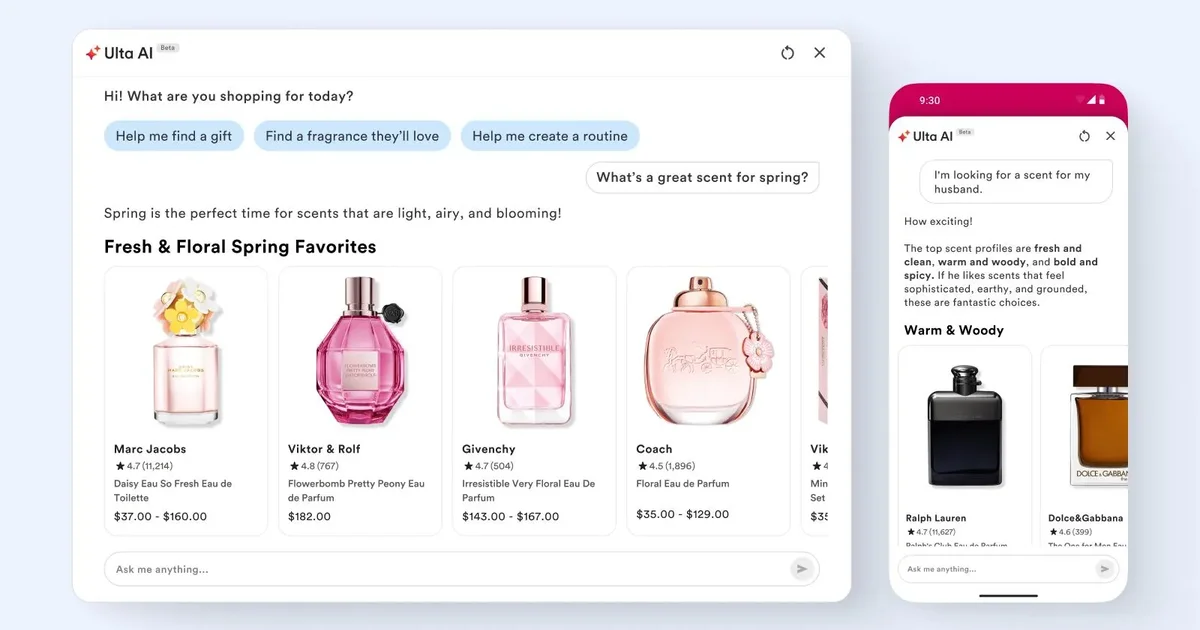
- At Google Cloud Next '26, Ulta Beauty announced two Gemini-powered launches in parallel: Ulta AI, a shopping assistant embedded in Ulta.com and its app, and agentic commerce that makes Ulta's catalog shoppable inside Google's AI Mode and the Gemini app.
- Both rely on Google's open Universal Commerce Protocol (UCP) and Gemini Enterprise for CX, making Ulta the first major category-specialist retailer to claim discovery ground both inside and outside its own surfaces in the agentic era.
- With 1,500 stores, 46 million loyalty members and 30,000 SKUs from ~600 brands, Ulta is using its first-party data and curation to defend differentiation in a world where AI agents mediate purchases, setting a pattern that D2C brands and Japanese category-specialist retailers will soon have to confront.
Ulta Beauty Steps Into Beauty-Category Agentic Commerce Through Gemini

Ulta Beauty is integrating Google's Gemini AI into its website and app, and extending its catalog across Google's platforms giving it a competitive edge in retail beauty.
www.forbes.comOn April 22, 2026, Ulta Beauty — the largest specialty beauty retailer in the U.S. — made a significant move on the Google Cloud Next '26 stage. Together with Google, Ulta unveiled two Gemini-enabled launches. One is Ulta AI, a shopping assistant embedded in Ulta.com and the Ulta Beauty App. The other is an agentic commerce experience that lets shoppers receive recommendations, compare products and complete checkout for eligible items directly inside Google's AI Mode in Search and the Gemini app.
The design logic behind both is the same: let an AI agent carry the shopper through discovery to purchase in a single conversation, across both Ulta's own channels and Google's. The official Google Cloud and Ulta press release spells out the division of labor. Ulta activates its 46-million-plus member base; Google captures demand flowing through AI Mode, Gemini and its Shopping Graph.
The reason this matters is not the shiny chatbot. It is that Ulta is among the first category-specialist retailers to adopt the Universal Commerce Protocol (UCP) and claim discovery ground inside and outside its own walls at the same time. This is not a department-store-style experiment. A single-category specialist is actively redesigning the path to purchase for the agentic era.
What Ulta AI Does: A Conversational Assistant Backed by 46M Members' Data
Start with the owned side. Ulta AI is a conversational shopping assistant built on Gemini Enterprise for Customer Experience. It is already live on Ulta.com, with the Ulta Beauty App rollout expected soon.
Three pieces of value sit at its core. First, it can carry 46 million loyalty members' purchase and browsing data directly into the conversation context. Purchase history, skin type, preferred brands and review history prime the model, giving sharper answers than talking to raw Gemini. Second, shoppers can navigate 30,000 SKUs across roughly 600 brands through natural language — for instance, "a vitamin-C serum under $50 suitable for sensitive skin" — rather than clicking through filter trees. Third, what Google Cloud calls a "shopping agent" can compare, propose alternatives and add to cart on behalf of the shopper.
Google Cloud's Ashish Gupta, VP and GM of Merchant Shopping, framed the work as "helping customers purchase right at the moment of discovery." Traditional e-commerce forces six steps — search, filter, listing, detail, cart, checkout. Ulta AI compresses that staircase into a single dialogue. Beauty is a category where SKU fragmentation is extreme and ingredient preferences are hard to express through filters, so the compression effect should be especially visible here.
It is also worth noting this is not a bolt-on chatbot. Gemini Enterprise CX, launched at NRF in January 2026, is an agent platform that Kroger, Lowe's, Papa John's and Woolworths had already adopted. With Ulta, Google now has a flagship reference in a high-emotion beauty category.
The Extension Into Google: UCP Pushes the Catalog Into AI Mode and Gemini
The move to place Ulta's catalog inside Google's surfaces is the bolder strategic call.
Over the next month, Ulta's assortment becomes shoppable inside AI Mode in Search and the Gemini app. Asking Google "which foundation matches my skin tone?" can surface Ulta products, compare them and complete checkout for eligible items inside the conversation. This is powered by the Universal Commerce Protocol (UCP), the open standard Google announced in January.
UCP is a shared language for retailers and AI agents to exchange intent, product metadata, inventory, pricing and cart state. As Let's Data Science describes it, it is protocol-level interoperability — once a merchant integrates, its catalog becomes transactable across Search, Shopping and Gemini without bespoke integrations for each surface.
Ulta CTO and transformation officer Mike Maresca said the company engaged early with UCP because "we see a clear shift in how guests are discovering and shopping for beauty, with AI playing a much bigger role in that journey." What is easy to miss is that Ulta is trying to shape the very structure through which AI agents mediate purchases, rather than react to it later.
McKinsey argues agents are reshaping "how intent forms, how products are discovered, and where value pools can be found." Bain's Consumer Lab finds that 30% to 45% of U.S. consumers already use ChatGPT, Perplexity or Gemini for research, comparison and product guidance. Leaving this unattended risks reducing retailers to a commoditized API behind someone else's agent. Ulta is moving before that door closes.
The Parallel Bunnings Story: Google Cloud's Retail Showcase Play
The Ulta announcement needs to be read alongside the broader tone of Google Cloud Next '26. Google surfaced a lineup of category-specialist retailers in parallel — Australian DIY chain Bunnings, U.S. home-improvement giant The Home Depot, supermarket chain Kroger, pizza chain Papa John's and more.
Bunnings was specifically flagged as completing its UCP and Gemini Enterprise CX implementation "in weeks." Home Depot's Magic Apron agent handles end-to-end project planning; Papa John's expanded natural-language ordering across mobile, kiosk and in-car systems; Estée Lauder's Jo Malone London debuted a Scent Advisor agent for fragrance.
Read together, the pattern is clear. Google Cloud is not betting on aggregator-style commerce players. It is trying to assemble a network of category specialists whose combined depth can route around Amazon. Stitch each category's authority into UCP and Google's discovery surfaces start to resemble a mall where the expert shop always happens to be next to the search box.
Ulta is positioned as the flagship for beauty. The Google Cloud "A new era of agentic commerce" post frames the shift as moving "from passive browsing to active doing," and hints at a deliberate category-by-category consolidation strategy.
Ulta's Position in the Agentic Commerce Landscape
This needs to be read in the context of the landscape that has taken shape over the past six months. Three camps are emerging.
The first is the OpenAI camp. OpenAI published the Agentic Commerce Protocol with Stripe and enabled Instant Checkout inside ChatGPT. Walmart announced a partnership letting shoppers buy directly from ChatGPT. The second is the Shopify-centered open camp, which pushes for a neutral commerce substrate. The third — sharpened by this announcement — is the Google/UCP camp.
Ulta's choice rests on UCP's unique reach: Search, Gemini, YouTube, Lens and Shopping are already dominant discovery surfaces. Forbes notes Ulta defines its target "beauty enthusiast" at roughly 140 million Americans. Only 46 million sit inside Ulta's loyalty program, and they already generate roughly 95% of revenue. Reaching the remaining ~100 million requires borrowed discovery — exactly what Google's surfaces provide.
Rival Sephora, part of LVMH, operates ~500 standalone stores and 1,100 Kohl's shop-in-shops. Kohl's own net sales have dropped from $16.6B in 2023 to $14.8B last year, dulling the digital momentum. Ulta, meanwhile, reported $12.4 billion in FY2025 sales, up 10%, giving it both capital and operational room to move first on AI.
Implications for E-Commerce Operators and Brands
Here is the harder question for EC operators, brand marketers and retail DX leaders. Ulta's move is the first concrete blueprint for how a category-specialist retailer can actually execute in agentic commerce.
| Issue | Ulta's Move | Your Question |
|---|---|---|
| Discovery channel | Expose catalog inside AI Mode and the Gemini app | Will you place your products on generative AI surfaces, and via which protocol |
| First-party data | Connect 46M loyalty members' data to Gemini Enterprise | Do you have infrastructure to feed customer data into a conversational AI, with sound privacy design |
| Product data quality | Make 30K SKUs machine-readable through UCP | Do your structured data, real-time inventory and price integrity meet agent-grade requirements |
| Connectivity protocol | Early adoption of Universal Commerce Protocol (UCP) | In what order will you support UCP, ACP and MCP |
| Experience design | One conversation covers recommend, compare and checkout | How far will you redesign a filter-centric UI into a conversational one |
Three implementation questions sit underneath. First, owned data plus conversational UI. Without feeding loyalty signals and purchase history into the conversation layer, you cannot differentiate from a plain LLM or a generic shopping agent. Second, the external-surface exposure decision. UCP, ACP and MCP will coexist for a while, and the answer depends on how dependent your business is on new discovery. LTV-driven repeat businesses can afford to wait; acquisition-driven ones will pay a premium for early placement. Third, catalog quality and real-time inventory. When agents can complete checkout, structured product data, price integrity, inventory APIs and return flows have to meet a much stricter bar than today.
Beauty, supplements, DIY, grocery and other depth-heavy categories can turn their expertise into a moat. For commoditized D2C brands, riding aboard hubs like Ulta over UCP may be the rational play. Japan's market still runs on aggregator marketplaces — Amazon, Rakuten, Yahoo — but once generative-AI-mediated discovery crosses the 10% threshold, the shape of the market will move quickly.
Wrap-Up
Ulta Beauty's Gemini partnership is less a flashy feature drop and more the first substantive example of a category-specialist retailer drawing its own map for the agentic commerce era. Ulta AI deepens experience for loyal members; AI Mode and the Gemini app grab the discovery entrance for new ones. Binding them together through UCP is a design other category leaders will be forced to respond to.
What to watch next: Sephora's and LVMH's counter-move, and the moment Japanese category specialists decide to make the same call. The discovery venue is already shifting from branded e-commerce sites to conversational AI. Which protocol to adopt, and how deeply, will shape revenue ceilings for the next one to two years.