AI Commerce News Digest (June 12, 2026)
India's Pine Labs launches P3P, an agentic payment protocol that completes UPI payments without human authentication. Plus two new studies from Checkout.com and Ecommpay quantifying the consumer trust gap, ShopAgentic's pre-seed raise, and more.


Key Takeaways
- India's Pine Labs announced P3P, an agentic payment protocol. It extends UPI's existing mandate framework so that once a consumer authorizes upfront, AI agents can browse, select, and pay with no human authentication. Digital gold savings platform Gullak is already live on it
- Two studies quantifying the trust gap landed on the same day. Checkout.com found 24% of consumers say they will never delegate purchases to AI, while Ecommpay's European survey shows 50.1% would not trust an AI agent with their card details
- Investment and M&A keep flowing into the infrastructure layer. Germany's ShopAgentic raised a €1.9M pre-seed, Ripple released an XRP Ledger AI starter kit, Akeneo acquired PricingHUB, and Unifonic acquired Segmentify
Today's Top Stories
Pine Labs Launches P3P, Completing UPI Payments With No Human Authentication

The P3P payment protocol works by extending the UPI's existing mandate into payments triggered by AI agents.
www.aninews.in"The consumer authorises once, upfront. After that, the agent browses, selects, negotiates, and pays. No human authentication. No interruption." That is how Pine Labs, the Indian merchant commerce platform, describes P3P, a payment protocol it launched to let AI agents complete UPI payments without human intervention.
P3P is anchored on UPI's Single Block Multiple Debit (SBMD) and One Time Mandate (OTM) frameworks: the user approves a single mandate upfront, and subsequent transactions are executed autonomously by the agent. P3P provides the payment and settlement rails, while Grantex supplies verifiable identity, delegated authorization, spend controls, and auditability. Combined with HTTP 402 for standardized payment requests, the framework enables trusted agent-to-agent transactions.
Use cases are already running. Digital gold savings platform Gullak is live on P3P, letting its AI agent buy gold the moment the price hits a user's target. Securing flash sales instantly or locking in purchases at a set price are, in CEO Amrish Rau's words, "new behaviours, native to how India transacts." Coming one day after Visa and Mastercard unveiled their agent payment platforms, the same playbook arriving on top of a national payment infrastructure like UPI is hard to ignore.
Read more: Inside Pine Labs' P3P: How AI Agents Pay on UPI Without Human Authentication
Checkout.com and Ecommpay Studies Reveal the Expectation-Trust Gap

New research from Checkout.com has found a growing gap between emerging consumer demand and the trust, control and infrastructure needed to support agentic commerce.
homeofdirectcommerce.comPayments company Checkout.com published "Agentic Commerce 2026," a six-market study. A third of consumers expect at least 10% of purchases to be AI-driven within a year, and 72% of merchants agree consumers will adopt agent-led shopping faster than merchants are prepared for. Yet 24% of consumers say they will never delegate purchases to AI, and 27% trust no organisation to operate an AI shopping agent. Consumers would allow an agent to spend an average of £177 per purchase without additional approval — below the £200 merchants assume.
Ecommpay's survey of 1,750 consumers across five European countries, released the same day, shows the same shape. While 59.2% have heard of agent-led purchasing and 73.4% expect it to become common, only 13.9% want an agent to complete purchases, and 50.1% would not trust an agent with their card details. Consumers happily use AI to compare prices (53.3%) and find deals (47.1%) — trust breaks down precisely where money changes hands.
Spending caps, instant revocation, and easy cancellation emerge as non-negotiables in both studies. The spend-control-laden payment platforms Visa and Mastercard announced a day earlier read as direct answers to this gap.
Read more: Reading the Agentic Commerce Trust Gap Through Two New Studies
Agentic Commerce
ShopAgentic Raises €1.9M Pre-Seed — A Bet on the Infrastructure Layer
German startup ShopAgentic has raised €1.9 million in an oversubscribed pre-seed round co-led by May Ventures and Greenfield Capital.
www.thefashionlaw.comGerman startup ShopAgentic announced a €1.9 million oversubscribed pre-seed round co-led by May Ventures and Greenfield Capital. Founders Alexander Ringsdorff and Kai-Thomas Krause are NewStore veterans, and rather than building a consumer-facing shopping agent, they are targeting the infrastructure layer — a "native agentic commerce system" that lets brands transact in an agent-mediated marketplace.
The Fashion Law frames the raise as a signal of where investors expect value to accrue if agentic commerce takes hold: away from optimizing consumer interfaces and toward the systems behind the storefront — product data, inventory visibility, pricing architecture, and transactional infrastructure.
Read more: ShopAgentic's €1.9M Raise Explained — Why Investment Is Shifting to Agent-Ready Infrastructure
Ripple Releases XRP Ledger AI Starter Kit
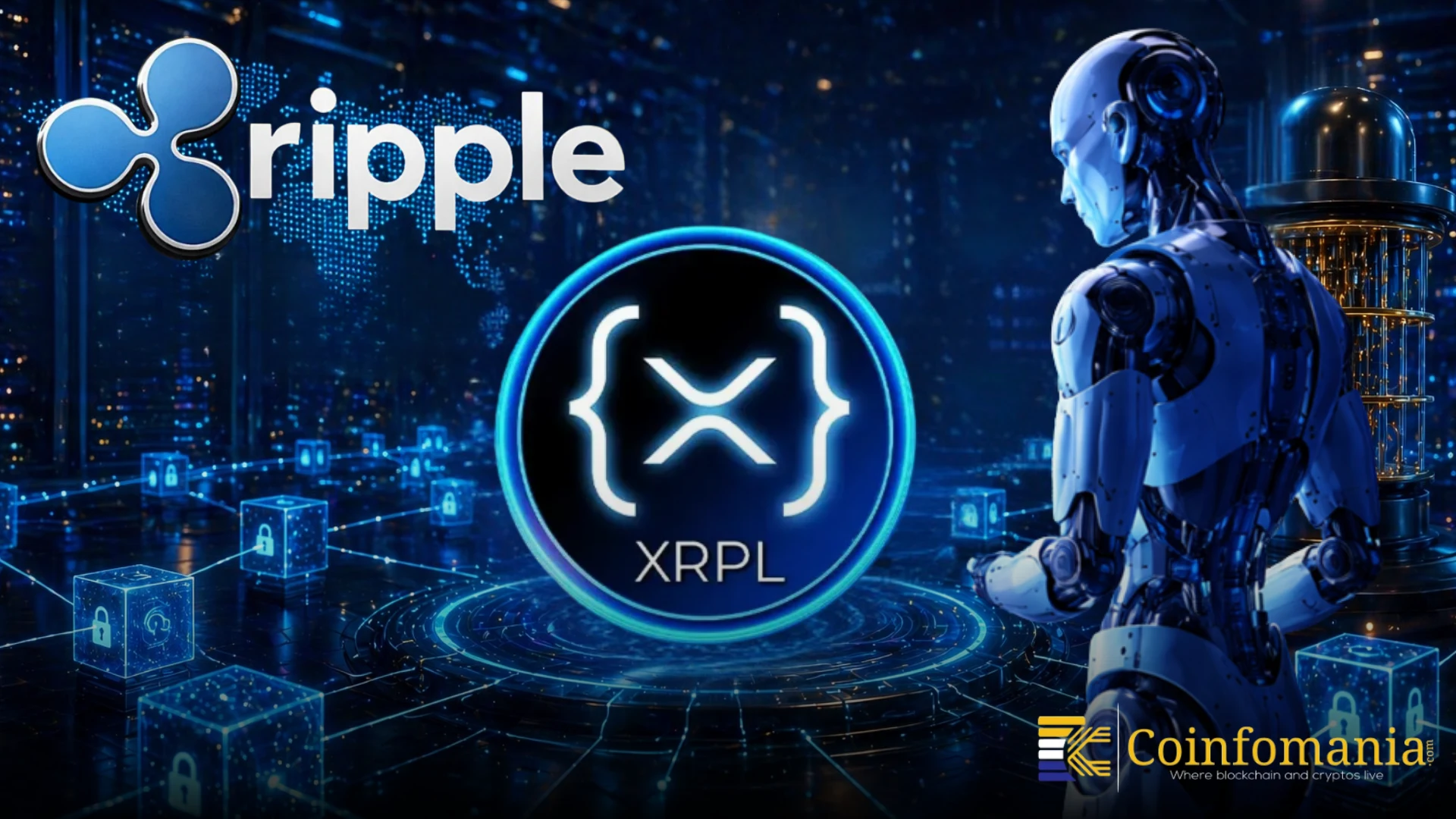
Ripple launches the XRPL AI Starter Kit to enable automated machine-to-machine payments using XRP and RLUSD on the XRP Ledger.
coinfomania.comRipple released the XRPL AI Starter Kit, enabling machine-to-machine payments by AI agents on the XRP Ledger. It ships with prebuilt wallet skills and an MCP server, supports the open x402 protocol, and lets agents autonomously pay for compute, model inference, and APIs using XRP or the RLUSD stablecoin, with on-chain settlement in 3–5 seconds.
Ripple also joined the 30+ initial partners of Mastercard's "Agent Pay for Machines" announced the previous day — working both the card network and blockchain sides of the agent payment rails.
AI Commerce Tools
Fractal Launches Cogentiq E-Commerce, Acting on Profit Signals in Minutes
Fractal, a publicly listed global enterprise AI company serving Fortune 500 organizations, announced the launch of Cogentiq e-commerce.
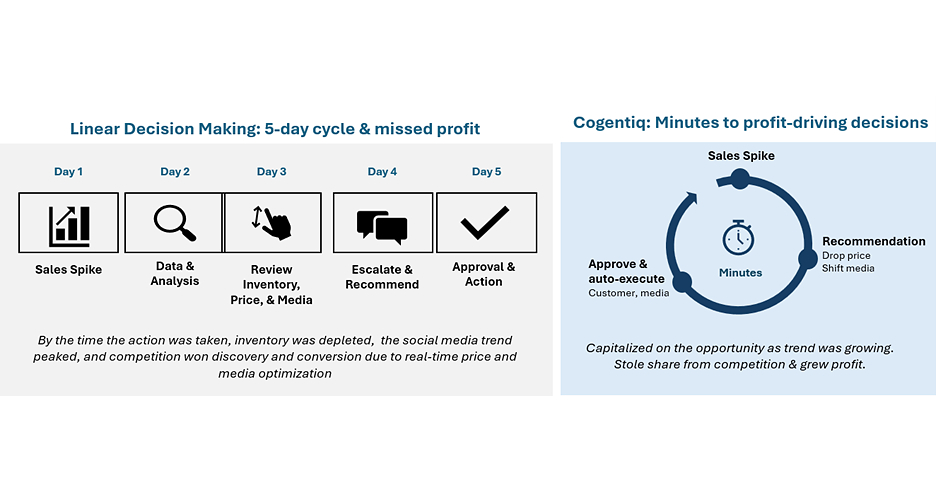
www.prnewswire.comListed Indian AI company Fractal announced Cogentiq E-Commerce, an "always-on e-commerce profit engine" for consumer products companies. It monitors 70+ profit signals per SKU daily — stock levels, media spend allocation, keywords, content, pricing — and recommends corrective actions orchestrated across customer, media, and supply chain teams within minutes.
When a product goes viral on Amazon, the current manual decision cycle of about five days compresses to minutes, preventing stockouts and wasted ad spend. Amazon marketplace integration is live today, with more platforms planned.
Corporate Moves & Partnerships
Akeneo Acquires PricingHUB — Product Data and Pricing in a Single Decision Layer
Akeneo, the Product Experience (PX) Company, announced the acquisition of PricingHUB, a leading pricing management platform.
www.prnewswire.comPIM leader Akeneo acquired pricing management platform PricingHUB. "Commerce is entering a new phase where AI agents increasingly influence how products are discovered and compared. In this world, product data and pricing can no longer be managed separately," explained CEO Romain Fouache.
Product data and pricing are becoming the two signals that determine visibility, relevance, and performance across AI-powered interfaces. A PIM vendor folding pricing optimization into its platform is a telling marker of where the industry is heading.
Unifonic Acquires Segmentify, Pushing "Agentic Marketing" Across MENA

Unifonic acquires Segmentify to deliver AI-driven personalization and behavioral intelligence for e-commerce brands across EMEA markets.
intlbm.comUnifonic, the AI-native customer engagement platform from the Middle East, acquired Turkey-born AI personalization company Segmentify. The pitch is "agentic marketing": autonomous AI agents that determine the next-best message, channel, and moment for each customer, shifting marketing away from manual, campaign-led execution.
The deal extends Unifonic's footprint into the UK, Türkiye, and Germany while reinforcing its position across MENA and GCC markets.
Global E-Commerce
China Summons Five E-Commerce Giants Over "Rat Race" Price Wars Ahead of 618

Officials summoned Alibaba, JD.com, Pinduoduo, Douyin and RedNote over marketing practices, underscoring official concern about subsidy wars.
www.scmp.comChina's market regulator summoned Alibaba, JD.com, Pinduoduo, Douyin, and RedNote ahead of the mid-year 618 shopping festival, demanding an end to destructive price cutting and inflated subsidy claims such as exaggerated "2-trillion-won subsidy" marketing.
Markets reacted quickly: Alibaba fell as much as 5.9% in Hong Kong, with e-commerce stocks broadly lower. Beijing's "anti-involution" campaign reaching platform promotion tactics will directly shape how the June 18 festival is run.
South Korea Fines Coupang a Record ₩624.7 Billion Over Data Breach

The record fine comes after around 37.5 million users had their private data exposed.
www.bbc.comSouth Korea's Personal Information Protection Commission (PIPC) fined e-commerce leader Coupang ₩423.6 billion for the data breach plus ₩201 billion for non-consensual data collection — ₩624.7 billion (over $400 million) in total, the commission's largest-ever penalty. Poor management of authentication signing keys and access controls exposed names, contacts, delivery details, and order histories of around 37.5 million users, more than half of South Korea's population.
Coupang says it "deeply regrets the concern caused" but plans to challenge the decision through legal proceedings. The breach had already cost the CEO his job, and the case has become a symbol of regulatory pressure on platform data governance.
Italy Mandates a "Return Button" on E-Commerce Sites From June 19

The function must be clearly visible and indicated using straightforward wording. Failure to comply may result in fines of up to €10,000.
en.ilsole24ore.comTransposing EU Directive 2023/2673, Italy will require B2C e-commerce sites, marketplaces, and subscription services to display a clearly visible returns (contract withdrawal) button from June 19. An email address or downloadable form is no longer sufficient — the flow must complete on the site, with an automatic acknowledgement of receipt. Non-compliance carries fines of up to €10,000.
Post-purchase experience becoming a legally mandated interface requirement is a pattern likely to spread across the EU, and cross-border sellers serving Italian consumers are in scope.
Walmart+ Expands to Canada — Its First International Market

Walmart views Walmart+ as a key relationship driver that increases customer frequency and supports its broader enterprise growth strategy.
www.retailbrew.comWalmart's paid membership program Walmart+ is now live in Canada — its first international expansion since launching in the US in September 2020. The $89 annual subscription includes unlimited free same-day delivery on orders over $35, free shipping with no minimum, and access to Canadian streaming service Crave's ad-supported tier.
In the US, Walmart+ members spend four times more than non-members and make seven times more e-commerce visits per year, per the CFO — making Canada a test of whether the membership flywheel travels.
Closing Thoughts
A day after Visa and Mastercard, the answer from a regional payments player arrived: Pine Labs implementing an agent payment protocol directly on top of UPI, India's national payment infrastructure. Meanwhile, the Checkout.com and Ecommpay studies put fresh numbers on the distance between technical readiness and consumer consent.
As ShopAgentic's raise and Akeneo's acquisition show, investment focus is shifting from consumer-facing agents to the data and infrastructure layers behind them. Watch for more national payment rails following P3P's lead, and for how China's e-commerce platforms run 618 under Beijing's new constraints.