Inside Travala's Travel MCP: The Transaction Stack That Lets AI Agents Book and Pay for 2.2M Hotels
Travala has launched Travel MCP, letting AI agents search, book, and pay for 2.2M+ hotels end to end. We dissect it as a working blueprint of the agentic commerce transaction stack — machine payments, delegated checkout, and the consent boundary kept with humans.

Key Takeaways
- Travala, a crypto-native travel booking platform, launched Travel MCP on June 10, 2026, letting autonomous AI agents search, book, and pay for more than 2.2 million hotels end to end
- It assembles the full transaction stack for letting an agent complete a purchase — MCP-connected inventory, x402 stablecoin payments, session keys that keep final authorization human, verifiable agent reputation, and performance-based developer rebates — making it a rare full-stack case study in agentic commerce
- For retail and e-commerce operators, the concrete homework is auditing which parts of checkout still assume human input, and deciding where to draw the boundary between delegated payment and human consent
The Booking Protocol That Declared the Death of the Checkout Button
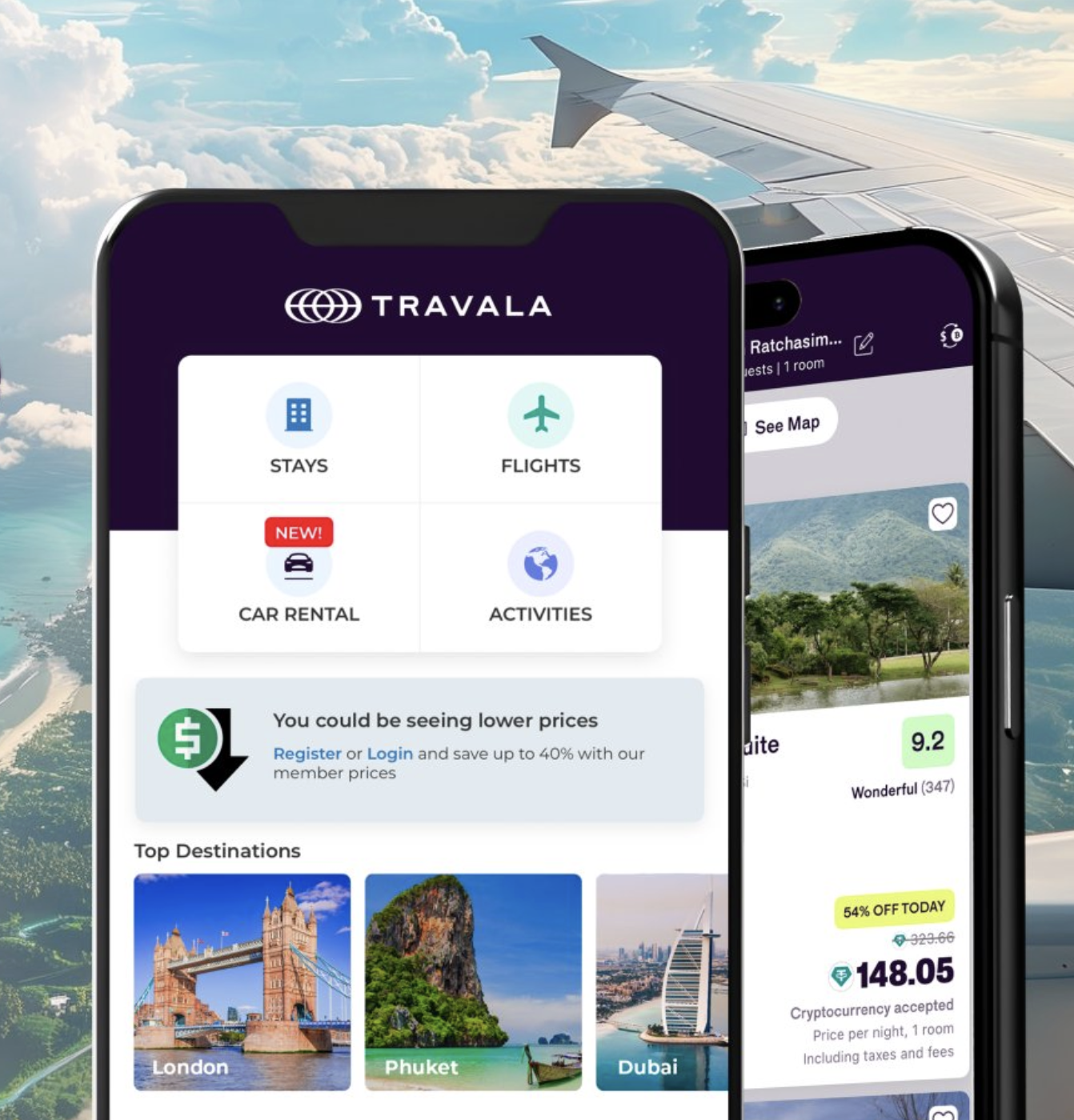
Travala has launched an agentic AI travel protocol that enables autonomous agents to search, book and pay for 2.2 million hotels using stablecoins on Base.
blockster.comThe checkout screen disappears from hotel booking. Travala, which has long operated crypto-powered travel booking, has now shipped that vision as a working product. The "Travala Travel MCP," officially announced on June 10, 2026, lets autonomous AI agents complete everything from hotel search to booking and payment inside a chat, and the company positions it as the world's first end-to-end agentic AI travel protocol.
The protocol covers more than 2.2 million hotels across 230 countries, including major brands such as Marriott, Hilton, and IHG. Users discuss their itinerary with an agent in Claude, and the agent handles comparison, booking, and cancellation management while maintaining context throughout. Payments settle in the stablecoin USDC on Base, an Ethereum Layer 2, with no step where a human types information into a form.
The launch of the world's first agentic AI travel protocol marks the death of the checkout button and the beginning of a truly autonomous travel economy.Source: Juan Otero, CEO of Travala
This article reads the launch not as a travel-industry story but as an implementation case for the transaction layer of agentic commerce. Agentic commerce means selling in which AI agents carry out comparison through purchase on the user's behalf. While most of the conversation still centers on AI search and chat-based product discovery, Travala's implementation pushes past discovery into the harder question of how an agent actually pays, which makes it worth studying regardless of industry.
The Full Parts List for Selling to an Agent
The foundation of the protocol is MCP, the Model Context Protocol. MCP is a connectivity standard that lets AI agents call external services' data and functionality in a uniform way, and Travala wired it into the inventory of an OTA (online travel agency). Through the Travel MCP, an agent retrieves availability and pricing and executes everything from comparison to booking requests without a human operating a screen. Opening the product in a machine-readable form, rather than as web pages built for humans, is the starting point for everything else.
Here is how the model compares with conventional online booking.
| Aspect | Conventional Online Booking | Agent Booking via Travel MCP |
|---|---|---|
| Search and compare | Humans enter criteria and compare options on a website | AI agents query 2.2M+ hotel inventory via MCP |
| Booking | Forms, member login, page navigation | The agent handles it inside a chat |
| Payment | Card checkout on a payment screen | USDC on Base (x402, gasless) |
| Human involvement | Manual at every step | Final authorization only (ERC-7715 session keys) |
| Cost and speed | Card fees, seconds to minutes to confirm | Roughly one cent, near-instant settlement |
What stands out is that Travala did not stop at machine-readable inventory. It shipped, at the same time, the payment rails for machine-to-machine settlement, a boundary for delegated spending authority and consent, a reputation record for gauging agent trustworthiness, and performance-based rewards for agent developers. The individual technology choices carry a distinctly crypto-native accent, but the parts list itself reads as a checklist for any business thinking about serving agents.
Delegate the Payment, Keep the Final Approval Human
For the payment layer, Travala adopted the x402 protocol, an emerging standard for machine-to-machine payments. x402 builds on HTTP status code 402 (Payment Required) to let APIs and AI agents complete stablecoin payments on the spot. A stablecoin is a crypto asset whose value is pegged to a fiat currency such as the U.S. dollar. In Travala's implementation, gasless (fee-free) USDC payments on Base bring transaction costs to roughly one cent per booking with near-instant settlement. There is no checkout form or 3-D Secure screen for a human to operate; the agent settles programmatically, which is the decisive break from conventional booking flows.
That said, this is not a design in which an agent can spend money on its own. The key is the session key, based on the Ethereum standard ERC-7715. The agent can autonomously initiate payment requests, but the final signing authority over funds stays isolated in the user's wallet. The official announcement puts it plainly: the agent does the legwork but can never move a cent without your final authorization. How much of the payment workflow to delegate, and where human consent must remain — Travala has drawn that line, the central question of agentic commerce checkout, as a concrete implementation.
A fraud-control layer is in place as well. Using the ERC-8004 standard, verifiable outcomes such as successful bookings are recorded as agent reputation, making trustworthy agents identifiable. It is an approach that anchors defenses against impersonation and low-quality agents in an onchain identity and reputation layer.
Why a Crypto-Native OTA Got There Before the Giants
Why did the self-declared world's first come from Travala rather than Booking.com or Expedia? The company's origins explain much of it. Travala is a Singapore-based OTA that has run crypto-powered travel booking since 2017, and it already operated the building blocks agent payments require: wallet connections, onchain settlement, and its own AVA token.
For autonomous agent payments, the traditional card-network path becomes friction. Authentication flows built around cardholder input, fees that weigh heavily on small transactions, fraud screens that block machine-like access. All of it exists to protect human purchasing, but in a world where software makes frequent small payments, it turns into an obstacle. The combination of stablecoins and session keys has emerged as one practical way to route around that friction while preserving user control, and Coinbase, which operates Base, is pushing x402 as a standard for agent payments. While incumbents move cautiously around their existing card-network relationships, Travala, free of those constraints, assembled the full stack first — that is one reasonable way to read the sequence.
Developer Rebates as Channel Design for the Agent Era
Easily overlooked, the protocol also has distribution economics built in. Developers who integrate the Travel MCP receive a 10% rebate in cbBTC (Coinbase Wrapped Bitcoin) for every completed booking generated through their agents. Rewards settle onchain directly to developer wallets, with no invoicing or manual reconciliation.
Think of it as affiliate marketing rebuilt for agents. The traffic-driving role shifts from media outlets and influencers to developers who build capable travel agents. In that world, making inventory machine-readable is not enough; merchants also have to design channel compensation — what to return, and how, to the agents that carry their products. Travala's mechanism, which automates performance measurement and settlement machine to machine, is an early template for channel design toward this new kind of distribution, and the question maps directly onto retail and e-commerce.
The Machine Customer Spreads From Travel to Retail
The timing was telling. In nearly the same week as Travala's launch, the head of JPMorgan Chase's consumer business revealed plans to pilot a consumer-facing AI travel agent before the end of the year. America's largest bank and a crypto-native OTA are heading toward the same future of AI-booked travel by different routes.
Market forecasts point the same direction. Juniper Research projections cited in Travala's announcement see agent-driven transactions growing from $8 billion in 2026 to $3.5 trillion by 2031, and Morgan Stanley estimates agentic shoppers could account for up to 20% of online retail spending by 2030. The figures vary widely by firm, but they share the same premise: the party visiting stores and websites is expanding from humans to agents.
In a world where agents are the customers, what wins is not the persuasiveness of banners and landing pages. It is whether inventory is machine-readable via APIs or MCP, whether an agent can complete payment, and whether your business is identifiable as a trustworthy counterparty. Most AI shopping features today still keep discovery and checkout separate, but Travala has shown, ahead of the pack, one combination of parts that closes that gap. None of it requires going fully onchain. What it does require, even for merchants firmly inside the card-payment world, is auditing which parts of checkout still assume human typing and screen navigation, and deciding how far to accept delegated payment.
Conclusion
Travala's Travel MCP is an early implementation that assembles the full parts list for letting an agent complete a purchase: machine-readable inventory, machine-to-machine payment rails, final approval kept with humans, verifiable reputation, and performance-based developer rewards. The real meaning behind the death of the checkout button is not that the purchase process disappears, but that the human role shrinks from input to approval. Whether this protocol becomes the standard rail for travel booking depends on adoption from here, but the parts list holds across industries. Re-examining your own sales flow through the eyes of an agent as the customer is the practical first step for retail and e-commerce operators.