AI Commerce News Digest (July 2, 2026)
Cloudflare unveils the Monetization Gateway to charge AI agents for any web resource via x402, and Worldline, Mastercard and Crédit Agricole complete France's first AI agent payment. Plus Lantern's agentic commerce platform, Alibaba's $600 million settlement and the EU's €3 parcel fee taking effect — the July 2 roundup of AI commerce news.


Key Takeaways
- Cloudflare announced the Monetization Gateway, which lets site owners charge for any web page, API, or MCP tool. With the x402 protocol and stablecoin settlement, the payment infrastructure for AI agents paying for web resources is taking shape
- The payments layer is moving fast: Worldline, Mastercard and Crédit Agricole completed France's first AI agent payment, while AEON expanded its agentic settlement rails into Zambia with mobile money integrations
- Lantern launched a platform to measure and improve how products appear in AI shopping, and the EU's €3 parcel fee took effect — momentum on both the monetization and regulation fronts of AI commerce
Today's Top Story
Cloudflare Announces the Monetization Gateway: Charge for Any Web Resource via x402

We're opening the waitlist for our Monetization Gateway, which will allow you to charge for any web page, dataset, API, or MCP tool behind Cloudflare. The charges will settle in stablecoins over the x402 open protocol.
blog.cloudflare.comOn July 1, Cloudflare announced the Monetization Gateway and opened its waitlist. It is an engine that lets Cloudflare customers charge for any resource behind Cloudflare — web pages, datasets, APIs, or MCP tools. Payments settle in stablecoins over the open x402 protocol, and site owners do not need to build a payments stack of their own.
The key design decision is that payment verification and enforcement happen at Cloudflare's edge. A single control plane manages payment policies and access controls across applications, while shielding origin servers from high payment volumes. The whole setup anticipates AI agents and crawlers paying for content and APIs without a human in the loop.
Cloudflare has been pushing in this direction for a while, from Pay per Crawl for AI crawlers to its work on the x402 protocol itself. This announcement extends that model to every asset on the web, and it marks a turning point: the payment infrastructure of the machine economy is becoming a standard feature offered by a major CDN. For businesses that own content or data, it opens a new monetization option.
Agentic Commerce
Lantern Unveils Agentic Commerce Platform to Measure and Improve AI Shopping Visibility
Lantern launched a loyalty tool for e-commerce brands. Now, it's doubling down on AI GEO and LLM result optimization. Read its pitch deck.
www.businessinsider.comEcommerce startup Lantern launched a platform that helps brands measure and improve how their products show up inside AI-powered shopping experiences. According to Business Insider, the company has pivoted from ecommerce search to GEO (generative engine optimization) and agentic shopping.
As ChatGPT and Gemini become entry points for product recommendations, demand is emerging for measurement and optimization tools that help brands get picked by AI. It is the same structural story as the SEO tool market growing alongside search engines — now replaying in AI shopping.
France's First AI Agent Payment Completed by Worldline, Mastercard and Crédit Agricole (Follow-up)

Worldline, Mastercard, and Crédit Agricole have completed France's first agentic payment transaction.
www.fintechfutures.comFinTech Futures reported the details behind France's first production AI agent payment, which we covered in the June 30 digest. The transaction was completed by a three-party alliance — payment processor Worldline, card network Mastercard, and bank Crédit Agricole — marking the first time in France that an AI agent completed a payment on a consumer's behalf.
The division of roles is the point worth noting. Agent payments only work in production when the bank, the network, and the processor coordinate at each layer. With major European players jointly completing the proof, agentic commerce payments are visibly moving from concept to operation.
AEON Expands to Zambia, Bridging Crypto Payments and Mobile Money

AEON, the settlement layer for the agentic economy, has expanded AEON Pay into Zambia, integrating local wallets Airtel Money and MTN Mobile Money.
www.moomoo.comAEON, which positions itself as the settlement layer for the agentic economy, expanded its AEON Pay service into Zambia. It integrates the widely used local mobile money wallets Airtel Money and MTN Mobile Money, bridging crypto payments with local payment rails.
In Africa, mobile money — not bank accounts — is the dominant way to pay. For AI-agent purchases and transfers to work globally, connecting to these region-specific payment methods is essential. The case shows that the infrastructure race in agentic commerce is advancing outside developed markets too.
AI Commerce Tools
Text Launches Shopify App and WhatsApp Integration, Positioning Conversational AI as Ecommerce's Operating Layer
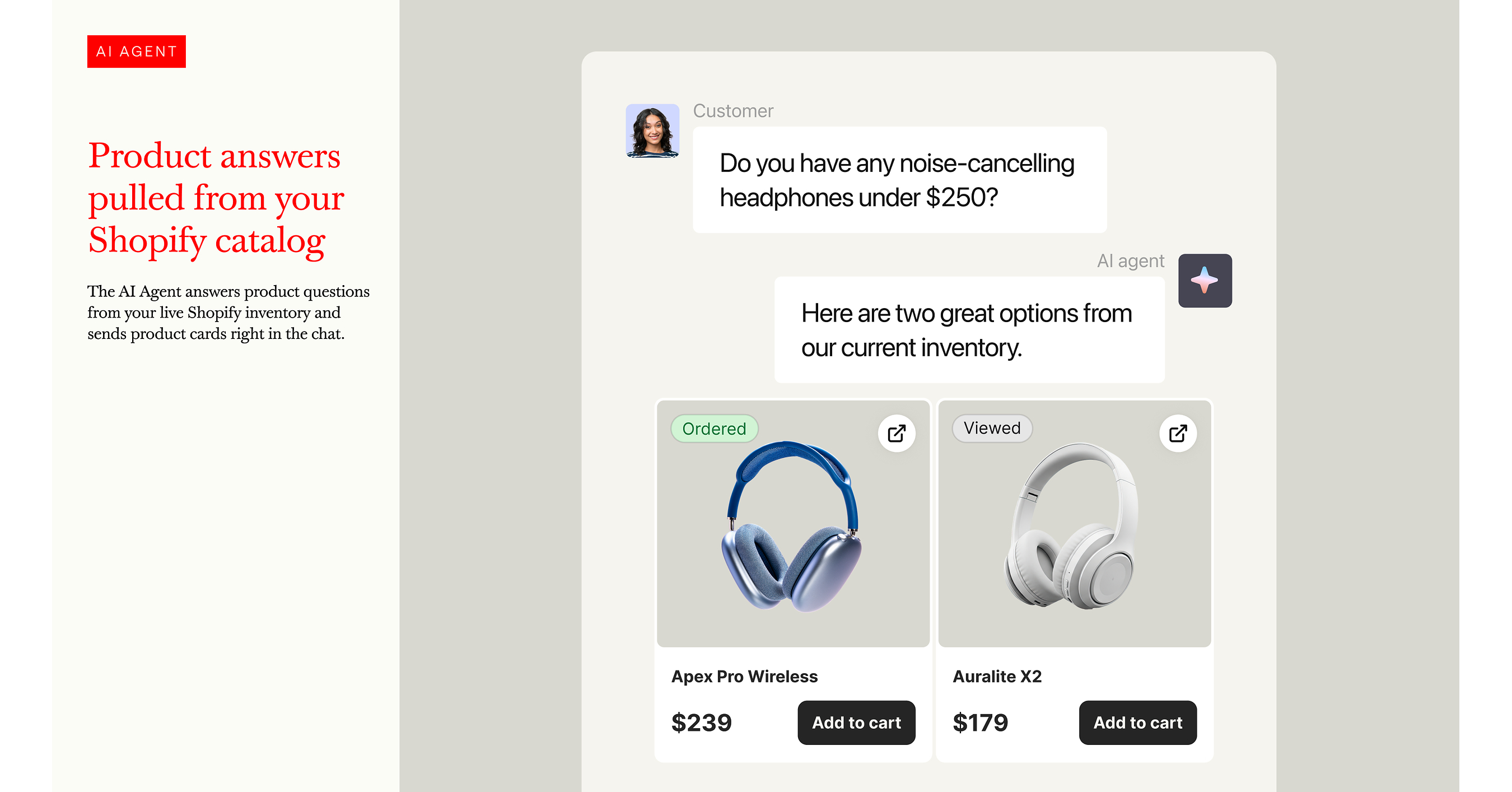
Text, an AI-powered customer service and sales platform, announced its launch on the Shopify App Store and new integration with WhatsApp.
www.prweb.comText, the AI-powered customer service and sales platform behind LiveChat, announced its official app on the Shopify App Store and a new WhatsApp for Business integration. The positioning: an AI "operating layer" that handles everything from ecommerce support inquiries to sales, all through conversation.
By connecting directly to Shopify's admin and customer data, the AI can automate order status checks, returns handling, and purchase suggestions. The WhatsApp integration targets markets in emerging economies and Europe where messaging apps are becoming storefronts. Conversational commerce tooling is evolving from standalone chatbots into an integration layer across the whole ecommerce stack.
Global Ecommerce
The EU's €3 Parcel Fee Takes Effect, Hitting the Cross-Border Models of Shein, Temu and AliExpress (Follow-up)

Europe took a first step towards curbing what it calls unfair competition from online retailers such as Shein, Temu and AliExpress by imposing a €3 fee on low-value e-commerce imports.
www.reuters.comThe EU's low-value parcel fee we covered in yesterday's digest formally took effect on July 1, with Reuters confirming the details. The bloc abolished the de minimis exemption that let imports under €150 enter duty-free, and now charges a €3 fee per low-value ecommerce parcel, largely from China.
The driver is sheer volume: parcels entering the EU under the duty-free threshold have surged to around 5.8 billion a year, raising alarms over lost customs revenue and products that fail safety standards. The low-price, direct-shipping models of Shein, Temu and AliExpress — all named in coverage — now face a forced rework of their cost structures.
Japanese businesses selling cross-border into Europe are not exempt. Pricing built on low-value direct shipping needs recalculation, and in-region inventory and fulfillment become comparatively more attractive.
Shopify Settles Copyright Lawsuit over Rival Platform's Alleged Software Copying

E-commerce company Shopify has settled a lawsuit that accused a rival company of copying its software to build a competing platform.
www.reuters.comShopify settled a copyright lawsuit it had brought against a rival company, Reuters reported. The suit accused the rival of copying Shopify's software to build a competing ecommerce platform.
Platform code and templates are increasingly exposed to copying risk as AI code generation spreads. How to protect platform intellectual property is a shared management question for every SaaS ecommerce provider, and this settlement becomes one of the early precedents.
Alibaba to Pay $600 Million to Settle US Probe over Illegal Drug Sales

Alibaba and its U.S.-based payment processor have agreed to pay $600 million to resolve allegations that they failed to prevent illegal drug sales, the U.S. Justice Department said.
www.reuters.comAlibaba and its US-based payment processor agreed to pay $600 million to resolve US Justice Department allegations that they failed to prevent illegal drug sales on the platform.
How far marketplace operators should be held responsible for the goods they intermediate is a question regulators are pressing worldwide. In an era when AI agents place orders automatically, platform compliance investment — including automated listing review and transaction monitoring — only gets heavier.
Corporate Moves
Global-e Closes $350M Passport Acquisition, Consolidating Cross-Border Logistics

Passport adds cross-border, domestic and last-mile logistics, plus non-MoR support. Global-e will update 2026 outlook on its August Q2 call.
www.stocktitan.netCross-border ecommerce provider Global-e completed its acquisition of US logistics company Passport. The deal is worth $350 million, with up to $75 million more in performance-based earn-outs. Passport brings cross-border, domestic and last-mile logistics, plus support for sales outside the merchant-of-record (MoR) model.
Global-e is a core player in cross-border commerce, known among other things for its Shopify partnership. As its integrated payments-tax-logistics offering strengthens, the shortlist for brands launching international sales keeps narrowing. Regulatory shifts like the EU's new parcel fee only increase the value of integrated players that can absorb the complexity.
Wrap-up
July 2 was a day when the infrastructure for AI agents to actually pay moved forward on every front. Cloudflare's Monetization Gateway built the billing endpoint on the resource side, the French three-party alliance ran consumer-side agent payments in production, and AEON extended agent settlement rails into Zambia's mobile money ecosystem. The arrival of GEO tools like Lantern shows that the race to be discovered by AI is becoming measurable.
At the same time, the rules governing commerce are gaining weight — the EU's €3 fee took effect and Alibaba settled for $600 million. Infrastructure for agent-mediated transactions and accountability frameworks for those transactions are advancing in parallel, and that dual track is worth keeping in view in the days ahead.