
AI Commerce News Digest (July 17, 2026)
HSBC UK and Visa completed an AI agent payment on a live merchant site while India's CERT-In proposed mandatory human approval. Your July 17 roundup of agentic commerce news for merchants.


Key Takeaways
- HSBC UK and Visa completed an AI agent payment on a live merchant website
- India's CERT-In proposed mandatory human approval for agentic payments above set thresholds
- As implementation advances, the guardrails of regulation and trust are being designed in parallel
Here is your AI commerce news roundup for July 17. Today could be called the day the accelerator and the brake were pressed at the same time. In the UK, HSBC UK and Visa completed an agent-initiated card payment on a real merchant website rather than in a sandbox. At almost the same moment, India's CERT-In proposed requiring human approval and full audit trails for agentic executions above a certain financial threshold. If yesterday's formal launch of the x402 Foundation marked progress on standards, today surfaced the question of how those standards connect to real consumer protection. In cross-border e-commerce, the EU's EUR 3 parcel fee has fed straight through to Shein's IPO valuation, showing that regulation now moves platform enterprise value directly.
Today's Top Stories
HSBC UK and Visa complete an AI agent payment on a live merchant site

HSBC UK and Visa complete an industry-first agentic card transaction on a live merchant website, with biometric authentication and customer spending controls.
www.resultsense.comA card issued by HSBC UK was used to complete a purchase initiated by an AI agent on an actual merchant website. Both companies describe the transaction as an industry first, and what separates it from earlier trials is that real money moved rather than a demo running in a sandbox. Authentication relies on biometrics, while permissions and safeguards are designed to leave spending decisions with the customer.
The point worth noting is Visa's stated intention to carry these transactions on its existing card network rather than a separate new rail. Rob Cameron, Visa's country manager for the UK and Ireland, stressed that agentic transactions will run within existing infrastructure and protections. Andy Rankin, HSBC UK's chief payments officer for consumer banking, described AI-powered commerce as the next evolution in how people shop.
Moving real money, however, sharpens the unresolved questions. How are card credentials presented to an agent? How is consent captured when software rather than a person initiates the purchase? And how do fraud and dispute rules apply when the customer never saw a checkout screen? Both Section 75 protections and chargeback rights in the UK were written on the assumption that a human clicks buy. No timeline for broader availability has been disclosed, and the FCA's stance will govern how fast this spreads.
India's CERT-In proposes mandatory human approval for agentic AI payments above a threshold

CERT-In proposes human oversight for high-value agentic AI payments as India weighs AI agents for UPI transactions.
www.medianama.comCERT-In, the cybersecurity arm of India's Ministry of Electronics and Information Technology (MeitY), used its Digital Threat Report 2025-26 to propose mandating human-in-the-loop controls and full audit trails for agentic AI actions above defined financial thresholds. Neither the specific threshold level nor an enforcement timeline has been disclosed.
What gives the proposal weight is its timing. NPCI, which operates India's payment infrastructure, is reported to be building a Unified Agent Protocol that would let AI agents make UPI payments, putting the country on a path toward opening the door. Into that came a regulatory design that forces human involvement in proportion to transaction size.
Nikhil Pahwa, founder of MediaNama, argued that trust has to be built first, offering concrete proposals: dedicated handles for agents, an agent-specific PIN on by default, and three layers of transaction limits covering a per-transaction cap, monthly limits on count and amount, and daily and weekly caps on count. He cited a reported case in the US where a user who handed a card to an agent found that the agent, swayed by an influencer, had bought a $2,500 course. Where to place the four guardrails of consent, limits, audit trails, and reversibility is a design problem facing every market, not just India.
Full article: India's CERT-In Proposes Mandatory Human Approval and Audit Trails for Agentic AI Payments Above Set Thresholds
Payments and Fintech
Visa expects stablecoins to power micro-commerce in the AI agent economy

Visa said it expects agentic commerce to integrate a hybrid flow that combines both card and stablecoin rails at different stages of a task.
www.theblock.coVisa published a joint research report with analytics firm Artemis titled "Agentic Payments from the Ground Up," setting out the view that cards and stablecoins will coexist rather than compete. The report splits agentic commerce into two categories: macro-commerce, meaning consumer-sized transactions such as travel bookings and subscription management, and micro-commerce, meaning sub-dollar payments moving between systems for API calls and compute resources.
Visa framed it as cards fitting the macro purchases that happen inside today's merchant networks, and stablecoins suiting machine-native micropayments. The reasoning is economic: fixed fees on card networks make sub-dollar transactions unviable, while newer blockchains have pushed settlement costs down to fractions of a cent.
Visa recently joined Stripe, Mastercard, BlackRock, and Coinbase to launch Open USD (OUSD), a stablecoin that shares reserve earnings with participants. Defending the card network while laying groundwork for machine payments is the posture underlying the report.
Agentic Commerce
Experian builds Agent Trust with Visa, Cloudflare, and Skyfire

Experian's Chief Innovation Officer explains the business case for Agent Trust, developed with Visa, Cloudflare and Skyfire
diginomica.comCredit data giant Experian has launched Agent Trust together with Visa, content delivery network specialist Cloudflare, and AI security provider Skyfire. The premise mirrors Know Your Customer: just as financial institutions verify customers, someone has to verify AI agents through a Know Your Agent layer.
Experian's Chief Innovation Officer argued that what blocks AI-based transactions is the same lack of trust that faced the internet in the 1990s. Her personal view is that 2027 is when it takes off. Bain & Company forecasts the US market alone will be worth $300 billion to $500 billion by 2030, though the article notes that figure may well be inflated.
The implication for merchants is direct. The more agent-driven traffic arrives, the more you need a layer that identifies whose agent is knocking. Designing verification that blocks bots while welcoming legitimate agents becomes the next operational problem.
Adyen designs Adyen Agentic around the fears of 200-plus companies
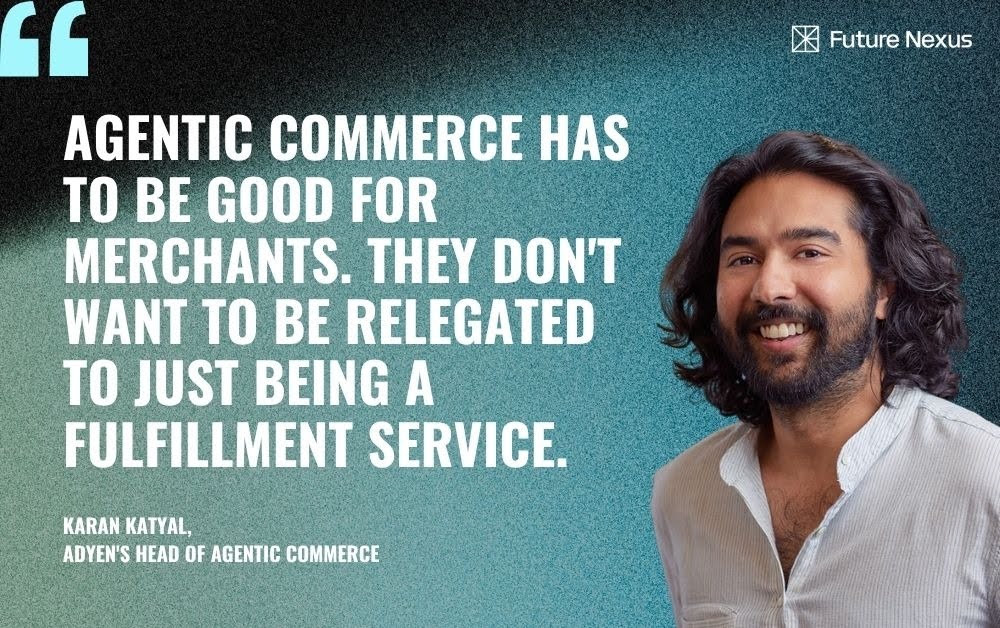
When Adyen talked with more than 200 companies about the coming wave of AI shopping agents, one fear came up in every single conversation: disintermediation.
www.heyfuturenexus.comWhen Adyen spoke with more than 200 companies about AI shopping agents, one fear surfaced without exception: disintermediation. Brands that have spent heavily building customer relationships do not want an AI agent stepping between them and the customer, reducing them to an interchangeable supplier. Karan Katyal, Adyen's head of agentic commerce, put it plainly: they do not want to be relegated to just being a fulfillment service.
That fear became the design brief for Adyen Agentic, which has three layers. Agentic Feed distributes real-time catalog, pricing, and availability data into conversational environments. Agentic Cart is the orchestration layer connecting existing merchant systems to conversational platforms. Agentic Payments handles authentication, token portability, and preservation of merchant-of-record status.
Adyen processed more than EUR 1.39 trillion in payment volume in 2025 and counts Meta, Uber, H&M, eBay, and Microsoft among its customers. American Express, Visa, Salesforce, and Scheels have signed on as partners. Positioning merchant control as the design principle is itself a move in the contest over who owns the agentic era.
Consumer Trends
Accenture survey finds 94% of Indian consumers want to shop inside generative AI tools

The recent Accenture Consumer Pulse Survey 2026 finds that consumers in India are increasingly embracing AI-led shopping experiences, signalling a significant shift in how products are discovered, evaluated and purchased.
www.bwmarketingworld.comAccenture's Consumer Pulse Survey 2026 has yielded a breakdown for the Indian market. 94% of respondents say they would like to shop directly within generative AI tools, and 86% indicate they are likely to rely on generative AI for 50% of their spending decisions. Nearly 30% already use large language models as their primary discovery channel.
The loyalty effects are equally visible. 59% would instruct their AI agent on which brands to consider, and 36% say they would switch preferred brands if an agent recommends a better fit. 70% want agents to shop for their idealised selves, helping them make healthier choices or stay within budget.
Ankur Chaudhary, Managing Director and Lead of Accenture's Products Group for India Business, commented that India's consumers are signaling agentic commerce may scale faster than many businesses expect. The survey covers 25,590 consumers across 16 countries, and this is the India cut of the APAC pattern covered yesterday. Accenture frames the near-term requirement as becoming the choice of agents through machine-readable product data and verifiable claims.
Korea's consumer agency flags terms and advertising problems at Chinese platforms

As use of China e-commerce (C-commerce) platforms such as AliExpress and Temu has grown, consumer complaints have also increased over delivery delays, return restrictions, and steering refunds toward credits.
biz.chosun.comThe Korea Consumer Agency (KCA) announced on July 16 the results of a review into the terms, conditions, labeling, and advertising practices of four Chinese platforms: AliExpress, Temu, Shein, and Taobao. It found clauses on some platforms that restrict consumer rights, along with advertising examples liable to cause misunderstanding.
The growth in complaints stands out. Across 2023 to 2025, a total of 5,341 consultations were filed, rising from 497 in 2023 to 1,351 in 2024 and 3,493 in 2025. By type, nonperformance of contract, covering delivery delays, wrong deliveries, and failure to refund return shipping or tariffs, was most common at 2,120 cases (39.7%), followed by refusals to accept order cancellations at 1,378 cases (25.8%) and quality complaints including defects and counterfeits at 840 cases (15.7%).
The review also found cases of consumers being steered toward platform credits during refunds, with 2.9% of all consultations (157 cases) reporting refunds in credits rather than the original payment method. As cross-border commerce expands, the findings show that return and refund terms, not just price and delivery speed, become the regulatory focus.
Global E-Commerce
Shein targets a $40-50 billion Hong Kong IPO as the EU's EUR 3 fee bites

Shein's ambitions for a valuation of up to $50 billion in its long-awaited Hong Kong IPO are likely to face a tough test from investors, as new fees on e-commerce parcels in Europe weigh on sales growth and profits.
www.reuters.comReuters reported, citing two sources with knowledge of the matter, that Shein's global revenue exceeded $40 billion in 2025 with net profit close to $2 billion. Its 2024 results, per its latest filing in Singapore, were $37 billion in revenue and $1.29 billion in profit, so growth has continued. The 2025 figures, however, are confidential, and the sources declined to give granular numbers.
The headwind arrived this month. The EU imposed a EUR 3 fee on low-value e-commerce imports to curb what it calls unfair competition from China. Europe accounts for a third of Shein's revenue according to Euromonitor, so the impact is not marginal. One source said CEO Sky Xu will have to convince investors this is a temporary blip with growth picking up again in 2027.
Investors are taking a harder line. Eddie Tam, chief investment officer at Hong Kong's Central Asset Investments, said $40 billion still looks a bit expensive and that closer to $30 billion would be more attractive. The gap from the $100 billion valuation reported in its 2022 funding round measures the impact of the rule change.
Full article: Shein Targets a $40-50 Billion Hong Kong IPO: How the EU's EUR 3 Parcel Fee Broke Cross-Border E-Commerce Unit Economics
US e-commerce grows at a 20.1% six-month annualized rate against a broader retail slowdown

U.S. e-commerce sales surge to a rare +20.1% annualized pace as overall retail growth slows.
seekingalpha.comThe six-month annualized growth rate for US e-commerce retail sales has reached 20.1%, according to Kevin Gordon, head of Macro Research and Strategy at the Schwab Center for Financial Research, who called the level historically rare.
Overall retail told a different story. Per GuruFocus's summary, June retail sales rose just 0.2% month over month to $768.6 billion, down from 1.0% growth in May, largely because gasoline station sales fell 5.3%.
Online accelerating while total consumption stalls points to continued channel share migration. Amid all the discussion of AI-driven product discovery, the underlying share of purchases happening online is itself rising, which is worth holding onto as a premise for investment decisions.
Company Moves and Partnerships
TikTok pilots a managed service that runs Shop operations for US sellers
TikTok is rolling out a new pilot program where it will oversee key Shop operations, like hiring creators and making ads, for e-commerce partners.
www.businessinsider.comTikTok is seeking participants for a US pilot in which it would oversee almost all of a merchant's Shop business, Business Insider reported based on company documentation it viewed. The scope covers marketing, automated ads and creative testing through its GMV Max tool, product listing optimization, creator hiring, and content production including hundreds of AI-generated videos.
Sellers would remain responsible only for getting products listed on Shop and sending free samples to influencers. The cost is a $10,000 flat fee plus a 10% to 20% commission per sale depending on product category, and the program is open to both US local sellers and foreign companies selling into the US. TikTok did not respond to a request for comment.
What stands out is that this puts TikTok in direct competition with its own Shop agency partners. Since launching US commerce in 2023, the company has leaned heavily on third parties to arrange creator affiliates and run ad campaigns. If the platform vertically integrates into operations, those partners face a redefinition of their role.
AI Commerce Tools
Generative AI makes refund fraud evidence easy to fabricate against $849.9 billion in US returns

Using AI, a fraudster can generate fabricated product images, adjust explanations, and repeat or even automate the process.
www.practicalecommerce.comFraudsters can now use generative AI to create fake photographs of product damage and false shipping records as evidence for refund claims, Practical Ecommerce reported. US retailers processed roughly $849.9 billion in merchandise returns in 2025, of which some 9% were fraudulent, according to the National Retail Federation and Happy Returns. E-commerce return rates run at 19.3%, far above brick-and-mortar.
The structural weakness is that online merchants evaluate refunds without physically inspecting the goods. A support agent reviews a photo, reads the description, checks delivery information, and approves. For inexpensive or perishable products, merchants often waive the return entirely because shipping and inspection costs exceed the item's value, and fraudsters count on exactly that.
Once image generation is a tool anyone can use, treating a single photo as evidence stops working. Whether you can move to decisions that combine purchase history and behavioral signals, and revise return policies accordingly, becomes a live question for next year's margins.
Advertising and Retail Media
Private equity money concentrates on e-commerce marketplaces while TikTok Shop's AI video draws pushback

Private equity is hungry for smaller ecommerce marketplace players. Plus: Brands and creators don't love TikTok Shop's AI-generated videos.
www.adexchanger.comCapital keeps flowing toward challenger e-commerce marketplaces. AdExchanger lines up the $53 billion Stripe and Advent bid for PayPal alongside reports that Criteo received a joint bid from Quinti Capital and Vista Equity at as much as a 50% premium to its market cap at the time, and that BNPL company Klarna raised $517 million from Blackstone and others.
The same piece relays the reaction to TikTok Shop's AI-generated videos: neither brands nor creators love the AI creative the platform is pushing. Read alongside the managed services pilot, it reveals friction between TikTok's drive to compress production costs with AI and the quality sellers actually want.
GameStop also proposed acquiring eBay in May. The idea was widely mocked, though the game retailer is reportedly still pursuing the deal.
Wrap-Up
Implementation and regulation advanced on the same day, and that is what defines July 17. HSBC UK and Visa closed an agent payment on a real merchant site and made clear it would ride the existing card network rather than a new rail. India's CERT-In, meanwhile, proposed requiring human approval and audit trails above a financial threshold. A gap remains between what has become technically possible and what is socially acceptable.
The question of who owns the trust layer also took concrete form. Experian moved into agent identity verification with Visa, Cloudflare, and Skyfire, while Adyen made merchant disintermediation fears the starting point of its design. That generative AI can now fabricate refund fraud evidence proves the need for that layer from the opposite direction.
In cross-border commerce, the EU's EUR 3 fee fed straight through to Shein's IPO valuation. Watch next for the FCA's posture on agent-initiated payments, and whether CERT-In's proposal becomes rule with an actual threshold attached.