
AI Commerce News Digest (August 4, 2026)
An IDC study projects AI will replatform $500 billion in digital spending by 2030 and warns most merchants are not ready. Visa agrees to acquire BioCatch for $2.4 billion, while Onton, AnyMind and SPS Commerce roll out agent-ready search, operations and supply chain products.

Key Takeaways
- IDC projects AI will replatform $500 billion in digital spending by 2030
- Visa agrees to buy BioCatch for $2.4 billion, internalizing AI fraud defense
- Agent-ready tooling advances across search, payments and operations at once
Here is your AI commerce news roundup for August 4. Yesterday's digest centered on bias in AI product recommendations; today the theme is readiness, with a study that quantifies how unprepared merchants are and a wave of infrastructure moves that aim to close the gap. IDC projects AI will replatform $500 billion in digital spending by 2030, and Visa agreed to acquire behavioral biometrics firm BioCatch for $2.4 billion. On the product side, Onton published benchmarks showing its new search model beating Google and Amazon, while AnyMind and SPS Commerce brought AI agent products to e-commerce operations and the retail supply chain. From discovery to payments to the back office, the groundwork for the agent era advanced on every layer today.
Today's Top Stories
IDC study: AI agents are already shopping, but most merchants are not ready

A new IDC InfoBrief sponsored by WooCommerce examines how AI agents that shop on behalf of buyers are reshaping how brands get discovered, and why most commerce platforms are not prepared for this discovery shift.
www.prnewswire.comAn IDC InfoBrief commissioned by WooCommerce, titled Build for What's Next, was published on August 3. Its central projection is that AI will replatform $500 billion in digital spending by 2030, with agent use among Global 2000 companies growing tenfold by 2027. Brands that fail to prepare risk losing access to 25% of their market, the study warns.
The buyer it describes behaves nothing like a human shopper. AI agents do not respond to design or advertising; they evaluate structured product data, live inventory and accurate pricing. By 2027, 80% of agentic AI use cases will require real-time, contextual data access, which reframes clean catalogs as discovery infrastructure rather than back-office hygiene.
The recommendations are pointed. With 65% of digital leaders citing legacy platform rigidity as the top barrier to scaling AI in commerce, IDC's Heather Hershey advises merchants to "choose openness over convenience" and audit their stacks for lock-in fees and AI capabilities gated behind premium tiers. The conclusion conveniently aligns with sponsor WooCommerce's open-source strategy, but for merchants that have deferred data work, it reads as a concrete checklist.
Visa to acquire BioCatch for $2.4 billion, embedding behavioral biometrics in the network
The card network giant plans to scoop up the Israeli firm to strengthen its defenses in a fight against fraud fueled by artificial intelligence.
www.paymentsdive.comVisa announced on August 3 that it has agreed to acquire BioCatch, the Israeli behavioral biometrics and fraud prevention firm, for $2.4 billion in cash. BioCatch analyzes thousands of signals, from keystrokes and touch gestures to how a device is held, to distinguish legitimate users from fraudsters in real time. It currently protects 1.8 billion devices and 760 million users across 350 banking clients in 21 countries.
The deal reflects an arms race against AI-scaled fraud. Andrew Torre, Visa's president of value-added services, noted that account takeovers and scams cost victims and the global economy roughly $1 trillion annually. Following the Featurespace acquisition of 2024 (about $1 billion), this is Visa's second major fraud deal in as many years, and it puts the ability to answer "who is really operating this session" inside the network itself just as AI agents enter payment flows.
Read more: Why Visa is paying $2.4 billion for BioCatch and internalizing identity signals for the agent era
Agentic Commerce
Onton releases Ontology 1, a neurosymbolic search model that beats Google and Amazon on accuracy

Onton's Ontology 1 scores P@10 0.630 on Subtext-Decor-90, beating Google Shopping 0.543 and Amazon 0.469 on intent-heavy queries
www.marktechpost.comSan Francisco search startup Onton has released Ontology 1, a product search model that scored 0.630 precision on a 90-query benchmark, ahead of Google Shopping at 0.543 and Amazon at 0.469. It achieved those numbers while indexing roughly 1% of its rivals' catalogs.
The model combines neural networks with symbolic reasoning, decomposing vague requests such as a pet-friendly sofa into verifiable attributes before matching. Coverage is currently limited to a single vertical, furniture and home decor, and partner access is being granted case by case to teams building on the agentic web.
As a bid to become the search infrastructure for the era when AI agents do the buying, the release carries clear implications for e-commerce operators.
Read more: What Onton's Ontology 1 is, and how a neurosymbolic product search beat Google and Amazon
Mastercard publishes Signals report on trust frameworks for agentic commerce

The report shows that growth will be driven not by autonomy alone, but by useful experiences that make everyday decisions easier while keeping people informed and in control.
techafricanews.comMastercard released its latest Signals report, Encoding Trust, examining what it will take for agentic commerce to scale as AI agents move beyond search and recommendations to transacting on behalf of consumers and businesses.
The report forecasts agent-assisted consumer spending of $3 trillion to $5 trillion by 2030, with B2B potentially three times larger. It argues growth will come not from full autonomy but from experiences that keep people informed and in control, and frames the race as one of encoding intent, consent and control. Together with Visa's BioCatch deal the same day, it shows the card networks competing directly on trust design.
Follow-up: Akamai's AI bot surge, and the authorization-control gap Transmit Security points to

AI shopping agents are reshaping ecommerce security. Learn why agentic commerce demands continuous trust, fraud prevention, and identity verification.
hackernoon.comBuilding on Akamai's commerce State of the Internet report, which we covered in depth earlier, HackerNoon examined how retail security teams are actually responding. The report showed nearly half of AI bot traffic observed between July and December 2025 heading to commerce, with organizations placing over 90% of AI bot activity into a monitoring category while letting three quarters of the remaining activity through without restriction.
The new argument comes from Transmit Security CEO Mickey Boodaei, who calls the gap between authorization and control the real problem: a permitted agent that keeps acting beyond what the customer intended. With legitimate shopping assistants and fraud rings sharing the same inbound lanes, security models that treat login as the only checkpoint are due for a rethink.
AI Commerce Tools
AnyMind Group launches AnyAI Agent to run marketing and e-commerce operations autonomously
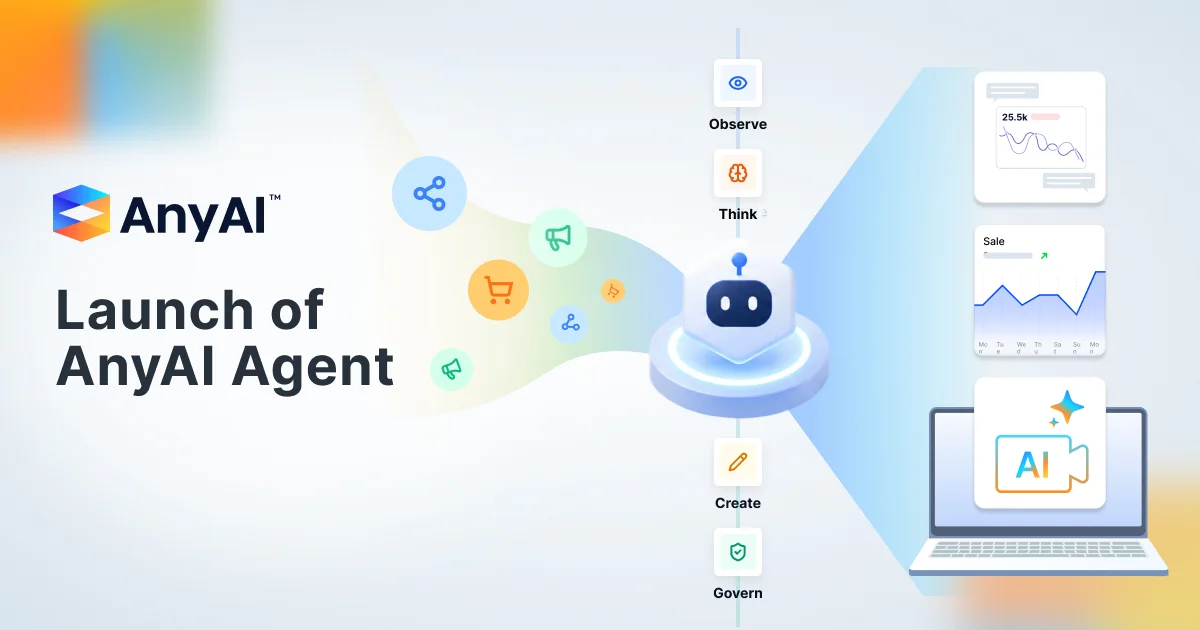
Enterprise-grade AI agent solution combines business data, workflows and operational expertise to independently analyze information, execute tasks and continuously improve outputs
anymindgroup.comAnyMind Group, a BPaaS company for marketing and e-commerce, has launched AnyAI Agent, an enterprise AI agent offering. It gathers data from social media, marketplaces and ad platforms, analyzes it, proposes actions, produces deliverables and, after approval, executes across connected systems. Teams can assign work in natural language through Slack and dashboards.
The company also published numbers from its own use. Between January and June 2026, more than 3,000 AI-supported tasks ran each week in one operating market, saving roughly 550 hours of employee time per month by its estimate. The launch packages operational know-how honed in AnyMind's own e-commerce services into sellable AI workflows, marking the shift from people using tools to agents running the workflow.
SPS Commerce lays out a chat-first roadmap for monetizing autonomous AI agents
Users of MAX through the chat interface are more likely to explore advanced MAX features.
aimmediahouse.comRetail supply chain network SPS Commerce paired its second-quarter results (revenue of $198 million, up 6% year over year) with a specific agentic AI monetization roadmap. MAX Chat, its conversational interface, is now included in all SPS Fulfillment subscriptions at no extra cost, while autonomous AI agents will be sold as premium subscriptions starting in late Q4 2026.
Beta results include users cutting weekly order management work by 90% and an anomaly detection catch that prevented a $290,000 revenue loss from invoice errors. Building usage habits with free chat and charging for autonomous execution looks like a template other B2B SaaS vendors will follow as they monetize agents.
Payments and Fintech
All four major US card networks declare the agent economy their market
When AI agents start buying things, somebody has to settle the transaction. This week, the four largest card networks in the United States each made the same declaration.
www.pymnts.comPYMNTS surveyed the past week's earnings calls and found the four largest US card networks making the same declaration: the agent economy runs on their rails.
Mastercard offered the most concrete detail. It is scaling Agent Pay with more than 30 industry leaders, described Agent Pay for Machines for permissioning and settling machine-speed transactions, and highlighted Verifiable Intent, developed with Google, which lets any party challenge a transaction they did not authorize. CEO Michael Miebach repeated the competitive case we detailed in our earnings coverage, saying he expects cards to prevail in an agentic world; what is new is that all four networks now share the stance. With Visa's BioCatch acquisition landing the same day, the race to own the trust layer of agent payments accelerated visibly this week.
Payabli launches Amigo, an AI agent suite for embedded payments

Software platforms using embedded payments can now query live transaction data in plain English as Payabli adds AI tools to reduce manual ops.
itbrief.co.ukMiami-based payments infrastructure provider Payabli has launched Amigo, an AI agent suite for its embedded payments platform. The first piece, Amigo Insights, is live in the Payabli Portal and lets platform teams ask natural-language questions about payment activity, funding status, chargebacks and merchant demographics, drawing on live account data instead of built reports or support tickets.
Alongside it come Agentic Vendor Enablement, which automates vendor outreach in payout workflows, and Agentic Vendor Enrichment for underwriting data. Agents for risk monitoring, chargeback responses and merchant underwriting are in development. The pitch is that vertical SaaS platforms can grow payments volume without growing headcount, a sign that payment operations are being agentified from the PSP side as well.
Corporate Moves
Amazon to put $600 million in recouped tariffs toward lower prices
The e-commerce giant also will use the $600 million it has recouped from invalidated tariffs to lower prices for shoppers, per a Thursday earnings call.
www.supplychaindive.comAmazon said on its earnings call that it will use roughly $600 million recouped from invalidated tariffs to lower prices for shoppers. Refunds to selling partners will be handled individually, in what the company called a limited set of circumstances.
How tariff costs flow through the marketplace directly affects sellers' pricing strategies. The scope and conditions of the refunds have not been disclosed, so sellers will need to check whether they qualify. With US tariff policy still in flux, this is a useful marker of how platforms absorb and redistribute cost shocks.
Conclusion
Today's stories frame the same picture from different angles: the agents have arrived, and the receiving side is not ready. IDC quantified the product data gap and Akamai the bot-sorting gap, while Visa spent $2.4 billion on the technology to tell legitimate actors from fraudulent ones, and Onton, AnyMind and SPS Commerce shipped agent-ready products for search, operations and the supply chain. The infrastructure supply side is falling into place; the open question is how fast merchants move. Watch next for the expansion of live Agent Pay transactions that Mastercard signaled, and for whether the platform reassessment the IDC study calls for turns into actual replatforming.