AnyMind Group Launches AnyAI Agent: Autonomous AI for E-commerce Operations, With 550 Hours Saved Monthly In-House
AnyMind Group has launched AnyAI Agent, an enterprise AI agent that handles marketing and e-commerce operations from analysis to execution. We break down its four core capabilities, the internal results behind it, and what agentic operations mean for online retailers.

Key Takeaways
- On August 3, 2026, AnyMind Group launched AnyAI Agent, an enterprise AI agent that handles marketing and e-commerce workflows end to end, from data collection and analysis to proposals, deliverables, and system execution after human approval
- In internal adoption, AI now executes more than 3,000 tasks per week, with an estimated 550 hours of employee time saved per month. A BPaaS company is productizing the operational know-how refined in its own operations as AI workflows
- E-commerce operations are shifting from a stage where people use tools to one where AI agents run the workflows. Retailers need to design operations around approval flows and data governance
What Is AnyAI Agent, AnyMind's New Launch
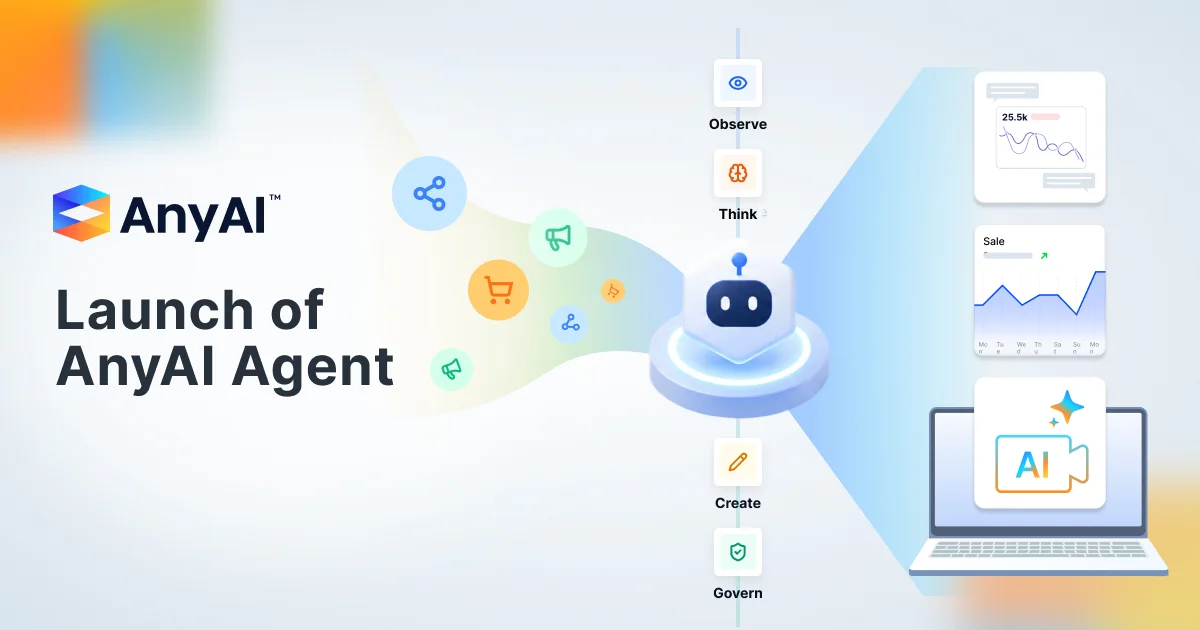
Enterprise-grade AI agent solution combines business data, workflows and operational expertise to independently analyze information, execute tasks and continuously improve outputs
anymindgroup.comOn August 3, 2026, AnyMind Group announced the launch of AnyAI Agent, an AI agent aimed at enterprise marketing and e-commerce operations. Founded in Singapore in 2016, the company operates across 15 countries and regions, primarily in Asia. It runs a BPaaS (Business Process as a Service) model that bundles platforms with operational support, and is listed on the Tokyo Stock Exchange Growth Market (ticker 5027).
Using AnyAI Agent is straightforward. Employees type requests in natural language through workplace tools such as Slack or a dedicated dashboard. The AI then plans the necessary steps on its own, retrieving and analyzing information across social media, e-commerce marketplaces, advertising consoles, and internal databases. From there it identifies issues, proposes improvements, and produces deliverables such as reports and ad copy, and once a person approves, it executes the changes in the connected systems.
What should not be overlooked is that the design always places human approval before execution. Operations that write directly into systems, such as updating product listings on marketplaces, are carried out by the agent only after a person signs off. For a solution that touts autonomy, keeping final authority with humans is a deliberate trade-off aimed at enterprise adoption.
Four Capabilities and AnyX Integration Behind End-to-End Workflows
The English announcement organizes AnyAI Agent around four interconnected capabilities.
| Capability | Stage | What it does |
|---|---|---|
| Observe | Data collection | Connects and organizes information from social media, e-commerce marketplaces, advertising platforms, databases and enterprise systems |
| Think | Analysis | Analyzes consumer behavior, market trends and performance data to generate actionable insights |
| Create | Production | Generates marketing content, campaign concepts, product information, proposals and other business outputs |
| Govern | Control | Reviews outputs against policies, brand guidelines and business rules before handing them over for human approval |
The sequence of these four capabilities maps directly onto the stages of marketing and e-commerce work. Processes that traditionally required a division of labor, with separate people gathering data, analyzing it, producing assets, and checking outputs, are handled continuously on a single agent platform.
Another distinguishing point is the connection to the company's existing platforms. The agent links with AnyTag for influencer marketing, AnyX for e-commerce management, and AnyDigital for digital marketing, retrieving information, analyzing data, and executing approved actions across connected environments. AnyX is an e-commerce management platform integrated with major marketplaces and advertising and analytics tools across Asia Pacific, and with an agent layered on top, everything from cross-marketplace sales analysis to product information updates can be treated as one continuous workflow.
Data handling is also addressed. Sensitive enterprise data and proprietary workflows can be stored and operated within a client-controlled environment, and when third-party large language models (LLMs) are required, only the information needed for defined tasks is transmitted via API, with enterprise data not used to train third-party foundation models. The architecture bakes in an answer to the data governance questions that inevitably arise in generative AI adoption.
Cited use cases include trend analysis across social and video platforms, analysis of UGC (user-generated content) and reviews, shortlisting influencer candidates, analyzing e-commerce sales data and producing reports, drafting product descriptions and ad copy, and updating marketplace product listings after approval. The company says supported tasks will continue to expand.
Behind the Numbers: 3,000 Tasks a Week, 550 Hours Saved a Month
AnyMind has been rolling out an AI agent architecture similar to AnyAI Agent across its own operations since January 2026. In Japan, AI now executes more than 3,000 tasks per week, and based on results from January to June 2026 the company estimates roughly 550 hours of employee time saved per month. Internal use spans social media analysis, influencer shortlisting, e-commerce sales analysis, and the production of reports and proposals, and the company says insights from this internal run informed the product's workflow design and governance mechanisms.
The future of business sees humans working side-by-side with AI. With AnyAI Agent, we enable businesses to convert their data, workflows, and expertise into scalable, AI-powered infrastructure. By combining AI with human creativity and judgment, enterprises can build smarter operating models and allow people to focus on higher-value decisions and ideas.Source: Kosuke Sogo, CEO, AnyMind Group
These figures deserve caveats. Both the 3,000 weekly tasks and the 550 monthly hours are the company's own estimates from internal operations, not results from external customers. The method for calculating time saved and the granularity of a single task are not disclosed, so the numbers cannot be transplanted directly into another company's expectations. Reproducibility at outside enterprises remains to be proven through future case studies.
Why a BPaaS Company Is Selling an AI Agent
Why would a company whose core business is operating workflows on behalf of clients sell an AI agent that automates those very operations? The apparent contradiction is where the real significance of this announcement lies.
AnyMind reported revenue of 57.3 billion yen for fiscal 2025, up 13 percent year on year, and is planning a substantial increase to 79.1 billion yen for fiscal 2026. Its financial materials position efficiency gains from AI, alongside M&A, as a pillar of accelerating profit growth. For a BPaaS model where people run the business processes, AI agents were first a way to change the company's own cost structure. The 3,000 weekly task executions are a progress report on that effort.
The external launch can be read as productizing the analytical frameworks, decision criteria, and operational processes accumulated through that internal transformation into reusable AI-native workflows. The company will also provide implementation support covering requirements definition, proof-of-concept development, workflow redesign, governance setup, and organization-wide deployment. This is less a tool sale than a consulting-style offering that takes on AI-first redesign of how work gets done. Pricing and commercial terms have not been disclosed at this time.
Where It Sits in the Race to Autonomous E-commerce Operations
AnyMind is not alone in handing seller-side work to AI agents. Shopify's AI assistant Sidekick has evolved from something that answers questions into an agent that judges and executes analysis, configuration, and improvements on its own, while Salesforce is pushing Agentforce, a platform for building and operating autonomous agents integrated with its CRM foundation. For e-commerce platform vendors, agent capabilities are rapidly becoming standard equipment.
Within that landscape, AnyAI Agent positions itself as an external, cross-system agent rather than one embedded in a specific platform, bundling technology with operational know-how and implementation support. The flip side is that an agent's real capability depends on the range of systems it can connect to and on how far each company's business rules can be articulated and structured. If general-purpose LLMs keep improving and platform-embedded agents get more capable at lower cost, the advantage of external agents will be continually tested.
There are two implications for e-commerce businesses. First is the recognition that alongside consumer-side agentic commerce, where AI agents discover and purchase products, a shift toward agentic operations is beginning on the seller side. When buyers become AI, demands on product data freshness and response speed for pricing and inventory will exceed what manual operations can sustain. Agent-driven operations on the selling side are becoming a precondition for meeting those demands.
Second is the question of how to design the boundary between automation and human approval. Just as AnyAI Agent puts its Govern capability and approval flows at the core, autonomous e-commerce operations are fundamentally about drawing the line between what AI handles and where people decide. Documenting business rules, brand guidelines, and approval criteria before selecting any tool will determine implementation success regardless of which agent platform a company chooses.
Conclusion
AnyMind Group's AnyAI Agent is an enterprise AI agent that handles the full span of marketing and e-commerce work, from data collection and analysis to proposals, deliverables, and post-approval execution. Built on internal results of more than 3,000 tasks executed weekly and roughly 550 hours saved monthly, it represents a BPaaS company productizing its own operational know-how as AI workflows, and it is emblematic of the broader move toward autonomous e-commerce operations.
At the same time, all published results are the company's own internal estimates, and pricing remains undisclosed. Reproducibility with external customers is still to be verified. What e-commerce businesses should prepare now is less a decision about any particular tool than the documentation of business rules and approval criteria, and the design of data governance. The shift of seller-side work to agents is a current that is unlikely to reverse.