Indonesia's Whoosh High-Speed Rail and the MaiA Tourism AI: A State-Built Discovery Layer and the Missing Link to Booking
Indonesia now runs Whoosh, Southeast Asia's first high-speed rail, and MaiA, its tourism ministry's AI assistant, as one strategy. An AI commerce reading of state-run discovery, algorithmic demand steering, and the still-unconnected booking layer.

Key Takeaways
- Indonesia's government has begun operating Whoosh, Southeast Asia's first high-speed rail, and MaiA, the tourism ministry's AI travel assistant, as a single tourism strategy rather than separate investments
- The state now holds both an AI discovery layer and execution infrastructure, yet no booking or payment capability has been announced for MaiA. The unconnected last leg between AI suggestion and transaction captures exactly where AI commerce stands today
- The takeaway for businesses is to prepare 'inventory with a route attached' that AI can read and fold into an itinerary. In markets where algorithms allocate demand, machine-readable product and inventory data becomes the condition for exposure
Bundling High-Speed Rail and an AI Assistant into One Strategy

Indonesia combines high-speed rail connectivity with AI-driven travel services to improve visitor experiences.
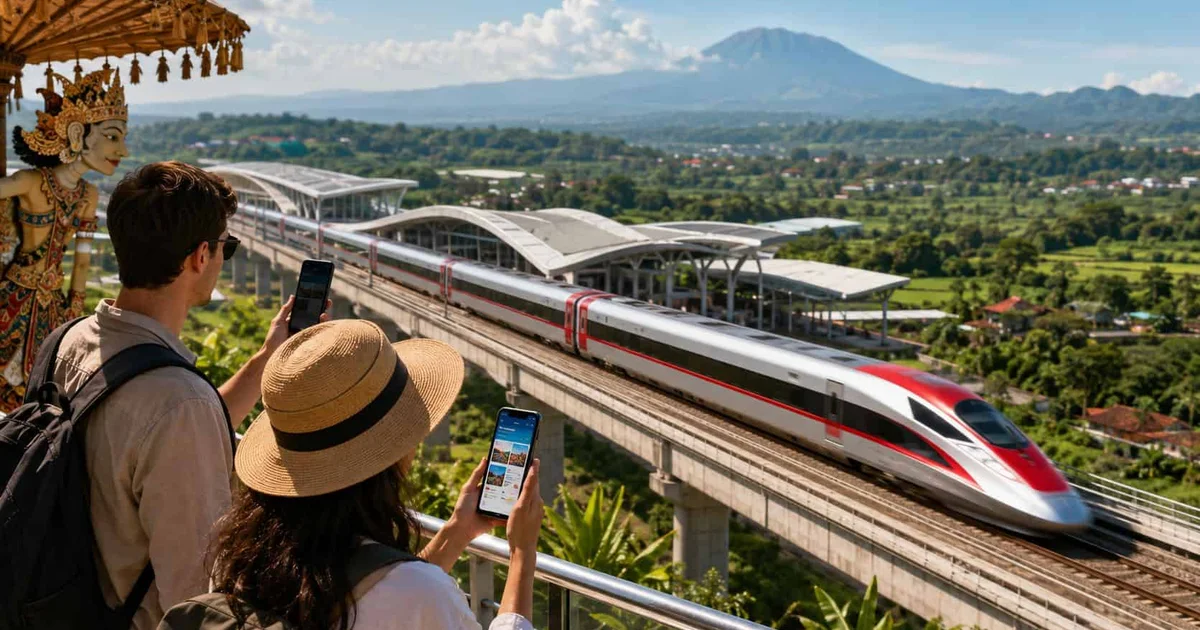
www.travelandtourworld.comIndonesia has begun positioning Whoosh, the high-speed rail that links Jakarta and Bandung in about 45 minutes, and MaiA, the tourism ministry's AI travel assistant, as one tourism strategy. The rail compresses an inter-city trip that took roughly three hours by road into 45 minutes, while the AI sketches a personalized itinerary from a traveler's preferences within seconds. Rather than celebrating the two as separate achievements, the government is reported to be bundling them as a combination of physical connectivity and intelligent digital services.
This article reads the move not as transport or tourism news but as an industry-specific case study in agentic commerce, the trend of AI agents handling product discovery through purchase on a user's behalf. When a state holds both the AI that drives discovery and the infrastructure that executes the plan, what gets connected, and what remains unconnected? That question extends to any business that holds products and inventory.
Behind the move sits tourism's weight as an industry. The government expects 16 to 17.6 million foreign visitors in 2026, and average spending per visitor was reported at 1,259 dollars in the third quarter of 2025. A railway and an AI are being mobilized at the same time as the apparatus of a strategy that pursues both volume growth and per-visitor spending.
Whoosh: Infrastructure That Turns AI Suggestions into Executable Plans
Whoosh is Southeast Asia's first high-speed rail, covering roughly 140km between Jakarta and Bandung at a top speed of 350 km/h. In the two years since commercial operations began in October 2023, cumulative ridership surpassed 12 million passengers. Annual ridership reached about 6.2 million in 2025, and service has expanded to 62 daily trips.
The meaning of that time saving goes beyond easier travel. With a predictable 45-minute link in place, weekend tourism, business travel, and multi-city itineraries become realistic options. When a trip that ended in one city widens into a circuit, sales opportunities for lodging and experiences multiply in chain. The railway is shifting from 'a means of reaching a destination' into 'a device that multiplies sellable itineraries.'
What stands out from an AI commerce perspective is the substance of the operating record. According to operator KCIC, Whoosh has maintained 99.9 percent on-time performance and zero accidents across nearly 40,000 trips. An AI can suggest 'how about a weekend in Bandung' only because that movement executes as predicted. A track record of punctuality works as a trust asset that underwrites the executability of AI itinerary suggestions. Intelligence that generates the proposal, and logistics that keep it. Only as a pair does a recommendation become a plan.
At the same time, Whoosh has a pressing reason to grow usage. The project cost about 7.3 billion dollars, financed largely through loans from China, and the operator posted losses of about 4.2 trillion rupiah in 2024. The government continues debt restructuring talks with the Chinese side. A mechanism that fills empty seats with demand is indispensable, and the expectations placed on AI grow out of this context.
MaiA: A State-Run AI for Product Discovery
The other lead actor, MaiA, is an AI travel assistant developed by the Ministry of Tourism. Formally named Meticulous Artificial Intelligence of Indonesia, it was unveiled on November 28, 2025 by Minister of Tourism Widiyanti Putri Wardhana. Embedded in the official tourism site indonesia.travel, it offers destination suggestions matched to preferences, automatic itinerary generation, interactive maps, and multilingual destination information. Supported languages include English, French, Arabic, and Indonesian, and the design has conversation shoulder the burden a first-time visitor faces in narrowing down destinations across thousands of islands.
This is our step toward shaping tourism that is not only beautiful to behold, but also intelligent and inclusive for all.
Translated into e-commerce terms, MaiA is a state-run product discovery layer. It lets travelers explore destinations and experiences, the 'products,' through conversation rather than a search box, with the AI shouldering comparison and narrowing. With MaiA's debut, Indonesia became one of six national tourism organizations worldwide to implement AI, alongside South Korea, Japan, Switzerland, Singapore, and Thailand. It is positioned at the core of the government's priority initiative, Tourism 5.0.
MaiA also carries a built-in design for demand allocation. The idea is 'digital nudging': algorithmically steering visitors concentrated in Bali toward destinations such as Lake Toba and Labuan Bajo. The same dynamics by which a marketplace's search ranking shapes sellers' revenue are starting to operate at the scale of national tourism. Which destinations and which operators the AI surfaces will determine how visitor flows and revenue are distributed.
The Unconnected Leg Between Discovery and Booking
Here it pays to look soberly at how far the integration can be confirmed from public information. The government speaks of Whoosh and MaiA as one strategy, but no announcement confirms that MaiA can query train seat or hotel inventory, or execute bookings and payments. The published capabilities stop at destination suggestions and itinerary generation, with transactions left to existing booking channels. The AI can bake travel times into its suggestions as premises, but the suggestion does not complete itself as a purchase.
| Commerce stage | Role under Whoosh x MaiA | Current status |
|---|---|---|
| Discovery and comparison | MaiA generates destinations and itineraries from preferences | Live on indonesia.travel |
| Planning (route design) | Itineraries built on the premise of Whoosh's 45-minute hop | Can be baked into suggestions |
| Execution (movement) | Whoosh transports at 99.9% on-time performance | In operation |
| Transaction (booking and payment) | Left to existing booking channels | No announced MaiA integration |
This split between discovery and transaction is not an Indonesian immaturity but a structure common across AI commerce today. Connecting a suggestion to a booking requires real-time queries against seat and room inventory, price confirmation, and mechanisms for identity verification and payment. Put the other way around, the countries and operators that first expose rail seat inventory and operating data in a form AI can reference will be the first to produce an experience that runs unbroken from suggestion to booking. Holding both discovery and execution, Indonesia arguably stands closest to making that connection.
Investment in the digital foundations that would carry such an implementation is also moving. Under a plan to invest 1.7 billion dollars over 2024 to 2028, Microsoft launched Indonesia Central, the country's first cloud region, in May 2025, and organizations including the major OTA tiket.com have onboarded. On the talent side, according to a January 2026 announcement, the AI skilling program Microsoft Elevate Indonesia has trained more than 1.2 million participants since December 2024 and targets 500,000 certified AI talents by 2026. The government itself has set out to train one million people in digital skills. It is this groundwork and talent that will carry the implementation connecting discovery to transaction.
What Businesses Should Take Away: Inventory with a Route Attached, Readable by AI
Beyond travel, in any sales channel where AI drives discovery, inventory that AI cannot read never even enters the candidate set. Whether data on lodging, experiences, and transport is structured and served in a form AI can interpret becomes the precondition for exposure. What is specific to travel is that product information becomes an executable itinerary only once 'how to get there' route information is attached. As long as destination data and transport data are managed separately, the AI cannot assemble a realistic plan. In retail terms, it is like asking an AI to recommend 'products that arrive tomorrow' while keeping product data and delivery lead times in separate silos.
The other question is how to position yourself relative to an AI that allocates demand. In a market where a public AI like MaiA sways where travelers go, whether you hand over data in a form that AI can read determines your exposure. Do you polish the discovery experience on your own channel, open your inventory to external AI channels, or design for both? That judgment is the long-standing question of marketplace dependence versus direct sales, restated at the AI layer.
For Japanese operators, this case is anything but remote. A dense high-speed rail network, surging inbound demand, and concentration in famous destinations are conditions Japan shares with Indonesia. Even the Shinkansen's world-class record of punctuality will not function as backing for AI recommendations unless it connects to itinerary suggestions in a form AI can reference. Which operator first steps into designs that join movement inventory and destination data in machine-readable form is becoming the competitive condition.
Conclusion
Indonesia's Whoosh and MaiA form an early example of a state holding both the AI that drives discovery and the infrastructure that executes the plan, and running them as one strategy. Yet the integration confirmable from public information stops at suggestions and itinerary generation; the transactional leg of booking and payment remains unconnected. That missing connection is a precise reflection of where AI commerce stands today.
What to watch next is when real-time inventory, seats and rooms, becomes tied into the AI's suggestions. Holding a discovery AI alone, or fast infrastructure alone, does not complete the experience. The businesses that ready machine-readable inventory and route information, and design the connection from discovery through transaction, will hold the next customer touchpoint, in travel and in retail alike.