What Marriott's Ask Bonvoy Teaches About AI Commerce Design — Owning Conversational Product Discovery While Working With External AI
Marriott has beta-launched Ask Bonvoy, a conversational AI hotel search grounded exclusively in its own verified data. We read it as an AI commerce case study: machine-readable product data, owned-channel discovery, the deliberate split between discovery and checkout, and what retail and e-commerce operators should take from it.

Key Takeaways
- Marriott has beta-launched Ask Bonvoy, a conversational AI on its own site and app that lets users search roughly 10,000 hotels in plain language
- Grounding answers exclusively in Marriott's own verified data, rather than ceding product descriptions to external AI, makes this a significant AI commerce implementation that keeps the path from discovery to booking inside owned channels
- Machine-readable product data is becoming the lifeline for both owned and external AI channels, and connecting discovery to checkout is the next question for retail and e-commerce operators
Conversation becomes the entry point to commerce

Marriott starts to roll out AI chat trip search; Hilton, IHG also building conversational AI search to keep guests on their sites and apps.
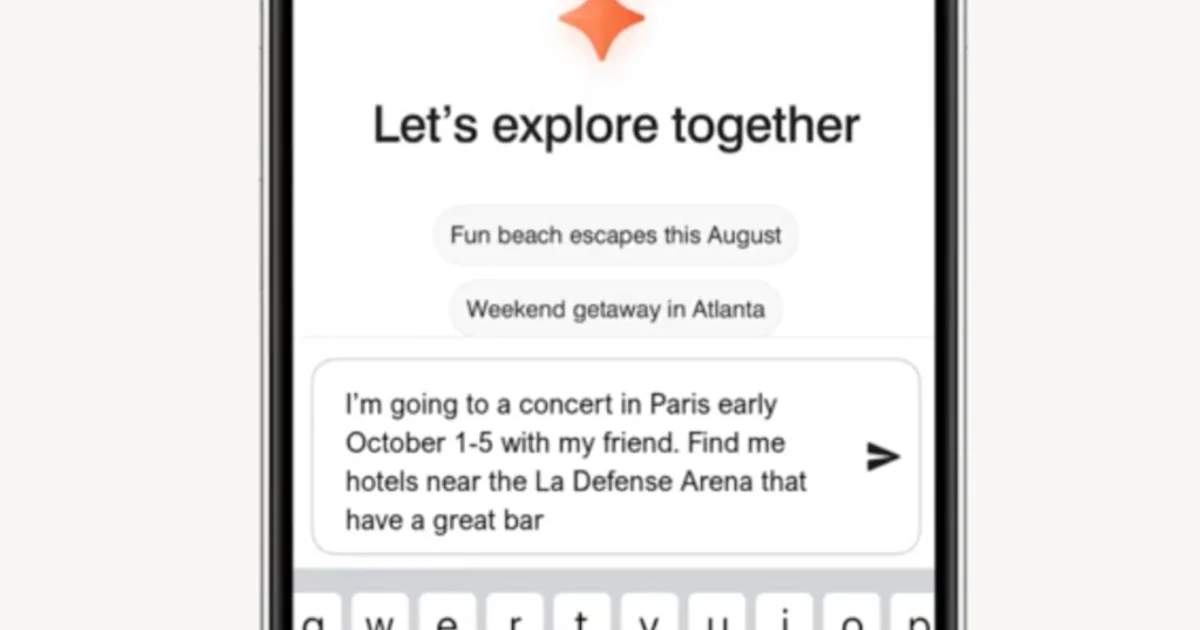
skift.comOn June 16, 2026, Marriott International began the beta rollout of Ask Bonvoy, a conversational AI search experience. Instead of typing dates and place names into a form, users describe what they want in everyday language and narrow down candidates from roughly 10,000 hotels across 146 countries and territories. The beta starts in U.S. English with a subset of Bonvoy members, with a global release planned for later this year. This article reads the move not as a hotel-industry story but as an implementation case study in AI commerce.
AI commerce here means selling in which generative AI and conversational agents handle the journey from product discovery to purchase. Agentic commerce refers to the stage within it where AI agents carry out comparison and transactions on the user's behalf. Ask Bonvoy still centers on discovery, but it gives a concrete answer to a question every merchant now faces: how do you let AI handle your product data, and on whose terms.
For retail and e-commerce teams, the questions this case raises are close to home. Any business that owns products, manages inventory and pricing, and holds member data faces remarkably similar design decisions, whether the product is a hotel room or a physical SKU. The sections below break down Ask Bonvoy as a product discovery system and draw out what transfers.
Ask Bonvoy is conversational product discovery
Viewed through a product discovery lens, the structure becomes clear. Marriott's own AI interprets a natural-language query, identifies the user's intent, and surfaces relevant candidates from the portfolio. Requests such as "good for families," "near the beach," or "strong on spa and golf" are absorbed within the flow of conversation. It is essentially the familiar search box and filters, rebuilt as dialogue.
What is being handled goes beyond hotels as products. Rooms are inventory, rates are pricing, and availability is real-time stock data. Amenity information such as dining and spa serves as product attributes, and data on the nearly 283 million Bonvoy members is first-party data, meaning customer data a business collects and holds itself. Marriott also plans to support loyalty points-based searches over time, linking member data and product data inside the conversation.
Translate this to physical e-commerce and the same roles are played by products, SKUs, prices, inventory, purchase history, and membership tiers. Whether you hold these in a form an AI can interpret accurately is what decides whether you can stand up conversational discovery on your own channel. Owning products and owning product data in a form AI can work with are two different problems.
What separates conversational discovery from traditional search is the range of intent it can capture. Ambiguous needs that are hard to express through keywords and filters can be taken in as they are. Users are freed from translating their needs into search terms, and merchants get to observe pre-purchase hesitation as conversation. Those dialogue logs themselves become first-party data that feeds product improvement and inventory planning.
Why ground answers in your own verified data
The defining feature of Ask Bonvoy is how it generates answers. Where typical generative AI draws on the open web, Ask Bonvoy grounds its responses exclusively in property data Marriott owns and has verified. This grounding is the technique of anchoring an AI's answers to a specific, trusted data source. It is designed to keep details like dining and spa information accurate and to suppress fabricated answers.
The decision carries business meaning beyond technical robustness. Leave product descriptions to an external AI's training data and guesswork, and stale information or mix-ups with competitors become possible. Ground them in your own verified data, and the merchant keeps the initiative over what gets surfaced and how it is described. A product catalog organized so AI can read it, an agent-ready catalog, becomes a competitive asset in itself.
On the retail and e-commerce floor, this lands as the concrete task of product data readiness. Are product names, attributes, inventory, and prices accurately structured in machine-readable form? Is naming consistent? Do stock and prices update in real time? The quality of this unglamorous groundwork determines whether you can power your own AI or end up misrepresented by someone else's.
Grounding also has a secondary effect. Restricting the reference scope to your own accurate data narrows the space an AI assembles answers from, making responses more predictable. The merchant can trace which product was presented, on what basis, and described in what way. That yields accountability and reproducibility that are hard to obtain when answers depend on external training data.
How to balance owned channels with external AI channels
Ask Bonvoy's aim is to keep the path from discovery to booking inside Marriott's own ecosystem. As more users ask ChatGPT or Google's AI Mode "what hotel should I book," businesses get compared and shown alongside competitors before a visitor ever reaches their site. Grounding answers solely in owned data is groundwork for keeping rivals out of the frame and consolidating bookings on Marriott.com and the app.
What makes the case instructive is that Marriott is building this walled garden while establishing footholds on external AI at the same time. The company is partnering with Google on its AI Mode travel product and participating in OpenAI's advertising pilot program. Raise the experience value of the owned channel while preparing to be discovered by external AI in parallel. That two-front posture is the pragmatic answer at a moment when no one knows where searches will start.
In a retail and e-commerce context, this amounts to re-asking the old platform-dependence question at the AI layer. Dependence on marketplaces and search engines used to cost merchants sales commissions, customer relationships, and data ownership. The same structure is about to repeat across AI channels. Peer moves are also telling. Hilton has offered an AI planner on its own site open to all visitors since March 2026, while IHG made more than 7,000 hotels discoverable through an app that runs inside ChatGPT and routes bookings back to its own direct channels. Be discovered externally, convert internally. How to divide roles between the open garden and the walled garden is becoming the central design decision in AI commerce.
Discovery and checkout are still separate
What should not be overlooked is that Ask Bonvoy is not an autonomous purchasing agent at this point. Once a user settles on a property, the experience hands off to Marriott's existing booking capabilities, and the AI does not complete payment itself. Conversational discovery and dependable transaction processing are deliberately kept apart.
This split between discovery and checkout is a structure shared across AI commerce today. For an AI to connect discovery, comparison, selection, booking, and payment in one motion, structured product data is not enough. It takes API integrations that can reliably secure inventory, mechanisms for passing member information, and consent and identity verification for delegating payment. Unless you can verify who authorized payment, for what, and up to how much, automated checkout cannot be entrusted with confidence.
For connections with external agents, standards such as MCP and UCP will shape the coming debate. MCP is a specification for connecting AI to external data and tools, and UCP is a proposed commerce protocol for handling products and carts across platforms. There is, however, no announcement that Ask Bonvoy has adopted either. For now it is a closed implementation on Marriott's own architecture, and standards support should be treated as a future question about external connectivity, kept separate from the confirmed facts. For background, see our overview of the major connectivity standards.
What retail and e-commerce operators should take away
First, machine-readable product data is the lifeline for both your own AI and external AI. Marriott could stand up conversational search on its own data alone because property information was already organized in a form AI can interpret. Whether product names, attributes, inventory, and prices are accurately structured decides whether you control the discovery experience in the AI era. This is the foundation of preparing for agentic commerce.
Second, discovery on your own channel and distributing products to external AI are not an either-or choice. Keep a conversational entrance on your site and app while preparing in parallel to be discovered by external AI such as ChatGPT and Google. Running both is how you widen reach while containing the costs of platform dependence. Alongside it comes the unavoidable design work of measuring AI-driven traffic and attributing conversions to it.
Third, it is realistic for now to treat polishing the discovery experience and guaranteeing checkout reliability as separate design problems. Build conversational discovery first, then assemble inventory integration, member data handling, and payment delegation behind it in stages. The split Ask Bonvoy made between discovery and booking is a useful example of building up from what can be done reliably rather than aiming straight for full autonomy.
Conclusion
Marriott's Ask Bonvoy is less a new feature than one answer to the question of how a business re-grips its data and customer touchpoints as product discovery moves to AI. Ground answers in your own verified data to secure reliability, consolidate discovery through booking in owned channels, and still establish footholds on external AI. The design carries well beyond hotels to any business that holds products, inventory, and member data. Precisely because discovery and checkout are still separate, organizing machine-readable product data and designing for both owned and external AI channels is the preparation that protects customer touchpoints in the AI commerce era.