AI Commerce News Digest (June 18, 2026)
Shopify opened end-to-end agentic commerce to every developer, Truecaller turned phone calls into a commerce surface with Call-to-Cart, Salesforce acquired Fin for about $3.6B, and Google detailed the Universal Commerce Protocol. A digest of the key June 17, 2026 news with takeaways for online retailers.


Key Takeaways
- Shopify's Spring '26 Edition opened end-to-end agentic commerce to every developer and rebuilt the platform's foundations, making AI-driven buying a standard building block.
- Truecaller launched Call-to-Cart, turning everyday phone calls into a commerce surface and pushing the entry point for agentic commerce beyond search and chat.
- Salesforce agreed to acquire Fin (formerly Intercom) for about $3.6B, and Google detailed the Universal Commerce Protocol, intensifying the race over the foundational layer of agent-led transactions.
The agentic commerce news on June 17, 2026 revolved around one question: who controls the foundations on which AI conducts transactions. Shopify opened its commerce platform to developers, Google presented an open interoperability protocol, and Salesforce absorbed autonomous customer service through a major acquisition. Meanwhile, Truecaller opened a new entry point through phone calls, and IndiaMART and THG advanced real-world deployments. This digest covers two highlight stories in depth, then organizes the key news across agentic commerce and market trends.
Today's Highlights
Shopify Opens Agentic Commerce to Every Developer in Spring '26 Edition

Anyone can now build end-to-end agentic commerce on Shopify, and the platform underneath every app gets a foundational rebuild.
www.shopify.comShopify released its semiannual Spring '26 Edition, with the full opening of agentic commerce at its core. AI-driven buying experiences that were previously limited to select partners can now be embedded by any developer into their own apps and services.
The keys are the Catalog API, which passes product information to AI agents, and the Universal Commerce Protocol (UCP), which serves as the foundation for interoperability. Through these, Shopify delivers end-to-end agentic commerce, where discovery, cart, and checkout can all be handed to AI, as a standard capability for developers. It is also connecting the buying experience from the Shop App all the way to physical stores.
A leading commerce platform standardizing AI support at the foundational level means that preparing product data for AI is no longer a concern for only a few advanced merchants.
Full article: Shopify Opens Agentic Commerce to Every Developer in Spring '26 Edition
Truecaller Turns Calls into a Commerce Surface with Global 'Call-to-Cart'

Truecaller Ads announced the global launch of Call-to-Cart, an AI-backed intelligent commerce solution that transforms everyday communication moments into commerce.
www.aninews.inTruecaller, known for its caller ID app, announced Call-to-Cart, an AI commerce feature that turns the everyday moment of a phone call into a buying touchpoint, globally. The idea is to use the communication layer itself, calls and messages, as a new surface for product discovery through purchase.
Call-to-Cart lets AI interpret the context of a call between a user and a business and connect it directly to product suggestions and cart actions. It extends the entry point for agentic commerce, which has tended to cluster around search engines and chat apps, to the large but overlooked surface of voice. Behind it is Truecaller's strategic shift toward commerce as advertising revenue growth slows.
It signals that the places where AI conducts transactions are spreading beyond the browser and chat. It is a prompt for retailers to reconsider where AI commerce could fit among their own customer touchpoints.
Full article: Truecaller Turns Calls into a Commerce Surface with Global 'Call-to-Cart'
Agentic Commerce
Salesforce Acquires Fin for About $3.6B to Strengthen Customer Service AI
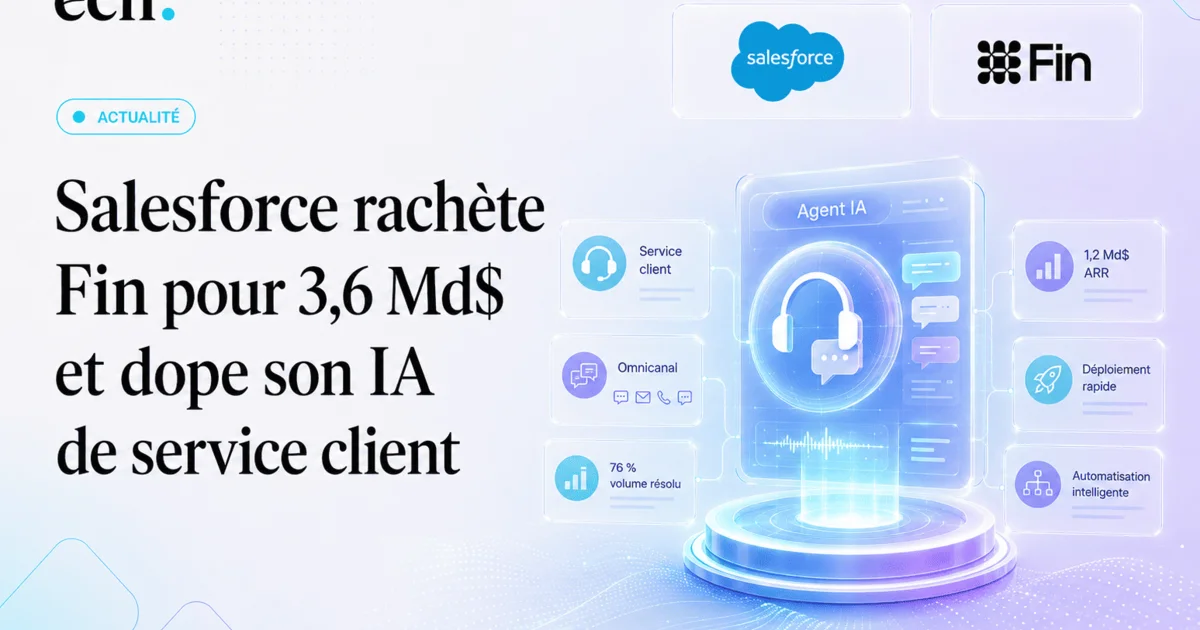
Salesforce announced the acquisition of Fin (formerly Intercom) for $3.6 billion, an agentic AI that transforms customer service for online retailers.
www.ecommerce-nation.frSalesforce signed a definitive agreement to acquire Fin (formerly Intercom), a provider of agentic AI customer service, for about $3.6 billion. Fin uses its own model, Apex, and is described as resolving up to 76% of inquiries end to end autonomously, significantly reinforcing Salesforce's autonomous agent platform, Agentforce.
The deal brings more than 30,000 customers to Salesforce. As Agentforce ARR grows sharply year over year, the trend of entrusting AI with the post-purchase experience, namely customer service, is accelerating. For retailers, automating inquiry handling shapes both the quality of the overall buying experience and operating costs.
Full article: Salesforce Acquires Fin for About $3.6B to Strengthen Customer Service AI
Google Presents UCP, the Open Rails for Agentic Commerce
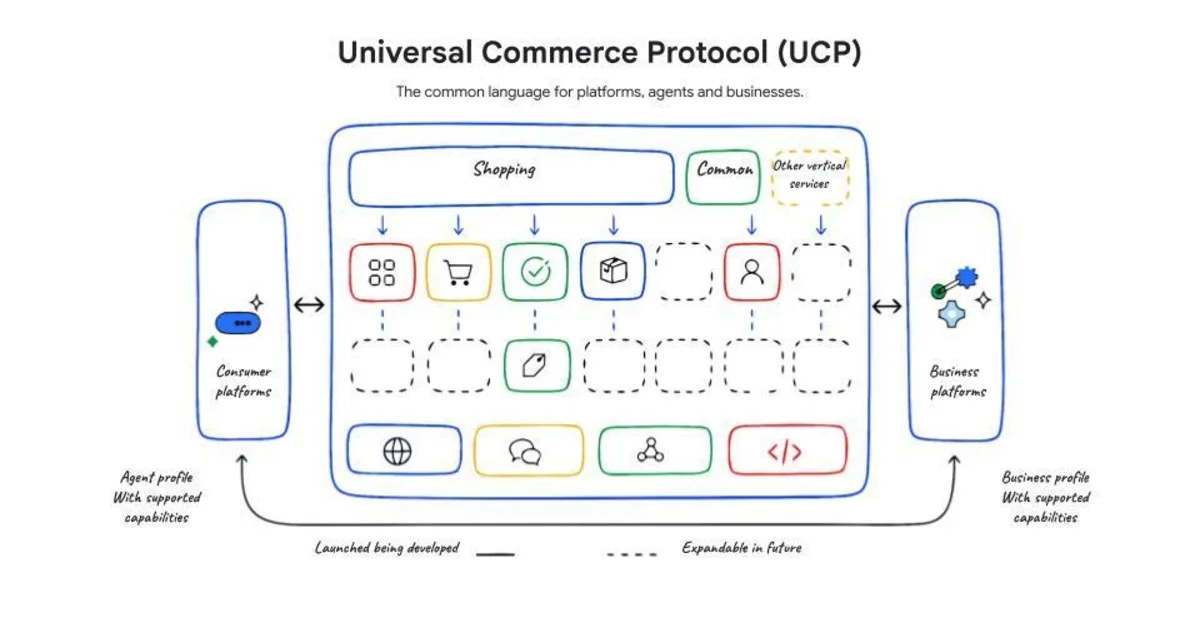
Universal Commerce Protocol (UCP) builds open rails for agentic commerce. See the architecture walkthrough from Open Source Summit North America.
opensource.googleblog.comAt Open Source Summit North America 2026, Google walked through the architecture of the Universal Commerce Protocol (UCP), an open protocol that underpins interoperability in agentic commerce. It handles product discovery, presentation, and checkout with a common grammar, dividing responsibilities with AP2 for payment authorization and A2A and MCP for communication.
UCP is positioned as a joint effort with more than 20 companies, including Shopify, Etsy, Wayfair, Target, and Walmart. In contrast to OpenAI and Stripe's ACP, which delegates to specific platforms, UCP aims for distributed, open rails.
With multiple protocols proliferating, which foundation becomes the de facto standard will shape retailers' implementation plans. Which AI to connect to, and via which standard, is becoming a new selection axis.
Full article: Google Presents UCP, the Open Rails for Agentic Commerce
THG Ingenuity Launches AI Shopping Assistant with Google Cloud

THG Ingenuity, the complete commerce solution provider, has launched an AI Shopping Assistant in collaboration with Google Cloud.
www.prnewswire.comUK commerce platform provider THG Ingenuity announced an AI shopping assistant built in collaboration with Google Cloud. Announced at Google Cloud Summit London '26, the company says the deployment delivered conversions up to eight times higher than before.
The assistant responds to shoppers' questions in natural language and handles everything from product suggestions to purchase support. THG Ingenuity provides commerce infrastructure to many brands, and by layering AI service on top, it aims to let client companies offer agentic buying experiences without building their own.
Platforms bundling AI service as a standard capability echoes Shopify's opening strategy. Whether to hold AI in-house or use platform-side features is becoming a practical question for retailers.
IndiaMART Deploys India's Largest Agentic AI Commerce System with SquadStack
IndiaMART has deployed what it describes as India's largest agentic AI commerce system, built with SquadStack.ai.
indiantelevision.comIndiaMART, India's largest B2B marketplace, has launched what it calls India's largest agentic AI commerce system in partnership with SquadStack.ai. It introduces autonomous AI agents at scale into B2B-specific processes such as buyer-seller matching and inquiry handling.
B2B commerce has a vast number of products and many steps that still rely on people, such as quotes and negotiation. Embedding AI agents there aims to handle large volumes of inquiries while shortening the path to a deal. The large-scale rollout in a massive, multilingual market like India is also notable.
It shows that agentic commerce is spreading not only to consumers but also into B2B sales processes.
Peec AI Launches AI Shopping Analytics as Recommendations Move into ChatGPT
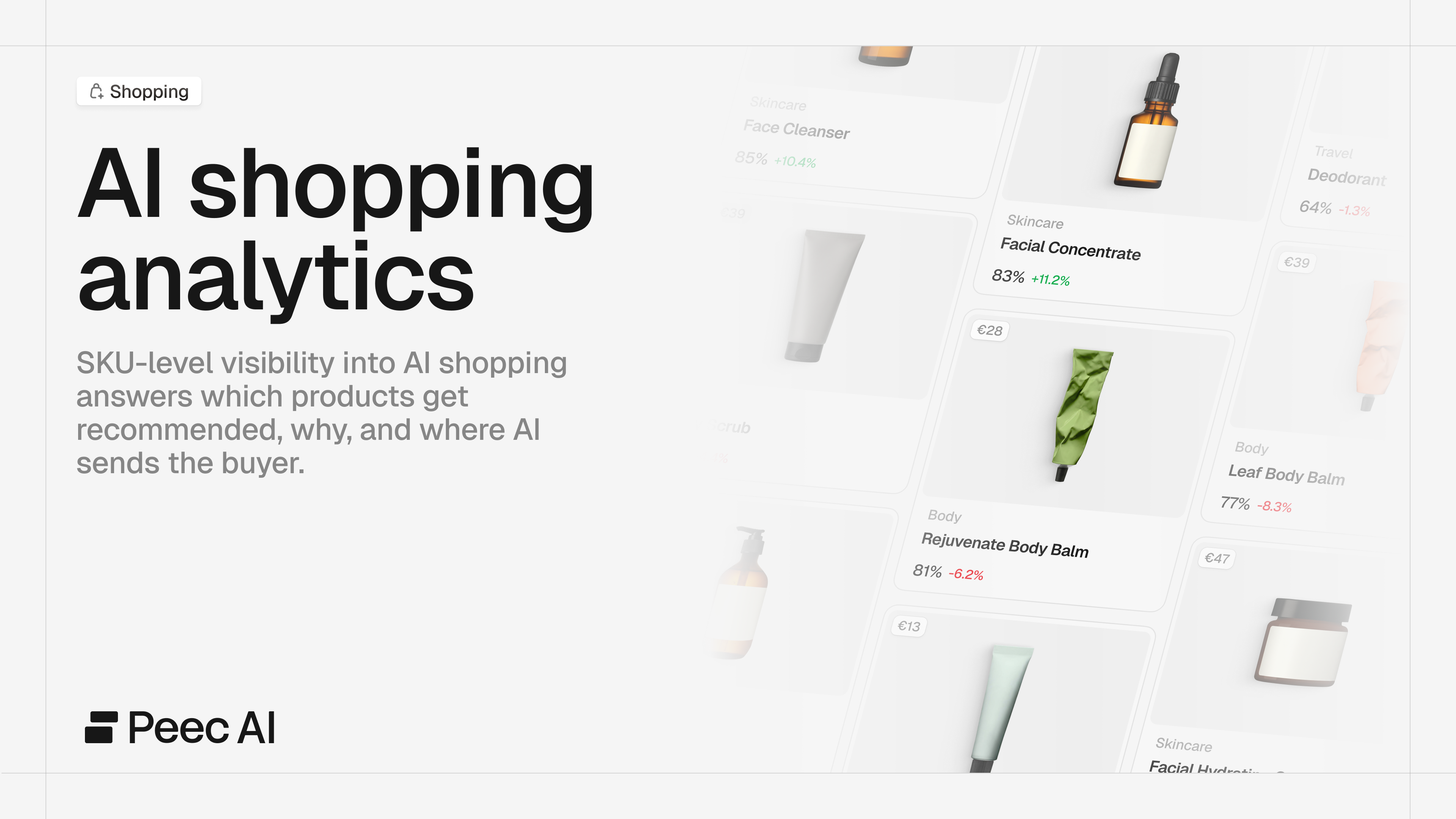
Peec AI, the AI search analytics platform, launched AI Shopping Analytics, giving e-commerce brands visibility into how they appear in AI assistants.
markets.businessinsider.comGerman AI search analytics company Peec AI launched AI Shopping Analytics, which makes visible how a brand's products are recommended inside AI assistants such as ChatGPT. As product recommendations move from search results into the conversation with AI, it is a tool for brands to measure how AI sees them.
Just as traditional SEO tracked Google's rankings, brands now need to track exposure and how they are recommended inside AI assistants. Peec AI provides this new visibility metric and offers clues for brands to optimize their product data and reputation for AI.
It reinforces that being recommended correctly by AI is becoming a new marketing challenge.
ReFiBuy Reports Claude Has Started Showing Product Cards

ReFiBuy's monitoring agents detected that Anthropic's Claude is now serving product cards across multiple queries.
www.tipranks.comReFiBuy, which monitors AI commerce trends, reported that Anthropic's Claude has started showing product cards for multiple queries. The company says its monitoring agents detected cases where product information appears in card form within Claude's answers.
If major AI assistants like Claude, following ChatGPT, begin presenting products directly in their answers, the exposure surfaces available to brands grow further. Which AI displays products in which format is still fluid, with each company experimenting.
The more surfaces where products appear, the more important it becomes to prepare product data tailored to each AI's specifications.
Global E-Commerce & Consumer Trends
ING Forecast: Agentic Commerce Will Further Shrink Brick-and-Mortar Retail

ING predicts a decline in brick and mortar stores due to agentic commerce, where AI agents make purchases. Fashion is only partially spared.
fashionunited.ukFinancial institution ING forecast that the spread of agentic commerce, where AI agents make purchases, will further accelerate the contraction of physical stores. As AI compares prices and conditions to buy, in-store impulse buying and browsing are expected to decline.
While categories with lasting experiential value, such as fashion with fitting, are seen as only partially affected, staples and consumables are more likely to shift to AI-driven buying. It sets up a picture in which the role of physical stores is forced to be redefined around experience and brand touchpoints.
Adobe Data: AI-Driven Retail Traffic Surged Again in May (Follow-up)

Artificial intelligence continues growing as a source of visitors to e-commerce sites, according to Adobe.
chainstoreage.comAccording to Adobe's latest data, consumers visiting e-commerce sites via AI assistants continued to surge in May. The growth since 2024 is on a different order of magnitude, signaling that AI is establishing itself as a new source of traffic to retail sites.
This is a follow-up to the June 16 study we reported, which found that shoppers arriving via ChatGPT and Gemini engage longer and buy more. Together with the quality of AI-referred visitors, not just the volume, it confirms that retailers can no longer ignore AI-driven traffic.
Summary
June 17 was a day when moves over the foundations of agentic commerce converged. Shopify opened its commerce platform to developers, Google presented the open rails of UCP, and Salesforce absorbed autonomous customer service through its Fin acquisition. On both the protocol and platform fronts, the groundwork for AI to handle transactions is advancing rapidly.
The diversification of entry points is also clear. From Truecaller's calls to Claude's product cards to recommendations inside AI assistants, the surfaces where products appear are steadily increasing. What to watch next is which of the proliferating protocols converges as the de facto standard, and how far retailers can prepare product data tailored to each AI's specifications in-house.