Naver Shopping's AI Agent Goes Official: What 2.7x Transaction Growth Says About Korea's Chat Commerce
Naver has officially launched its Shopping AI agent after a four-month beta. We break down the 2.7x transaction growth, new features, Naver's search-to-payment agentic strategy, and the implications for e-commerce operators.

Key Takeaways
- Naver's shopping-focused AI Agent ended roughly four months of beta service and went official on June 25, 2026. It has evolved from a guide that finds and summarizes products into an execution-type agent that understands question intent and shopping context, then proposes next actions
- Compared with March, right after the beta launch, daily users in June grew more than 50% and transactions through the agent expanded over 2.7x. More than 70% of users enter specific queries of 15 or more characters, showing that conversational shopping is taking hold in Korea
- Naver aims to complete an agentic shopping experience spanning search to payment in the second half of the year. In a flow where AI proposes shopping criteria first and cites UGC as evidence for recommendations, well-structured product data and content become the conditions for being chosen
What Changed in the Official Release
Beta ends as Naver's agent shifts from guide to doer, boosting purchases with smarter, context-aware suggestions
biz.chosun.comAfter roughly four months of beta operation, Naver's shopping-focused AI agent has switched to official service. According to Chosun Biz, the transition took place on June 25, 2026. Following the conversational search AI Tab, the release is positioned as a move to extend the agentic experience, which turns exploration into real actions, across Naver's services.
Looking back, the agent debuted in beta at the end of February 2026 on the AI shopping app Naver Plus Store. The initial version stayed in a guide role, supporting users' searches by summarizing and comparing product information and analyzing reviews. A June 1 update added the ability to analyze behavioral data such as clicks, saves, and cart additions, letting the agent proactively initiate conversations. The official version is the culmination of this trajectory, promising an evolution into an execution-type agent that proposes next actions based on question intent and shopping context.
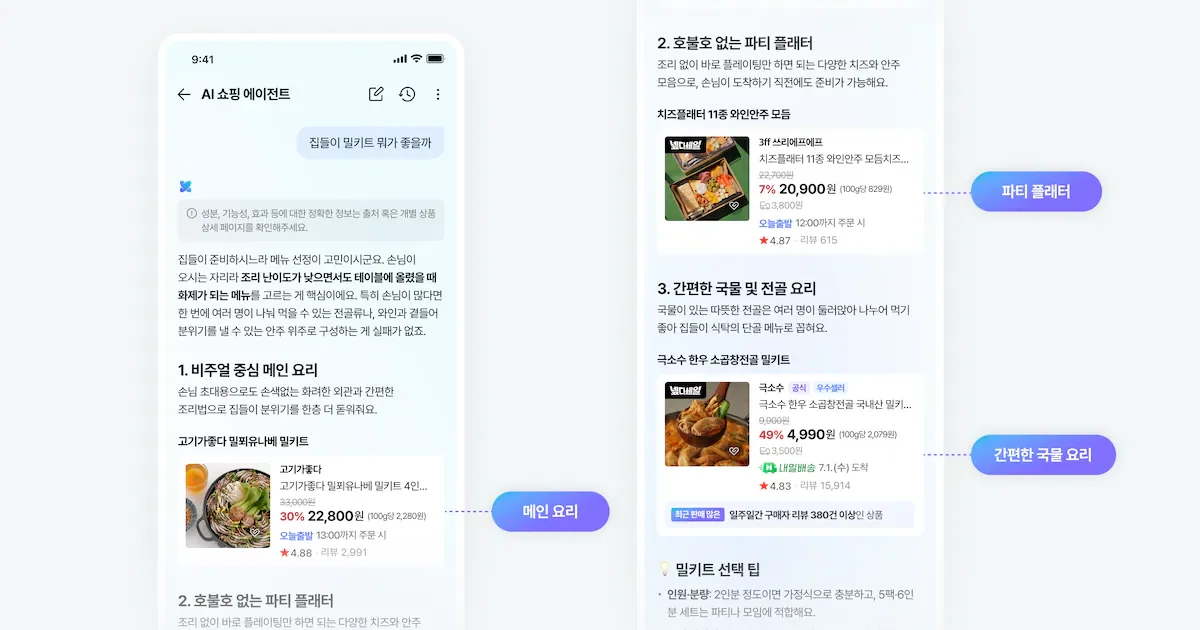
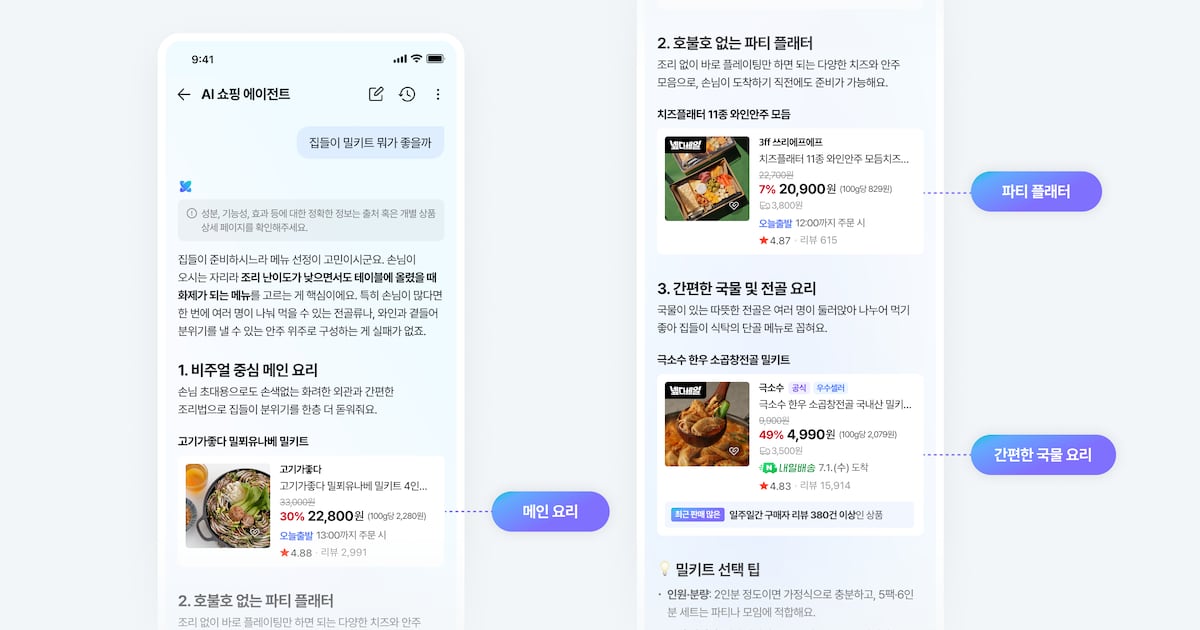
The biggest upgrade in the official release is answer design. Ask "What meal kit is good for a housewarming?" and instead of listing products, the agent first proposes shopping criteria that fit the situation, such as visually appealing main dishes, party platters, and simple soup dishes, then recommends products that match. Even for a simple query like "Recommend cat health care items," it presents purpose-driven themes such as gut health and joint or skin care, helping steer the exploration itself. Promotion and membership benefit information is also woven into answers so each user can buy under the best available conditions.
Usability gained three additions as well. An edit-question feature lets users revise questions already entered mid-conversation, a feedback feature accepts ratings and opinions on answers, and a view-sources-at-once feature shows the UGC behind each recommendation. The sources feature is especially notable: it makes visible that the latest content from blogs and cafes, Naver's community service, underpins the recommendations, which Naver says should improve trust in the agent's answers.
The Numbers Behind Chat Commerce Adoption
More than 70% of users enter concrete long-tail queries of 15 or more characters. This figure, disclosed by Naver alongside the official launch, shows conversational shopping has moved past novelty into practiced use. Complex requests combining multiple conditions such as price and features keep increasing, and Naver's analysis is that users have grown accustomed to refining their shopping criteria through conversation and arriving at optimal choices.
The change in usage scale is even more striking. Key June metrics compared with March, right after the beta launch, are as follows.
| Metric (June 2026 vs. March) | Change |
|---|---|
| Daily users | Up more than 50% |
| Average daily returning users | Roughly 3x |
| Transactions through the AI agent | More than 2.7x |
| Share of long-tail queries of 15+ characters | More than 70% of users |
The near tripling of returning users deserves attention. It means a user base is forming that relies on the agent repeatedly as an everyday shopping tool rather than trying it once. And the 2.7x-plus growth in transactions confirms that product exploration through conversation with AI is flowing naturally into actual purchases. The pattern, better recommendations converting dialogue into buying, now has numbers behind it.
Search to Payment: Naver's Execution-Type AI Lineup
Viewing this launch as a one-off feature release misses the point. Throughout 2026, Naver has been assembling, step by step, a lineup of execution-type AI agents spanning search, maps, reservations, and shopping.
At its core is the conversational search AI Tab, officially released on June 26, just before the shopping agent went official. It gathered 4 million users during its beta from late April and is now available to all users from Naver's main page, which draws about 50 million daily visitors across PC and mobile. AI Tab goes beyond understanding intent and answering; it connects to actions such as shopping, place discovery, and reservations. Going back further, Naver unveiled its integrated agent vision Agent N in November 2025 and laid out plans to deploy agents across shopping, finance, health, and local services within the year. R&D spending in 2025 reached 2.22 trillion won, up 20% year over year, while infrastructure investment piled up in parallel, including securing 60,000 Nvidia Blackwell GPUs and a partnership with AMD.
Lee Jeong-tae, head of Shopping Search & AI at Naver, said the following in the launch announcement.
The Naver AI shopping agent is rapidly evolving into an execution-type agent that, through a process of asking and answering with users, performs the complex steps of online shopping, such as searching, comparing, and exploring, on their behalf and even proposes actions that can lead to actual purchases. In the second half of this year, we will focus on advancing the technology to deliver a seamless, smart, agentic shopping experience from search to payment, including personalized membership benefit recommendations and enhanced cart and delivery information.
The phrase worth dwelling on is "from search to payment." Today's agent handles exploration, comparison, and recommendation, but the second-half focus sits on delegating the full transaction including payment. With cart and delivery enhancements explicitly named, an experience where users manipulate their cart within the conversation and complete purchases in place is clearly in view.
The move is also entangled with Korea's platform competition. Kakao has partnered with OpenAI around its KakaoTalk messenger and is rolling out agents powered by its own Kanana model. Naver starts from search and Kakao from conversation, but both have set AI that reads user intent and executes on their behalf as the main battleground for 2026, making Korea one of the fastest-moving markets for chat commerce implementation.
Implications for E-commerce Operators
There are three main points that e-commerce operators, in Japan and elsewhere, should take from Naver's case.
First, a new question: does your product fit the shopping criteria the AI proposes? The official version presents axes for choosing before listing any products. If product data cannot express use cases, occasions, and target users in machine-readable form, an item may fail to attach to any of the criteria the AI sets up and never enter the recommendation pool. Structuring product information has long been discussed in the context of search optimization, but in conversational flows it becomes a precondition for being read into the AI's criteria-setting.
Second, UGC now carries more weight as recommendation evidence. The view-sources feature showed users plainly that the agent's answers rest on blog and cafe content. Content assets such as reviews and experience write-ups are starting to function as a new exposure channel routed through AI recommendations. Separate from buying ad placements, whether high-quality content about your products circulates will shape visibility in conversational commerce.
Third, Naver's vertically integrated approach itself. While AI companies like OpenAI in the US push open agentic commerce standards that connect to external e-commerce sites, Naver chose to complete everything, from search and comparison through recommendation and payment, inside its own ecosystem. The 2.7x transaction figure is early evidence of the upside when a platform builds its own conversational funnel end to end. It can be read as a preview of what happens when Japanese marketplaces or major retailers deploy similarly integrated agents.
Conclusion
The official launch of Naver Shopping's AI Agent signals that chat commerce has left the experimental stage and entered a phase measured in results. Daily users up 50%, returning users roughly tripled, and transactions up more than 2.7x confirm that conversational product exploration flows naturally through to purchase. With an end-to-end experience from search to payment promised for the second half, Korea's implementation is set to go further still. For e-commerce operators, how to prepare product data that gets read into the AI's shopping criteria and content assets that serve as recommendation evidence is taking shape as the competitive condition of the conversational commerce era.