What Is ACP (Agentic Commerce Protocol)? — OpenAI × Stripe's ChatGPT Shopping Protocol Explained
A comprehensive guide to ACP (Agentic Commerce Protocol), the open standard co-developed by OpenAI and Stripe for AI agent purchases in ChatGPT. Covers technical architecture, SPT payments, partner ecosystem, cost structure, and the Instant Checkout to Discovery pivot.

Key Takeaways
- ACP (Agentic Commerce Protocol) is an open standard co-developed by OpenAI and Stripe, enabling AI agent purchases in ChatGPT through a minimal 4-endpoint REST API
- In March 2026, OpenAI pivoted from Instant Checkout to product discovery, expanding partnerships with Target, Sephora, Nordstrom, Walmart, and other major retailers
- The cost structure of 4% platform fee plus Stripe processing (~7.2% total) is offset by access to ChatGPT's hundreds of millions of users and a 2-4 hour integration timeline
What Is ACP (Agentic Commerce Protocol)?
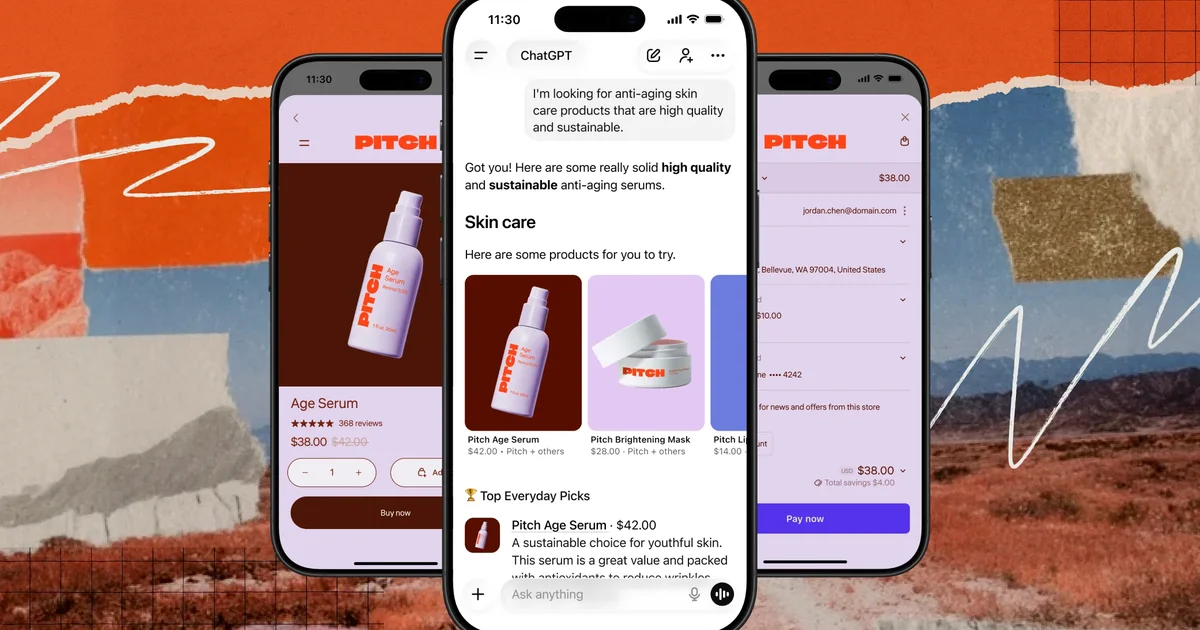
On February 16, 2026, OpenAI launched "Buy it in ChatGPT," making Instant Checkout available to all US ChatGPT users. The infrastructure powering this feature is the Agentic Commerce Protocol (ACP).
ACP is an open standard protocol that enables AI agents to discover products and complete purchases on behalf of humans. Jointly developed and governed by OpenAI and Stripe as Founding Maintainers, it is published under the Apache 2.0 license. As one of the key protocols underpinning agentic commerce, ACP is built around the ChatGPT ecosystem.
Why was a new protocol necessary? Traditional ecommerce assumes a linear flow: the consumer enters card details on a merchant's checkout page, and the payment is processed. When an AI agent becomes the starting point for purchases, fundamental questions arise about who holds payment credentials and how agent payment authority is controlled. ACP is OpenAI and Stripe's answer to these structural challenges.
A Deliberately Minimal Architecture: Four Endpoints
The defining technical characteristic of ACP is its intentional minimalism. The core API consists of just four endpoints. Here is the full checkout flow based on OpenAI's developer documentation.
Create Checkout initiates the process. When a ChatGPT user expresses purchase intent, the AI agent sends a SKU to the merchant's endpoint. The merchant returns cart data, supported payment methods, and fulfillment options.
Update Checkout handles pre-payment adjustments: quantity changes, shipping method selection, and customer information updates. This mirrors traditional cart editing, except everything is processed programmatically via API.
Complete Checkout executes the payment. This is where Stripe's Shared Payment Token (SPT) comes into play. A single-use token generated from payment information the consumer entered once into Stripe's secure interface is passed through the AI agent to the merchant. The merchant creates a PaymentIntent using this token. Card numbers, CVVs, and other sensitive data are never exposed.
Cancel Checkout notifies of transaction cancellation and releases reserved inventory.
Stripe's blog describes this four-endpoint design as "deliberately minimal." Product discovery and catalog management fall outside ACP's scope — the protocol focuses tightly on checkout transactions. Communication uses REST HTTP only, authentication relies on Bearer Tokens, and webhook authenticity is verified through HMAC signatures.
| Component | Details |
|---|---|
| Developers | OpenAI + Stripe (Founding Maintainers) |
| License | Apache 2.0 (GitHub) |
| Transport | REST HTTP / MCP Server |
| Authentication | Bearer Token + HMAC Webhook signatures |
| Payment | Stripe SPT (Shared Payment Token) |
| Versioning | Date-based (YYYY-MM-DD) |
| Latest stable | 2026-01-30 |
| Availability | US (as of April 2026) |
The specification uses date-based versioning in YYYY-MM-DD format. From the initial release (2025-09-29) through fulfillment enhancements (2025-12-12), capability negotiation (2026-01-16), and extensions with discounts and payment handlers (2026-01-30), four updates shipped in roughly four months. Each version represents a complete snapshot of the specification, evolving while maintaining backward compatibility.
How SPT Solves the Agent Payment Dilemma
SPT (Shared Payment Token), which powers ACP's payment layer, was designed to address a problem unique to agentic commerce.
The fundamental dilemma is straightforward: storing card information on the AI platform creates security risks, while transmitting it directly to merchants through an intermediary expands the potential for leaks. SPT offers a third option that avoids both pitfalls.
Three constraints are built into every SPT. First, it is scoped to a specific merchant. Second, the amount cap is tied to the cart total. Third, the expiry window is measured in minutes. This combination of single-use, time-limited, amount-restricted tokens structurally eliminates replay attacks and unauthorized charges.
In March 2026, SPT's coverage expanded significantly with support for Visa Intelligent Commerce and Mastercard Agent Pay network tokens, plus BNPL integration with Affirm and Klarna.
From "Buy it in ChatGPT" to "Powering Product Discovery"
No account of ACP is complete without addressing the March 2026 strategic pivot.
At launch in February 2026, OpenAI's vision was clear: find products through conversation with ChatGPT, purchase them without leaving the chat. The name "Buy it in ChatGPT" said it all. Etsy sellers were live as initial partners, with over 1 million Shopify merchants (including Glossier, SKIMS, Spanx, and Vuori) announced as coming soon.
Reality intervened. CNBC reported that OpenAI underestimated the difficulty of enabling transactions at scale. Merchant onboarding stalled, accurate product data display proved challenging, and basic features like multi-item carts and loyalty integration lagged behind. Digital Commerce 360 reported that out of Shopify's millions of stores, only about 12 merchants had actually enabled checkout.
OpenAI acknowledged that "the first version did not offer the level of flexibility that we aspire to provide." This candid assessment led to the March 24 announcement of "Powering Product Discovery in ChatGPT".
The new direction shifts focus to product discovery. Image-based product search, side-by-side comparisons, and conversational refinement by budget and preferences. Actual purchases redirect to retailer apps or websites. The pivot does not invalidate ACP as a protocol — checkout APIs remain in the specification, and Walmart has implemented full in-ChatGPT purchasing. But ACP's center of gravity has clearly moved from transaction execution to purchase intent creation.
The Partner Ecosystem Today
The partner ecosystem has actually expanded since the pivot.
Walmart's integration is the most comprehensive. The retailer launched a full in-ChatGPT app experience supporting account linking, loyalty programs, and Walmart Payments. Digital Commerce 360 reported that the web version launched immediately, with iOS and Android app versions rolling out.
Discovery partners now include Target, Sephora, Nordstrom, Lowe's, Best Buy, The Home Depot, and Wayfair. These retailers provide product catalogs to OpenAI's index, surfacing products based on ChatGPT users' conversational context.
On the platform side, Shopify's catalog integration supplies product data to ChatGPT, and PayPal's ACP server is expected to connect tens of millions of small businesses to the platform in 2026. Checkout.com has announced ACP support, and Wix, WooCommerce, BigCommerce, Squarespace, and commercetools offer integration through Stripe's Agentic Commerce Suite.
Cost Structure — What That 4% Means
| Item | ACP (OpenAI) | UCP (Google) | Amazon Marketplace |
|---|---|---|---|
| Platform fee | 4% | 0% | 15-25% |
| Payment processing | ~2.9% + 30¢ | ~3.2% | Included |
| Total cost | ~7.2% | ~3.2% | 25-30% |
| Integration effort | 2-4 hours | 8-16 hours | Weeks+ |
ACP's cost structure reflects the nature of its ecosystem. OpenAI's 4% platform fee plus Stripe's processing fee (~2.9% + 30 cents) brings the total to approximately 7.2%. For Shopify merchants, adding Shopify Payments brings the combined rate to roughly 9.2%.
How should merchants evaluate these numbers? Compared to Amazon Marketplace's 25-30%, the cost is clearly lower. Against UCP (Google's) zero platform fee and ~3.2% total, it is roughly double. At $1 million in monthly revenue, the gap versus UCP amounts to about $40,000 per month.
But cost alone tells an incomplete story. The 4% is better understood as an access fee to ChatGPT's hundreds of millions of users. As customer acquisition costs continue to rise, ChatGPT's unique channel characteristic — purchase intent emerging from conversational context — offers value distinct from advertising spend. A 30-day free trial from the first qualifying order further lowers the adoption barrier.
How ACP Differs from UCP
Understanding ACP requires comparison with Google's Universal Commerce Protocol (UCP). The differences trace back to design philosophy.
UCP uses a decentralized architecture where merchants host JSON profiles at /.well-known/ucp on their own domains. Following the robots.txt model, any AI agent can access product information without registration or platform approval. Data control remains with the merchant, with no dependency on any specific platform.
ACP takes the opposite approach: merchants submit product catalogs to OpenAI's index. Product ranking and display are platform-controlled, and payments are processed exclusively through Stripe. commercetools' analysis frames the distinction as "UCP operates at the infrastructure layer, ACP at the application layer."
The practical insight is that both protocols capture different "demand moments." UCP serves intent-driven channels like Google Search and Gemini, while ACP creates purchase opportunities from ChatGPT's conversational context. For a detailed comparison of technical differences and implementation strategies, see the dedicated comparison article.
Implementation Guide for Merchants
The integration path depends on your existing payment infrastructure.
Fastest path: existing Stripe users can enable agentic payments with as little as one line of code, according to OpenAI. A Stripe dashboard configuration adds SPT support to existing PaymentIntent flows.
Platform-mediated path: Wix, WooCommerce, BigCommerce, Squarespace, and commercetools have built ACP into their platforms through Stripe's Agentic Commerce Suite. Opt-in is typically available through the platform's settings interface.
Custom implementation: Build the four REST endpoints based on the OpenAPI specifications on GitHub (openapi.agentic_checkout.yaml, openapi.delegate_payment.yaml). Applications can also be submitted through OpenAI's developer portal at chatgpt.com/merchants.
Product feed preparation is also required. Supported formats are JSON Lines (.jsonl.gz) or CSV (.csv.gz), with updates supported as frequently as every 15 minutes. Required fields include GTIN/UPC/MPN, title, price, availability, seller name, and policy URLs (returns, privacy, terms of service). Maximum feed size is 10GB, with UTF-8 encoding and gzip compression.
Stripe account setup (required for SPT processing)
Structured product feed (GTIN/UPC/MPN, title, price, availability)
Four checkout endpoints implemented (Create/Update/Complete/Cancel)
HMAC webhook signature verification logic
Returns, privacy, and terms of service pages (required feed fields)
SPT payment flow testing in sandbox environment
Positioning in the Open vs Walled Garden Landscape
In the open vs walled garden landscape, ACP is published under the Apache 2.0 license, making it technically "open." But its operational reality is more nuanced. While the specification is open, it is strongly tied to a specific surface (ChatGPT) and a specific payment provider (Stripe). This contrasts with Google's UCP, which is designed as an infrastructure layer usable by any AI agent.
That said, ACP's specification does support deployment via REST HTTP or MCP Server, making implementation by non-ChatGPT agents technically feasible. OpenAI and Stripe have also stated their intent to transition toward neutral foundation governance, leaving room for broader ecosystem participation in the future.
Future Outlook
ACP's next phase is likely to advance along three axes.
First, global expansion. As ACP moves beyond the US, compliance with regional payment regulations and data protection laws (GDPR, Japan's APPI, etc.) will be required.
Second, multi-agent support. While ACP currently assumes ChatGPT as the sole AI surface, the open specification allows other AI agents to adopt it. Integration with enterprise agents like Salesforce Agentforce and Microsoft Copilot could open new B2B demand.
Third, an Instant Checkout comeback. The March 2026 pivot was a timing adjustment, not an abandonment. As product data accuracy improves and multi-item carts and loyalty integration mature, end-to-end purchasing within ChatGPT is likely to resurface.
Summary
ACP is the protocol born to transform ChatGPT from a conversational AI into a commerce channel. Its technical foundation — four REST endpoints and SPT-secured payments — is in place, and an ecosystem of major retailers including Walmart, Target, and Sephora has formed. The pivot from Instant Checkout to discovery is not a retreat but a pragmatic course correction acknowledging the complexity of ecommerce integration. Whether the 4% platform fee represents a cost burden or an access ticket to hundreds of millions of ChatGPT users depends entirely on each merchant's channel strategy.