Hey Savi and PayPal Launch the UK's First Agentic Commerce Platform: Debenhams Becomes First Retailer, In-App Checkout Unifies Discovery and Purchase
Hey Savi and PayPal launched the UK's first agentic commerce experience with in-app checkout. Here is why Debenhams Group adopted it first and what AI-powered fashion search means for merchant acquisition and conversion.

Key Takeaways
- Hey Savi and PayPal launched the UK's first agentic commerce experience with native in-app checkout, with Debenhams Group joining as the first retail adopter
- The core idea is turning a photo, screenshot or text into intent, ranking products from 10,000-plus brands by relevance rather than paid placements, and completing checkout without leaving the app
- For merchants, this marks a shift from ad-dependent acquisition toward capturing the moment of purchase intent, making clean, structured product data the new condition for being discovered by AI
What the UK's first agentic commerce platform really means
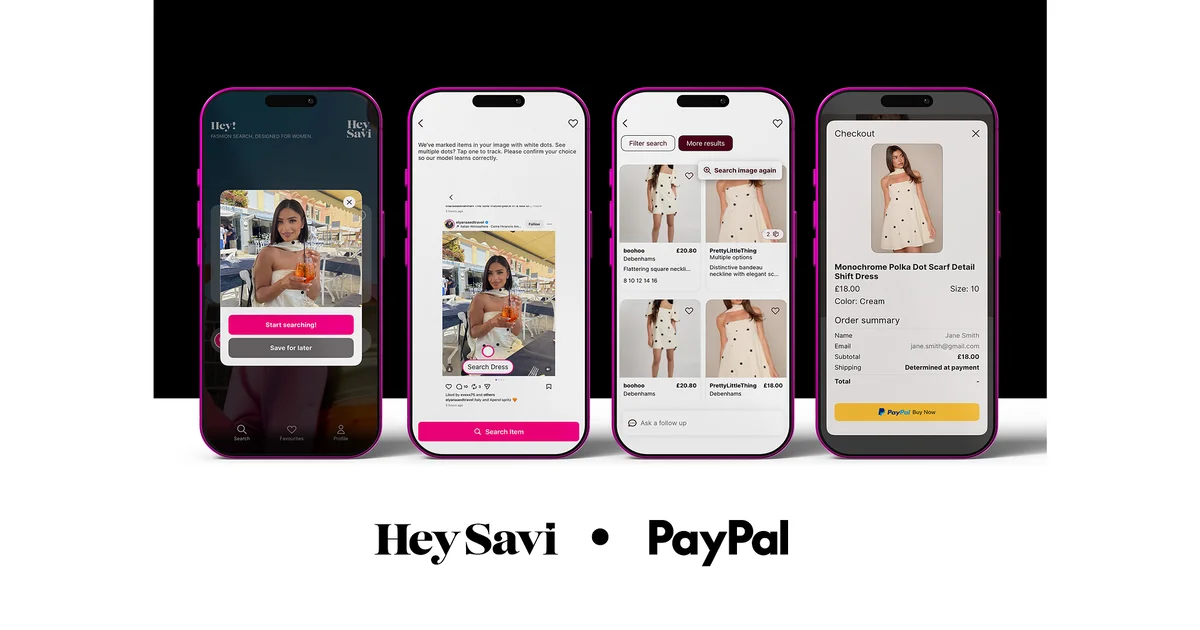
Hey Savi launched UK's first agentic commerce experience with native checkout powered by PayPal.
newsroom.paypal-corp.comOn June 2, 2026, at the annual payments event Money20/20, the UK fashion search platform Hey Savi and PayPal announced the UK's first agentic commerce experience. What sets it apart is native in-app checkout, which collapses finding a product and buying it into a single screen.
Agentic commerce refers to a style of shopping where the consumer expresses an intent for what they want, and an AI agent compares options across sources and takes on the steps of the purchase. It re-stitches the previously fragmented flow of search, cart and payment into one continuous path.
The most notable detail is that Debenhams Group, the parent of a stable of iconic British retail brands, became the platform's first retail adopter. Group brands including Debenhams, Karen Millen, Boohoo and Pretty Little Thing are the first to bring end-to-end AI-powered shopping to UK consumers.
What Hey Savi changes: ranking by relevance, not by ad slots
The key to understanding Hey Savi lies in how it orders results. The platform turns any search, whether a photo, a screenshot or text, into intent, then ranks products from more than 10,000 brands by relevance rather than by sponsored placement. Co-founder Sarah Daniel says this means brands of every size can be discovered by the highest-intent shoppers in fashion.
Why does this matter? Online shopping today is fragmented between inspiration and purchase. Try to buy an outfit you spotted on social media and you often end up crossing multiple sites, wading through paid ad slots, and finding the item out of stock or unavailable in your size when you finally arrive.
Until now, online shopping could be long-winded and inefficient for the customer: a redirect, a forgotten password, a site that did not carry the right size. Hey Savi simplifies it.
Technically, Hey Savi is built on proprietary computer vision and conversational AI that turns screenshots into shoppable results. Its revenue comes not from on-site ad slots but from a mix of affiliate commissions and brand partnerships, with no paid placements, no sponsored results and no bidding for position, as reported by Retail Systems. In other words, the principle that relevance directly drives revenue is built into the business model itself.
PayPal closes the loop: the role of Agentic Commerce Services
If Hey Savi owns the entry point of discovery, PayPal owns the exit of purchase. The moment a shopper is ready to buy, PayPal's suite of agentic commerce services surfaces current pricing and availability and enables in-app purchasing. It plays the role of closing the loop so that discovery and checkout never break apart.
This platform did not appear out of nowhere in 2026. PayPal introduced its Agentic Commerce Services (ACS) in October 2025, assembling a set of solutions for AI-driven shopping. There are two main components.
| Component | Role | Availability |
|---|---|---|
| Agent Ready (agentic payment) | Lets existing PayPal merchants accept payments on AI surfaces, with fraud detection, buyer protection and dispute resolution | Early 2026 |
| Store Sync (catalog / order management) | Makes product data discoverable across AI channels and routes orders into existing fulfillment systems | From late 2025 |
The key point is that these services are designed to integrate into a merchant's existing order management systems. Retailers can expose their product data (pricing, images, descriptions, reviews and inventory) to AI platforms while retaining their status as merchant of record and ownership of customer communications.
Mike Edmonds, who leads the area at PayPal, frames this experience as exactly what agentic commerce promises.
Shopping now starts with a screenshot or a creator post, but the path to purchase does not move at the same speed. PayPal is committed to collapsing the distance between inspiration and transaction.
Why Debenhams Group went first
Debenhams Group becoming the first adopter reflects the retailer's ongoing AI strategy. The launch builds on Debenhams' existing collaboration with PayPal and is positioned as one move within a broader effort to deliver seamless shopping experiences across next-generation AI platforms, including Hey Savi.
What should not be overlooked is that this is not a UK-only move. According to Retail Systems, ahead of this UK launch Debenhams Group had piloted AI-driven checkout on Meta in the US in May 2026, advancing its investment in AI shopping across regions. Its title as the UK's first retail adopter is best read as one facet of that global strategy.
CEO Dan Finley says agentic commerce has the potential to completely reshape how consumers discover and shop for fashion online, calling it an important moment for the industry. The company's vision of smarter, more seamless experiences that better reflect how people actually browse, discover and buy clearly informed the decision to adopt.
Implications for merchants: the premise of acquisition is shifting
This is not a story about a single UK fashion player. Indicators are emerging that show how far AI-mediated buying has come.
According to the McKinsey and Business of Fashion State of Fashion 2026 report, shopping-related searches on generative AI platforms grew 4,700 percent between 2024 and 2025. McKinsey estimates that agentic commerce could orchestrate as much as $1 trillion in US retail and $3 trillion to $5 trillion globally by 2030.
The essential change for merchants is that the premise of acquisition shifts from buying ad slots to capturing the moment of purchase intent. On a relevance-ranked platform like Hey Savi, you do not win the top spot by bidding; instead, the quality of your product data and the accuracy of your inventory determine whether you are discovered at all. Whether information such as price, images, descriptions, reviews and stock is readable by AI platforms becomes the new competitive condition.
That said, this transition will not run in a straight line. In March 2026 OpenAI temporarily pulled its Instant Checkout feature, citing insufficient adoption by sellers. Who owns the agent's entry point, and which platforms to list products on, remain open questions. That is precisely why a neutral payment layer like PayPal's, which can support multiple AI ecosystems through a single integration without locking merchants in, is becoming more valuable.
Conclusion
The Hey Savi and PayPal launch in the UK makes the new shape of shopping, where discovery starts on social media or AI and purchase completes in-app, concrete by bringing a real retail brand into the picture. Debenhams Group's participation signals that established retailers are now entering the stage of testing this flow.
The question merchants now face is whether they are ready to be found by AI agents. The move from optimizing ad slots to organizing product data is underway. What to watch next is which markets follow the UK, and which brands the platforms beyond Hey Savi choose to onboard first.