SAP Launches Autonomous CX at Connect 2026: How Its Joule Assistants Connect AI Agents to Order and Inventory Data
SAP unveiled its Autonomous CX Joule assistants at SAP Connect 2026. We explain how SAP is wiring AI to orders, inventory and customer master data, what its consumer survey says about delegating purchases to AI, and what e-commerce teams should fix first.

Key Takeaways
- On October 6, 2026 (US time), SAP announced its Autonomous CX Joule assistants at SAP Connect in Las Vegas. The six assistants cover campaigns, content, shopping, quoting, incentive compensation and service planning, with general availability of the new and expanded capabilities planned for Q1 2027
- The aim is to connect marketing, sales and service AI to core data such as orders, inventory and customer master records. The design targets failures where AI promises something the back end cannot deliver, such as promoting out-of-stock products or creating orders with mismatched data. SAP is extending its order management to non-SAP ERPs and has made its SAP Reltio master data solution generally available
- In SAP's consumer survey, 33% said they trust an AI assistant to complete a purchase, yet only 4% want fully autonomous AI and 56% want to be able to reverse AI decisions. Retailers should first make sure the inventory and pricing data their agents read is current, and that customers have a clear way to step in
What SAP Showed in Las Vegas: Autonomous CX
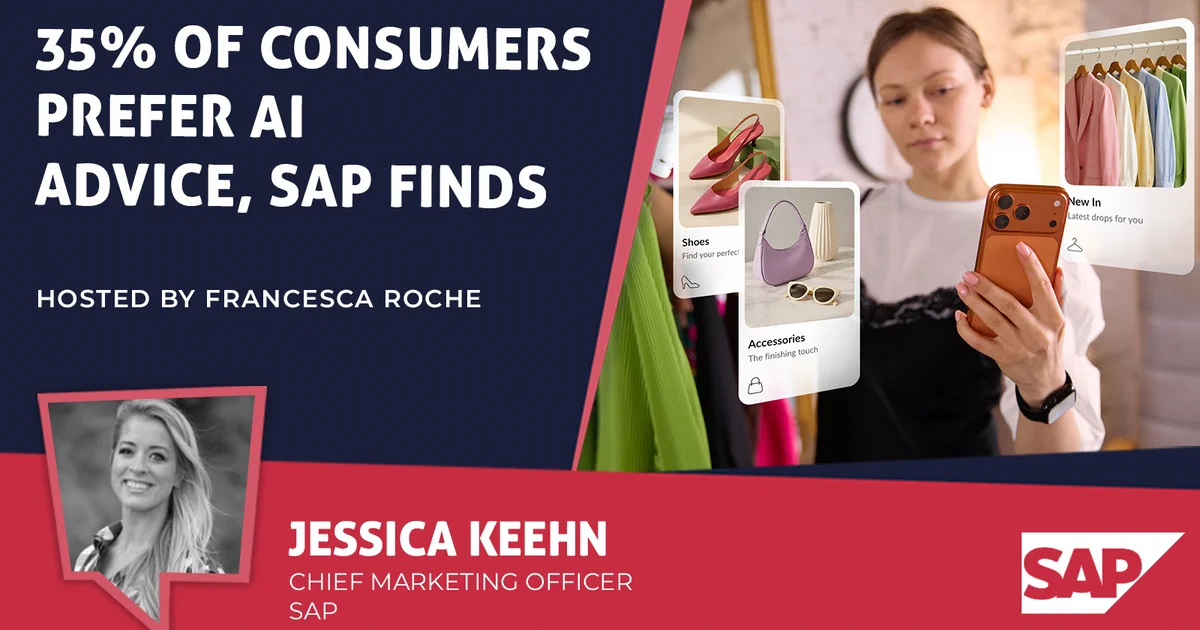
SAP's new Autonomous CX suite coordinates marketing, commerce, sales and service as consumers increasingly trust AI recommendations.
cxtoday.comWhen a marketing AI launches a campaign for a new product, that product may already be gone from the warehouse. The Autonomous CX assistants SAP announced on October 6 are meant to close exactly this kind of gap between departments. The stage was SAP Connect, the company's annual event held in Las Vegas from October 5 to 7.
Autonomous CX is one of the domains SAP introduced at SAP Sapphire in May 2026, and this announcement fills it in with concrete Joule assistants. Joule is SAP's brand for its AI assistants. According to SAP's Innovation News Guide, the assistants prepare and carry out defined workflow steps using shared business context: customer interactions, orders, contracts, pricing, payment history and policies. SAP also states that people retain responsibility for exceptions and consequential decisions.
Speaking with CX Today, SAP CMO Jessica Keehn described the problem the launch is meant to address.
Customer experience has historically been organized in separate functions and systems. Customers don't experience brands that way, though.Source: Jessica Keehn (CMO, SAP)
The six assistants are listed below. General availability for both the expanded capabilities and the new assistants is planned for Q1 2027.
| Assistant | Main role | What was announced |
|---|---|---|
| Campaign Assistant | Activates omnichannel campaigns informed by customer and business signals from ERP and marketing systems | New capabilities for an existing assistant |
| Content Assistant | Assembles personalized, channel-ready content adapted for each channel | New capabilities for an existing assistant |
| Shopping Assistant | Validates customer and product information in B2B email orders and prepares them for fulfillment | New capabilities for an existing assistant |
| Quoting Assistant | Creates accurate, compliant quotes and customer-ready proposals | New |
| Incentive Compensation Assistant | Lets salespeople raise compensation disputes and gives visibility into crediting and payment issues | New |
| Service Planning and Operations Assistant | Connects planning, logistics and post-service work from first contact to final invoice in one guided workflow | New |
Of these, the Shopping Assistant and the order management expansion announced alongside it matter most for agentic commerce.
The Shopping Assistant Is About B2B Order Processing
The name suggests an AI that chats with consumers and recommends products. CX Today describes the Shopping Assistant as validating customer and product information to help teams prepare orders for fulfillment faster and with fewer errors.
SAP's own guide is more specific. The new capability is support for B2B email order processing. For orders that arrive by email from business customers, the assistant validates customer and product information and prepares the order for fulfillment. Manual order entry goes down, while people remain responsible for exceptions and approvals.
In other words, this is not about AI serving shoppers. It is about AI checking that an order is correct after it arrives. That sounds unglamorous, but it touches a central issue in agentic commerce.
Once AI agents start placing orders on behalf of shoppers, orders will arrive through more channels than ever: email, chat and external AI. The more entry points there are, the heavier the work of confirming that each order maps to a real customer, a correct product code and a valid price. SAP starting with email orders, which arrive in inconsistent formats, can be read as preparation for receiving orders through agents.
Order Management and Master Data: Keeping AI From Promoting What You Cannot Sell
Two platform announcements made at the same time have a wider impact than the Shopping Assistant.
The first is the expansion of SAP Order Management Services. It lets companies build a common order management layer that connects customer demand, inventory, pricing and order execution across multiple ERP systems, including non-SAP ERPs alongside SAP S/4HANA. SAP says this can be done without lengthy ERP consolidation projects. The service now reaches beyond traditional B2C scenarios into complex B2B order processes: validating orders, checking inventory across locations and coordinating transactions between business units. New Joule Agents that help operations teams spot and respond to order disruptions faster are also planned for Q1 2027.
The second is SAP Reltio, which handles master data management. Built on technology from Reltio, whose acquisition SAP completed in May 2026, it is now generally available as part of SAP Business Data Cloud. What stands out is how SAP frames the problem. The same customer, supplier or product is recorded with different identifiers and attributes in each business application, and each system holds only a partial view. SAP points out that AI does not automatically reconcile these differences, and positions Reltio as a "system of context" that spans systems.
Put the two together and SAP's design philosophy becomes clear. CX Today lists the kinds of friction customers feel: campaigns promoting unavailable products, sales delayed by complex quote creation, and purchases disrupted by disconnected processes. Each one comes from the customer-facing systems running separately from the systems that hold inventory and orders.
The more AI agents take over service and advertising, the bigger this problem gets. A human associate might check with the warehouse before recommending a product that looks low on stock. An agent fed stale data will recommend it with full confidence. SAP's answer is not a smarter agent but consolidating the inventory, orders and master data that agents read into a single layer.
External connections are worth a note too. According to SAP's press release, Joule can connect with third-party AI and agents through the Agent2Agent (A2A) protocol. If a shopper's buying agent asks a retailer's system about stock or delivery times, having an endpoint that answers from core data matters. The announcement, however, did not include any concrete integration with consumer-facing AI agents.
A Third Would Let AI Buy for Them, but Only 4% Want Full Autonomy
As background for the launch, SAP pointed to the 2026 Customer Loyalty Index released on September 16 by SAP Engagement Cloud (formerly Emarsys). Research firm Opinion Matters surveyed 10,002 people in the US, UK, Germany and Hong Kong between July 7 and 22, 2026.
According to the full report, 35% prefer AI recommendations over advice from friends and family, and 33% have purchased products recommended by AI. The same share, 33%, trust an AI assistant to complete purchases on their behalf. In the 2025 survey, 30% had used AI agents to make decisions and act for them when buying, and the report treats this as an early sign that delegation is growing.
The other side of the ledger matters as well. 30% have switched away from a brand they were loyal to because of how it uses AI, rising to 45% among Gen Z. Adding AI does not automatically lift loyalty, and getting it wrong can cost customers.
The answers about control speak most directly to agentic commerce design. 60% want shared control between humans and AI, 20% want full human control, 16% want AI-led decisions with oversight, and just 4% want full autonomy. 56% want to be able to reverse AI decisions when needed, and 48% want human intervention to remain available. That lines up with SAP's statement that people keep responsibility for exceptions and consequential decisions.
There are caveats. This is SAP's own survey, and Japan is not among the markets covered. The numbers also vary across materials. CX Today reports that 32% regularly use AI to decide what to buy, which SAP Engagement Cloud's September 16 press release gives as a US figure; the four-market report puts it at 31%. The share preferring AI recommendations over friends and family rises to 44% in the US alone. The report itself recommends building agentic workflows that incorporate ERP data, so its conclusions sit close to SAP's product pitch and should be read with that in mind.
Much of It Is Not Available Yet
Timing is another point to keep in view. Constellation Research notes that much of what was announced at SAP Connect will be available through SAP's Early Adopter Care program in Q1 2027, and that little of it is generally available now.
Customers are cautious as well. Jens Hungershausen, chairman of the German-speaking SAP user group DSAG, said there is still a gap between the vision, the available solutions and actual customer benefits when it comes to SAP's autonomous enterprise vision. Of the announcements covered here, SAP Reltio is the one explicitly described as generally available. The impact of the CX assistants will have to be judged once customer deployments appear.
What E-commerce Teams Can Check Today
Even for companies that do not run SAP, this announcement works as a yardstick for their own readiness.
Start with how current the inventory and pricing data your AI reads actually is. Map whether ad delivery, email campaigns, on-site chat and product feeds for external AI all read the same inventory data at the same time, and the paths that lead to ads for out-of-stock products become visible. When Keehn said the first thing brands need to do is fix the friction in the process, she was talking about this order of work.
Product and customer identifiers deserve a second look as well. It is common for the same product to carry different codes across marketplaces, the brand's own store, physical stores and the ERP. People can fill those gaps from experience; agents cannot. The SAP CX executive who rated retailers' readiness at "3 or 4 out of 10" also named data organization and integration as the biggest challenge.
Finally, build the exits for reversal and handoff. With only 4% of consumers wanting full autonomy, orders placed through agents need confirmation, cancellation and a switch to a human representative. Deciding up front what AI can handle and where people can step in is a condition for not losing customers to AI.
The idea of layering order management over multiple systems instead of replacing the ERP outright also mirrors moves by other vendors, such as Kibo's integration of agents with its OMS.
Conclusion
SAP's Autonomous CX is an announcement about getting orders, inventory and master data in order before putting AI agents in front of customers. The main act is not chat but the order management and master data layers.
Most of the products arrive in Q1 2027 or later, and their impact is unproven. Still, with a third of consumers saying they would let AI buy for them and a similar share leaving brands over how they use AI, the shift is relevant to e-commerce businesses in Japan as well. The next thing to watch is how closely early-adopter retailers can align what their agents promise with what their inventory can deliver.