Swap Launches Its First Agentic Storefront with AIR MAIL Brand in Residency: A New Retail Playbook at the Newsstand
Commerce infrastructure firm Swap debuts its first agentic storefront with an AIR MAIL Brand in Residency at retail newsstands in London and New York, fusing the Talk to my Agent platform with OMO and pop-up culture.

Key Takeaways
- Commerce infrastructure firm Swap debuts what it calls the first agentic storefront, with AIR MAIL serving as its inaugural Brand in Residency
- Retail newsstands in London and New York become Talk to my Agent pop-ups that fuse AI-assisted shopping, OMO, and editorial brand experience
- As static storefronts give way to conversational interfaces, e-commerce operators face new design questions about agent-led shopping
Swap Launches Its First Agentic Storefront with AIR MAIL

Today, Swap is debuting its first agentic storefront through a multi-city Brand in Residency at AIR MAIL's retail newsstands in London and New York.
www.businesswire.comOn May 11, 2026, e-commerce infrastructure company Swap publicly unveiled what it bills as the "first agentic storefront" - and chose an unconventional stage for it. Instead of a software launch event, Swap is debuting the product through a multi-city Brand in Residency at the retail newsstands operated by digital weekly AIR MAIL in London and New York. For Swap, AIR MAIL is its inaugural residency brand, and the rollout is framed as much as a cultural pop-up as a product launch.
The London residency runs May 11-15 at Shreeji Newsagents on Chiltern Street, followed by a New York residency from May 18-24 at the AIR MAIL Newsstand at 546 Hudson Street. Both locations are reshaped into immersive expressions of Swap's storefront, featuring branded installations, editorial takeaways, curated merchandise, cafe moments, and a roster of industry events. The London week is timed to Pulse, the leading commerce and retail conference, with an AIR MAIL x Swap happy hour bringing together founders, operators, and editors.
What Swap Is - From Returns Platform to Agentic Infrastructure
Swap was co-founded in 2022 by Sam Atkinson and Zach Bailet. The company started as a returns management platform and has since expanded into cross-border, tax, and global compliance, now serving more than 800 brands.
In January 2026, Swap raised a $100 million Series C co-led by DST Global and ICONIQ. At the time of that announcement, the company already framed its mission as building "AI-driven commerce infrastructure that allows agents to transact, recommend, and process payments across merchants globally." Swap then quietly rolled out its agentic storefront model in March 2026 to a select set of clients, posting initial results including higher conversion rates, more time on site, and reduced returns. The AIR MAIL residency marks the moment Swap moves from limited deployment to outward-facing category evangelism.
CEO Sam Atkinson stressed in the announcement that "the future storefront is not another widget or chatbot, but an interface designed to improve conversion while keeping brands in control." Swap is positioning the agentic storefront not as a feature, but as a new category of e-commerce experience.
Talk to my Agent: A New Storefront Design Philosophy
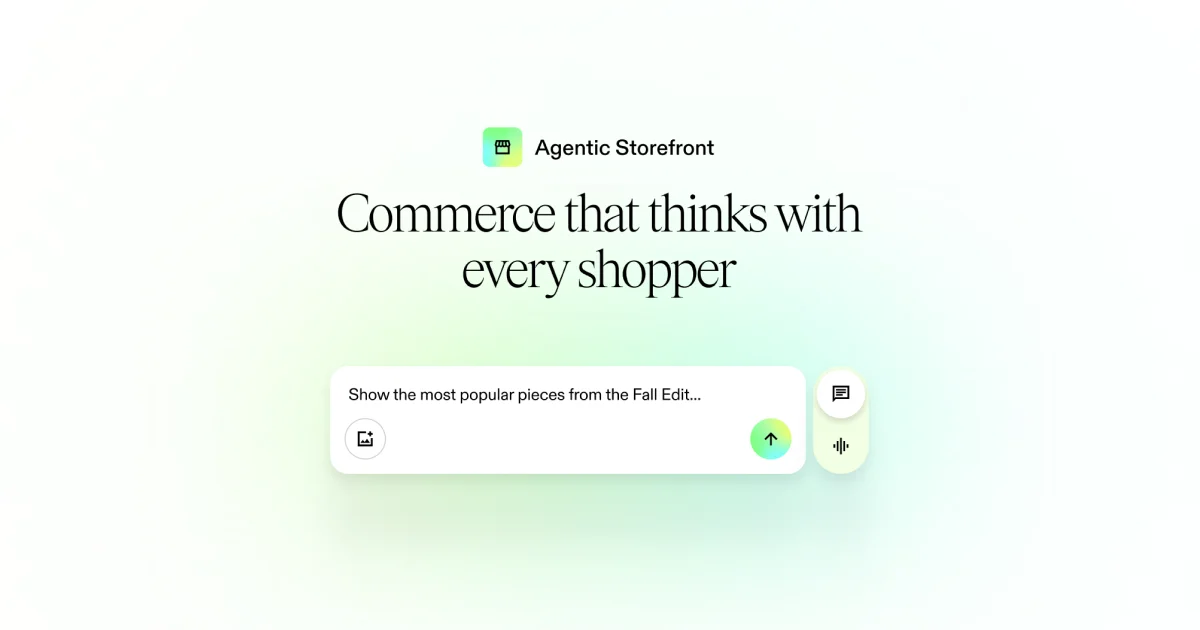
The residency is anchored by Swap's Talk to My Agent campaign. The "agent" here is not a generic chatbot but a brand-specific storefront layer that inherits a brand's voice, knowledge, and judgment. Instead of clicking through endless product grids, shoppers complete discovery, comparison, decision-making, and checkout in a single conversation.
What sets the design apart, based on Swap's published architecture, is the way storefront elements are reorganized around agents rather than pages:
Conversational Commerce Agent - Voice or text prompts replace menus and filters. The system adapts to past interactions and preferences, recreating the back-and-forth rhythm of in-store service in an online flow.
Brand Voice Agent - Merchants upload a short voice clip, and Swap trains the agent to speak in their tone. The same "What do you have in stock?" question can sound like a mass retailer, an editor, or a quiet luxury house, depending on the brand the agent represents.
Virtual Try-On Agent - Shoppers upload a photo and see products on a personalized avatar instantly. Swap argues this lifts conversion and reduces returns simultaneously by making remote purchase decisions more concrete.
Crucially, Swap describes its storefront in terms of agents, not pages. Search, filtering, cart, and recommendations are all handled inside one continuous conversation rather than stitched together across separate UI surfaces.
Why AIR MAIL's Newsstand Was the Right Stage
The choice of partner is as deliberate as the product itself. AIR MAIL is a digital weekly launched in 2019 by Graydon Carter (former Vanity Fair editor) and Alessandra Stanley, covering culture, lifestyle, and society. In April 2024, it expanded into physical retail with the AIR MAIL Newsstand at 546 Hudson Street in New York's West Village, a curated shop selling magazines, books, and gifts. In 2025, Puck acquired AIR MAIL, combining its editorial voice with Puck's subscriber-focused media model.
AIR MAIL's Chief Revenue Officer Liz Gough described the newsstand as "a place for discovery," and said the team was "delighted to welcome Swap into that tradition and give our community a first look at what they're building." Layered on a retail format that has always been about cultural discovery, Swap's storefront introduces a new shopping behavior - "talk to it" - in the place that already invites browsing and serendipity.
What sets this apart from a typical pop-up is intent. Swap explicitly says it is "introducing a category through culture, rather than through a traditional software launch." The residency targets AIR MAIL's dense audience of readers, editors, and operators with demos and live experiences, betting that cultural permission is a faster route to category adoption than press releases. For AIR MAIL, the program also doubles as a way to redefine the newsstand's role as a cultural ignition point.
What This Says About Retail in the Agentic Era
The announcement makes a point that is easy to miss in agentic commerce discussions: as agents take over more of the shopping journey, brands likely need to strengthen, not weaken, their real-world experience design. Several implications stand out for e-commerce operators.
The storefront becomes an interface, not a page - Optimization shifts from static PDPs and landing pages to the quality of what the agent says and recommends. Product data (PIM), brand guidelines, FAQs, and historical conversations all need to be structured into "agent-feedable" form. For many merchants, this work will matter more than the next round of SEO tweaks.
Pop-ups plus AI service are a strong combination - When shoppers can actually talk to an agent in person, the psychological cost of trying the same experience online drops sharply. For brands introducing new categories, this builds depth of understanding that an A/B test on the website cannot reach.
Brand in Residency as a reusable format - Rather than open a flagship, Swap "moved in" with a culturally credible media brand's existing retail footprint. That is a new variation on OMO, and a format DTC brands and agentic-era startups without their own stores can replicate.
How "double the industry conversion rate" is being pitched - Swap chose to lead with conversion, not just engagement metrics, when describing its product's impact. The numbers will need independent verification, but the framing - that agentic storefronts should be judged on conversion, not on session length or chat volume - is itself a signal to the rest of the market.
Summary
Swap launching its agentic storefront "through culture" signals that agentic commerce is moving past the protocol and infrastructure conversation and into a phase where it actively rewrites the consumer experience. Stacking the newest conversational interface on top of one of the most classic retail formats - a newsstand - offers a vivid case study for e-commerce operators.
Worth watching from here: whether the "first agentic storefront" label sticks as the industry's shorthand, which brands follow AIR MAIL as future residencies, and whether the "double the industry conversion rate" claim shows up consistently across other deployments. Beyond Swap itself, this residency is worth tracking as an early sample of how stores and e-commerce reconnect in the agentic era.