Wizard CEO: 91% of AI Shopping Stops at Chat — Anatomy of the Agentic Commerce Conversion Gap
Wizard CEO Melissa Bridgeford reveals 91% of AI shopping ends in chat without checkout. We unpack the structural conversion gap and how spending intelligence and native checkout close it.

Key Takeaways
- Wizard CEO Melissa Bridgeford told PYMNTS Monday Conversation that nine out of ten AI shopping experiences today end as chat with no checkout, exposing a structural conversion gap in agentic commerce
- Wizard's prescription is a three-pillar stack of spending intelligence, native checkout, and personalization, anchored by partnerships with Mastercard and Stripe to deliver a single query-to-checkout flow
- Merchants now face a binary architectural choice between in-agent native checkout (the Wizard model) and agent-to-store designs like Visa's Trusted Agent Protocol, with the legacy "land on a product page, then buy" model capturing only 9% of intent
What Bridgeford's "9 Out of 10" Number Really Says
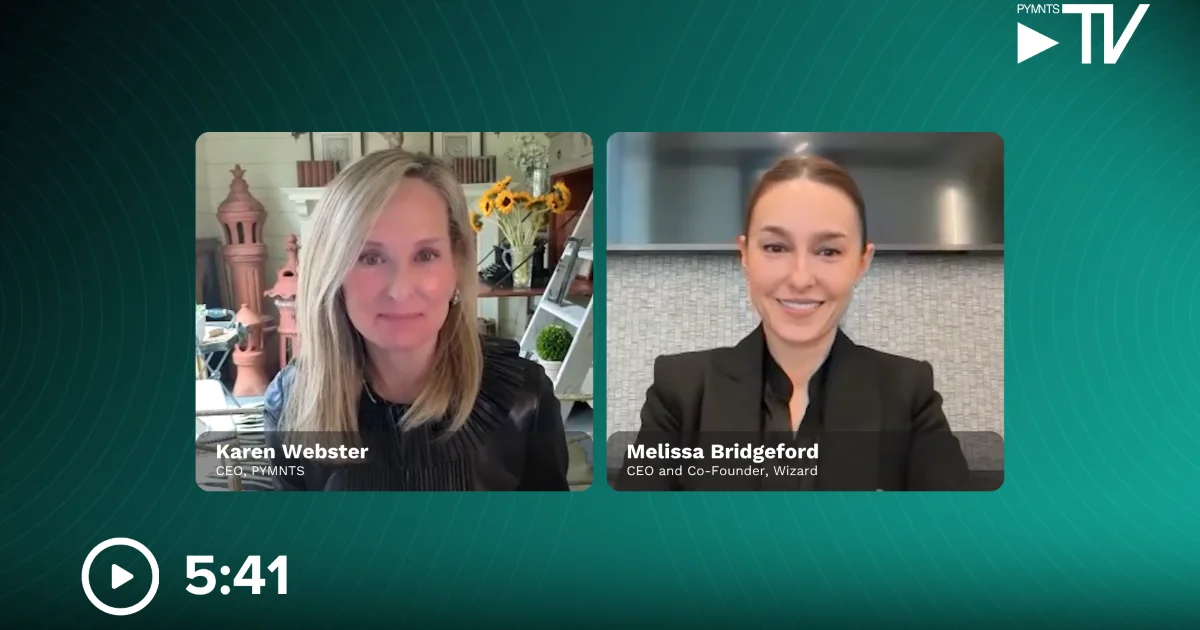
CEO Melissa Bridgeford says Wizard combines spending intelligence, native checkout and personalization to turn AI chat into actual commerce.
www.pymnts.comOn Monday, May 4, 2026, Wizard CEO Melissa Bridgeford appeared on PYMNTS Monday Conversation and pinned the state of AI shopping with a single number. Nine times out of ten, she said, today's AI tools deliver a chat experience rather than a shoppable experience. The conversation is information-rich. The transaction never happens. Bridgeford likened it to walking into a store where a knowledgeable associate can explain why one mattress pad beats another, but there are no cash registers in the building.
The number is not a verdict on the AI models themselves. PYMNTS CEO Karen Webster has run her now-famous "Toaster Test" for more than a year, and the LLMs handle research, comparison, and shortlisting beautifully. What they cannot do is surface the brand a buyer actually wants, in stock, at a real price, available right now. In Webster's framing, this is not a technology failure but a marketplace infrastructure failure.
PYMNTS Intelligence research from January 2026 found that 54% of U.S. adults now start daily tasks with AI, up ten points in a single month. Two in three millennials have used a conversational AI assistant for product research, and among AI power users, 34% rely on native AI interfaces as their primary discovery method, compared with 22% one month earlier. The behavioral shift is stair-stepped, not gradual. Yet only one in ten of those discovery sessions converts. The nine sessions that end in conversation are the lost opportunity.
Webster's sharper framing is structural. "The moment you have to click out, that model and that merchant has lost the opportunity for conversion." The LLM is a great salesperson, but it has no register access. That is the honest state of agentic commerce mid-2026.
Why the Gap Between Chat and Checkout Is So Wide
The structural distance between conversation and transaction comes from three compounding gaps.
The first is product data is not yet agent-ready. An AI agent can only recommend what it understands. Products without structured attributes, real-time inventory, and clean price APIs simply drop out of the consideration set. When Webster's Toaster Test fails to surface the brand she wants, that is the manufacturer's metadata absent from the agent's worldview, not a model limitation.
The second is payment primitives were built for browsers. 3DS, PCI, tokenization, and authorization flows assume a human entering card details into a web form. For an agent to close a transaction in-conversation, the agent itself needs scoped, authorized credentials it can fire on the buyer's behalf. That category of primitive only began to mature in 2026 with Mastercard Agent Pay, Visa Intelligent Commerce, and Stripe Shared Payment Tokens.
The third is missing personalization. Asking an agent for the "best running shoe" and receiving a hundred options does not produce a purchase. The decision happens when the answer narrows to "the Brooks model that fits your arch, under $150, available in your size today." Bridgeford put it this way: "Right now, we send people the top five products for their query, but in a future state might just send you the one because we know it's what you want." The winning agent is the one consumers trust enough to accept a single recommendation.
When all three gaps remain open, AI shopping stays a smarter search bar instead of a real commerce surface. That is the joint diagnosis from Bridgeford and Webster.
Wizard's Three Pillars: Spending Intelligence, Native Checkout, Personalization
Bridgeford's prescription maps cleanly onto those three structural gaps.
The first pillar is spending intelligence. Through the Mastercard partnership, Wizard taps Insight Tokens, which deliver geographic spending pattern signals to the agent. Two consumers searching for "coffee machine" can receive different price bands based on local purchase behavior — a $50 drip brewer for one shopper and a $400 espresso machine for another. Bridgeford described it as "a good salesperson sizing you up the moment you walk through the door, except in this case, it's Mastercard's transaction data doing the sizing." Crucially, this is aggregated geographic signal, not individual transaction history.
The second pillar is native checkout. Mastercard Agent Pay deployed through Stripe lets Wizard close the transaction inside the conversation. No redirect, no new tab, no "please re-enter your billing address." Bridgeford credits Stripe with building "the backbone of that transaction layer for agent commerce," handling multi-retailer cart mechanics and orchestration. As of April 2026, Wizard had launched its first native checkout integration with Best Buy, with apparel and beauty categories on the roadmap.
The third pillar is personalization. Bridgeford calls it Wizard's "north star" and frames it as curation, not advertising. The product ranking system uses internal scoring on relevance, product quality, brand signals, and trends. Bridgeford cited a striking data point: 75% of Americans lose trust in an agent shopping experience the moment they see ads. Wizard's choice not to accept sponsored placement is a deliberate philosophical bet that consumer trust beats short-term monetization.
The structural significance of the three pillars is that each addresses a different side of the chat-to-transaction gap. Spending intelligence makes up for missing product context. Native checkout fills the payment primitive hole. Personalization breaks the choice-overload paralysis. Only when all three click into place does Bridgeford's "query to checkout experience" become real.
The Strategic Map: In-Agent Native Checkout vs Agent-to-Store
For merchants, two architectural patterns are emerging for completing AI-mediated transactions.
The first is in-agent native checkout, the Wizard model. The full flow happens inside the agent's UI. The shopper never leaves. A cart forms, Stripe routes Mastercard Agent Pay, and the merchant receives the order data. OpenAI's ACP follows the same logic (OpenAI Checkout/ACP explained) — purchase completes inside the ChatGPT conversation. For merchants, this trades away the discovery surface and checkout UI in exchange for agent-mediated traffic.
The second is agent-to-store, exemplified by Visa Trusted Agent Protocol (Visa TAP explained). Here the agent visits the merchant's site and completes checkout in the merchant's own flow. Merchants keep their checkout UI, conversion optimization, and first-party data. The tradeoff is an additional signal layer the merchant must integrate to distinguish trustworthy agents from fraud bots.
These are better understood as parallel rails than competing standards. Buying behavior will likely route between them by category. Repeat-purchase commodities — household goods, electronics, subscriptions — favor the in-agent path because immediacy and personalization win. Brand-experience purchases and complex configurations — insurance, travel, custom orders — favor the agent-to-store path because the merchant's own flow handles complexity better. Japanese merchants would do well to start by mapping their catalog to one rail or the other on a category-by-category basis.
Wizard sits at the leading edge of the in-agent path, with $50M Series A funding and the kind of press cycle (Fortune, AdExchanger, NRF) that signals it is willing to spend to earn its own demand. On the network side, Mastercard and Stripe are signaling, as we covered last week, that the Insight Tokens plus SPT bundle is becoming a standard kit for independent AI shopping surfaces. "Network plus independent agent surface" is taking shape as a coherent four-quadrant in the partnership map.
Three Questions Merchants and PSPs Should Resolve in the Next 12 Months
PYMNTS Intelligence finds 43% of retailers piloting autonomous AI and 81% saying they trust autonomous AI given proper controls. On the consumer side, 45% would let an AI agent purchase on their behalf (54% for Gen Z), but 95% express at least one concern, and 50% would trust agentic commerce more if fraud protections were visible. The market has moved past the "wait and see" stage. The question now is execution.
The first question is product data agent-readiness. To be recommended by an independent surface like Wizard, products need structured attributes, citations from reviews and editorial media, and real-time price and inventory APIs. The shift from SEO to AEO (AI Engine Optimization) is here, and merchants need feeds that both independent surfaces and general-purpose LLMs can ingest. This is no longer a deferrable backlog item.
The second question is payment primitive selection. Stripe Shared Payment Tokens are positioning as the unified interface that abstracts Mastercard Agent Pay and Visa Intelligent Commerce, with BNPL providers (Klarna, Affirm) integrating through the same surface. As Visa's Q1 FY26 earnings established Intelligent Commerce as a long-term growth driver, the network strategies have crystallized enough that merchants can now reverse-engineer their rail choices.
The third question is integration with independent discovery surfaces. Wizard's share of U.S. purchase intent is still tiny in percentage terms. But the pattern is clear: surfaces that solve the "9 out of 10 chat-only" problem will be rewarded, and successors will follow. Merchants choose between direct native-checkout integration with specific surfaces (the Best Buy approach) and standard-protocol coverage that handles many surfaces at once. Wizard is also an early Stripe ACP partner, which means merchants who implement ACP get Wizard-class agent traffic effectively for free.
Conclusion
Bridgeford's "91% chat with no checkout" number is not an indictment of AI models. It is the visible signature of three structural gaps: product data not yet agent-ready, payment primitives built for browsers, and missing personalization. Wizard's answer is a three-pillar stack of spending intelligence, native checkout, and personalization, made possible by Mastercard Insight Tokens and Stripe-routed Agent Pay.
For merchants, the strategic reframe is to map the catalog onto two parallel rails — in-agent native checkout and agent-to-store — by category. The legacy assumption that you land shoppers on a product page and let them buy is now capturing only the 9%. The three open questions — agent-readiness of product data, payment rail selection across SPT and Agent Pay, and integration strategy with independent discovery surfaces — are no longer distant horizon work. They are the decisions of the next few quarters.