Visa's Q2 FY26 Earnings Frame Agentic Commerce as a Long-Term Growth Engine — $11.2B in Revenue and the Real Substance Behind Intelligent Commerce
Visa posted its strongest quarterly revenue growth since 2022 (up 17% to $11.2B). CEO Ryan McInerney explicitly named agentic commerce a long-term growth driver, while a fresh $20B buyback authorization signals room for sustained AI investment.

Key Takeaways
- Visa posted $11.2B in Q2 FY26 net revenue (up 17% YoY), its strongest quarterly growth since 2022, with net income up 20%
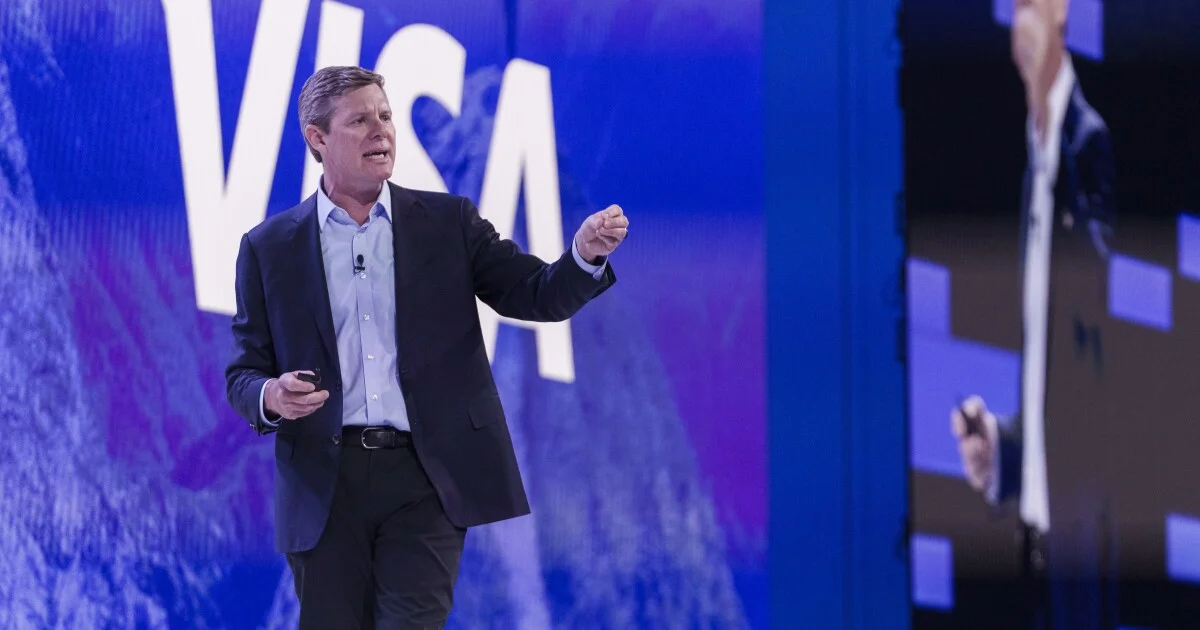
- CEO Ryan McInerney told analysts that agentic commerce is creating 'an entirely new ecosystem' Visa can attach itself to over the long term
- A new $20B buyback authorization runs alongside continued investment in Visa Intelligent Commerce, signaling that merchants should re-evaluate their payment partner's Visa readiness now
Visa's Strongest Quarterly Revenue Growth Since 2022

American Banker reports Visa's strongest revenue growth since 2022, with CEO McInerney highlighting agentic commerce as a long-term growth driver.
www.americanbanker.comOn April 28, 2026, Visa reported its fiscal second quarter 2026 results (calendar Q1 2026). American Banker reporter Joey Pizzolato noted that net revenue reached $11.2B, up 17% year-over-year — the strongest quarterly growth Visa has posted since 2022. EPS came in at $3.31, up 20% YoY and well above the $3.10 consensus. Payments volume grew 9% in constant currency to $3.7T, and processed transactions also rose 9% to 66 billion.
The short-term tailwind is the FIFA World Cup this summer, which Visa expects to lift both consumer and commercial volumes. But what drew the most attention on the analyst call was CEO Ryan McInerney's repeated framing of agentic commerce as a long-term growth engine. McInerney told analysts that agents will 'create significantly more transactions,' and that 'in some use cases, we expect agents will pay for their own data and resource consumption, transaction by transaction and event by event, which creates an entirely new category of commerce with micro transactions.'
Positioning Agentic Commerce as 'Internet 1.0 All Over Again'
McInerney's remarks make clear how big Visa thinks this opportunity is. American Banker reported that he described agentic commerce as 'creating a whole new ecosystem to which Visa can attach itself.' That language echoes Chief Product Officer Jack Forestell at the April 2025 Visa Intelligent Commerce launch, who said he hadn't seen anything like it 'since the dawn of ecommerce itself in the late 90s or early 2000s.'
Visa's leadership clearly believes the company can replicate the structural advantage card payments captured in the early internet era — this time, for AI agents acting as the buyer. The Q2 numbers also signal that Visa has the financial firepower to keep funding that vision. The company executed $7.9B in buybacks during the quarter, declared a $0.670 quarterly dividend, and authorized a fresh $20B multi-year repurchase program.
Q2 FY26 Headline Numbers
The gap between payments volume growth (9%) and revenue growth (17%) is worth noting. Value-added services — fraud, tokenization, data analytics, and consulting — are pulling well above their weight, and these are the same businesses that will monetize agentic commerce in the years ahead. The quarter confirmed in numbers what Visa has been saying in narrative form: it is no longer just a card network, but a 'payments hyperscaler' selling rails plus data on top.
Inside Visa Intelligent Commerce — Tokenized Cards and Know Your Agent
Visa's product layer for agentic commerce is Visa Intelligent Commerce, unveiled in April 2025 with OpenAI, Anthropic, Microsoft, IBM, Mistral AI, Perplexity, Samsung, and Stripe as launch partners. Capabilities have expanded steadily over the past year.
At its core are AI-ready cards: physical card numbers are replaced with tokenized digital credentials that AI agents can use to transact on behalf of consumers. Shoppers set spending caps, eligible categories, and time limits in advance, and Visa validates each agent request before authorization. Combined with the Trusted Agent Protocol launched in October 2025, the stack distinguishes legitimate AI agents from malicious bots.
In 2026, Visa Intelligent Commerce Connect extended the merchant-facing API surface, letting merchants accept agent-initiated payments through a single integration that spans Visa and non-Visa rails. Regional rollouts followed in Asia Pacific, CEMEA, and Latin America. The 'over 100 global partners' and 'more than 30 in sandbox development' numbers cited on the earnings call are the visible result of those efforts.
Competitive Picture — Mastercard, Stripe, Coinbase
The agentic commerce race is not a Visa solo run. Mastercard reports its Q1 results on April 30, putting both companies' numbers and AI strategies side by side for investors.
Mastercard launched Mastercard Agent Pay in April 2025 with Microsoft, IBM, and OpenAI, then unveiled an Agent Suite in January 2026 expanding work with Stripe, Google, and Ant International's Antom. Its Agent Toolkit exposes Mastercard APIs through a Model Context Protocol server, giving developers using Claude, Cursor, or GitHub Copilot direct access — arguably ahead of Visa on the developer experience front.
Stripe ships its own Agent Toolkit, competing for developer mindshare alongside Visa's network. Coinbase's x402 protocol and Circle's USDC offer 'agents pay directly' models on a different rail entirely, and represent a longer-term competitive vector against card networks.
The shape of the contest, then: Visa's edge is the combined weight of consumer card ubiquity, fraud data, and tokenization infrastructure, while competitors push from the developer-experience side (Mastercard, Stripe) or the non-card-rail side (Coinbase, Circle). McInerney's framing of agentic commerce as a 'long-term engine' on the Q2 call is, in part, a deliberate defensive posture against this multi-front pressure.
Three Decisions E-Commerce Operators Should Make Now
Visa's strategy and earnings now line up cleanly enough that merchants need to elevate Intelligent Commerce in their roadmap.
First, audit your processor's Intelligent Commerce readiness. Whether your acquirer or PSP supports Visa Intelligent Commerce Connect and the Trusted Agent Protocol is the gating question for agentic commerce participation. PYMNTS' March 2026 report already documented meaningful gaps in acquirer readiness.
Second, accelerate the move to network tokens. Agent-initiated payments assume tokenized credentials, not raw PANs. Merchants who already tokenized for subscriptions or fraud reduction will have a much shorter path to agent enablement. Those who haven't should consider sprinting to get it done before the holiday season.
Third, prepare to stop blanket-blocking 'bot' traffic. Visa's Trusted Agent Protocol is built precisely to separate legitimate agents from abuse, but if your WAF or fraud rules still treat all non-human signatures as adversarial, you will lose legitimate agent transactions. This typically requires revisiting configurations with your acquirer or WAF vendor.
Conclusion
Visa's Q2 FY26 release reads, on the surface, as a story about World Cup tailwinds and a $20B buyback. Underneath, it was the quarter Visa formally codified agentic commerce as a long-term growth engine. McInerney's 'agents will create a new commerce category' line is not a forward-looking aspiration — it is the management commentary that lines up with Visa's continuing investment in Intelligent Commerce.
For e-commerce operators, the next several quarters are about taking a hard look at payment-partner readiness for agents. The next data points to watch: Mastercard's Q1 earnings on April 30 and its AI strategy disclosures, plus the partner counts and transaction figures Visa releases as it heads into the 2026 holiday season.